LOS ANGELES: The threat of powerful wind gusts combined with bone-dry humidity in Los Angeles on Wednesday could pose a severe test for firefighters who have been battling to keep monstrous fires in check since last week.
Local officials urged residents to stay vigilant throughout the day on Wednesday and be prepared to evacuate at a moment’s notice, even after tamer-than-expected winds over the last 24 hours.
“We want to reiterate the particularly dangerous situation today. Get ready now and be prepared to leave,” County Supervisor Lindsey Horvath said during a news conference on Wednesday.
Some 6.5 million people remained under a critical fire threat as winds were forecast to be 20 to 40 miles (32-64 km) an hour with gusts up to 70 mph and humidity dropping into the single digits during the day, the National Weather Service said.
The combination of low humidity and strong winds has further dried out the brush, increasing the risk of fire, Los Angeles City Fire Chief Kristin Crowley said.
“The danger has not yet passed,” she said, noting that firefighters have seen up to 40 mph winds on Wednesday.
The death toll from the fires stood at 25. The estimate of structures damaged or destroyed held steady at over 12,000, portending a Herculean rebuilding effort ahead. Entire neighborhoods have been leveled, leaving smoldering ash and rubble. In many homes, only a chimney is left standing. Some 82,400 residents were still under evacuation orders with other 90,400 facing evacuation warnings, County Sheriff Robert Luna said.
Winds were tamer than expected on Tuesday, letting firefighters extinguish or gain control of some small brush fires that ignited. No major wildfires erupted in the area, as had been feared.
During the day, the milder-than-expected conditions also allowed some 8,500 firefighters from at least seven states and two foreign countries to hold the line on the Palisades and Eaton fires for the second day running.
The Palisades Fire on the west edge of town held steady at 23,713 acres (96 square km) burned, and containment nudged up to 19 percent — a measurement of how much of the perimeter was under control. The Eaton Fire in the foothills east of the city stood at 14,117 acres (57 sq km) with containment at 45 percent. The fires have consumed an area the size of Washington, D.C.
“In the past 24 hours, there has been little to no fire growth on both incidents,” Cal Fire Incident Commander Gerry Magaña said.
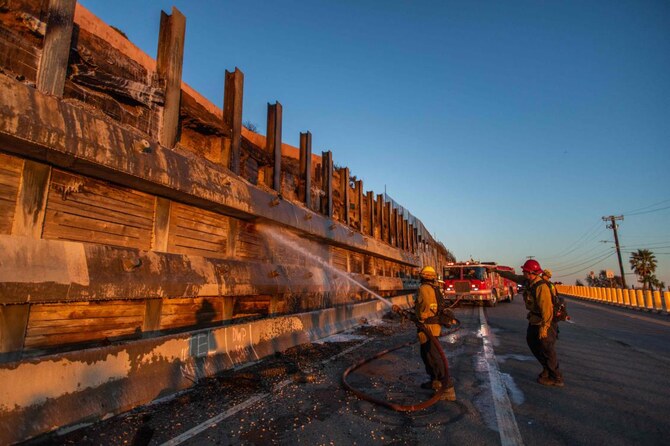
A fleet of aircraft dropped water and retardant into the rugged hills while ground crews with hand tools and hoses have worked around the clock since the fires broke out on Jan. 7, with the aircraft occasionally grounded by high winds.
Crowley and Los Angeles Mayor Karen Bass fielded questions on Wednesday about a Los Angeles Times report that 1,000 firefighters were on standby but not quickly deployed after fire broke out on Jan. 7.
“We did everything in our capability to surge where we could,” Crowley said.
Southern California has lacked any appreciable rain since April, turning brush into tinder as Santa Ana winds originating from the deserts whipped over hilltops and rushed through canyons, sending embers flying up to two miles ahead of the fires.
Private forecaster AccuWeather estimates total damage and economic loss between $250 billion and $275 billion, which would make it the costliest natural disaster in US history, surpassing Hurricane Katrina in 2005.

Los Angeles firefighters brace for threat of more powerful winds
https://arab.news/v58e4
Los Angeles firefighters brace for threat of more powerful winds
- Local officials urged residents to stay vigilant throughout the day on Wednesday and be prepared to evacuate at a moment’s notice
- Some 6.5 million people remained under a critical fire threat
Trump warns Maduro against playing ‘tough’ as US escalates pressure campaign on Venezuela
- Venezuelan President Nicolas Maduro on Monday fired back at Donald Trump, who has ordered US naval forces to blockade the South American country's oil wealth, saying the US president would be "better off" focusing on domestic issues rather than threatenin
- The Defense Department, under Trump’s orders, continues its campaign of attacks on smaller vessels in the Caribbean and eastern Pacific Ocean that it alleges are carrying drugs to the United States and beyond
WEST PALM BEACH, Florida: President Donald Trump on Monday delivered a new warning to Venezuelan President Nicolás Maduro as the US Coast Guard steps up efforts to interdict oil tankers in the Caribbean Sea as part of the Republican administration’s escalating pressure campaign on the government in Caracas.
Trump was surrounded by his top national security aides, Secretary of State Marco Rubio and Defense Secretary Pete Hegseth, as he suggested that he remains ready to further escalate his four-month pressure campaign on the Maduro government, which began with the stated purpose of stemming the flow of illegal drugs from the South American nation but has developed into something more amorphous.
“If he wants to do something, if he plays tough, it’ll be the last time he’ll ever be able to play tough,” Trump said of Maduro as he took a break from his Florida holiday vacation to announce plans for the Navy to build a new, large warship.
Trump levied his latest threat as the US Coast Guard on Monday continued for a second day to chase a sanctioned oil tanker that the Trump administration describes as part of a “dark fleet” Venezuela is using to evade US sanctions. The tanker, according to the White House, is flying under a false flag and is under a US judicial seizure order.
“It’s moving along and we’ll end up getting it,” Trump said.
It is the third tanker pursued by the Coast Guard, which on Saturday seized a Panama-flagged vessel called Centuries that US officials said was part of the Venezuelan shadow fleet.
The Coast Guard, with assistance from the Navy, seized a sanctioned tanker called Skipper on Dec. 10, also part of the shadow fleet of tankers that the US says operates on the fringes of the law to move sanctioned cargo. That ship was registered in Panama.
Trump, after that first seizure, said the US would carry out a “blockade” of Venezuela. Trump has repeatedly said that Maduro’s days in power are numbered.
Last week, Trump demanded that Venezuela return assets that it seized from US oil companies years ago, justifying anew his announcement of a blockade against sanctioned oil tankers traveling to or from the South American country.
Homeland Security Secretary Kristi Noem, whose agency oversees the Coast Guard, said in a Monday appearance on “Fox & Friends” that the targeting of tankers is intended to send “a message around the world that the illegal activity that Maduro is participating in cannot stand, he needs to be gone, and that we will stand up for our people.”
Russian diplomats evacuate families from Caracas
Meanwhile, Russia’s Foreign Ministry started evacuating the families of diplomats from Venezuela, according to a European intelligence official speaking on condition of anonymity to discuss sensitive information.
The official told The Associated Press the evacuations include women and children and began on Friday, adding that Russian Foreign Ministry officials are assessing the situation in Venezuela in “very grim tones.” The ministry said in an X posting that it was not evacuating the embassy but did not address queries about whether it was evacuating the families of diplomats.
Venezuela’s Foreign Minister Yván Gil on Monday said he spoke by phone with his Russian counterpart, Sergey Lavrov, who he said expressed Russia’s support for Venezuela against Trump’s declared blockade of sanctioned oil tankers.
“We reviewed the aggressions and flagrant violations of international law that have been committed in the Caribbean: attacks against vessels and extrajudicial executions, and the unlawful acts of piracy carried out by the United States government,” Gil said in a statement.
The scene on a Venezuelan beach near a refinery
While US forces targeted the vessels in international waters over the weekend, a tanker that’s considered part of the shadow fleet was spotted moving between Venezuelan refineries, including one about three hours west of the capital, Caracas.
The tanker remained at the refinery in El Palito through Sunday, when families went to the town’s beach to relax with children now on break from school.
Music played on loudspeakers as people swam and surfed with the tanker in the background. Families and groups of teenagers enjoyed themselves, but Manuel Salazar, who has parked cars at the beach for more than three decades, noticed differences from years past, when the country’s oil-dependent economy was in better shape and the energy industry produced at least double the current 1 million barrels per day.
“Up to nine or 10 tankers would wait out there in the bay. One would leave, another would come in,” Salazar, 68, said. “Now, look, one.”
The tanker in El Palito has been identified by Transparencia Venezuela, an independent watchdog promoting government accountability, to be part of the shadow fleet.
Area residents on Sunday recalled when tankers would sound their horns at midnight New Year’s Eve, while some would even send up fireworks to celebrate the holiday.
“Before, during vacations, they’d have barbecues; now all you see is bread with bologna,” Salazar said of Venezuelan families spending the holiday at the beach next to the refinery. “Things are expensive. Food prices keep going up and up every day.”
Venezuela’s ruling party-controlled National Assembly on Monday gave initial approval to a measure that would criminalize a broad range of activities that could be linked to the seizure of oil tankers.
Lawmaker Giuseppe Alessandrello, who introduced the bill, said people could be fined and imprisoned for up to 20 years for promoting, requesting, supporting, financing or participating in “acts of piracy, blockades or other international illegal acts against” commercial entities operating with the South American country.
The Defense Department, under Trump’s orders, continues its campaign of attacks on smaller vessels in the Caribbean and eastern Pacific Ocean that it alleges are carrying drugs to the United States and beyond.
At least 104 people have been killed in 28 known strikes since early September. The strikes have faced scrutiny from US lawmakers and human rights activists, who say the administration has offered scant evidence that its targets are indeed drug smugglers and that the fatal strikes amount to extrajudicial killings.


