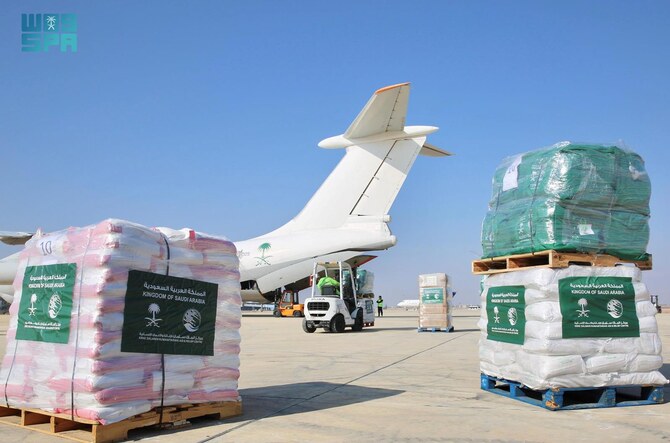
KSrelief’s 11th aid plane lands at Damascus airport
KSrelief dispatched dozens of aid trucks and planes after collapse of Assad regime
Updated 15 January 2025
Arab News
RIYADH: The 11th Saudi relief plane landed at Damascus International Airport in Syria on Wednesday as part of a humanitarian airlift launched by the King Salman Humanitarian Aid and Relief Centre.
After the collapse of Bashar Assad’s regime early in December, KSrelief has sent dozens of trucks and planes loaded with food, shelter, and medical supplies to meet the urgent basic needs of Syrians.
Najran's mountainous parts are blessed with temperate climate and abundant water resources, suitable for sugarcane production
Updated 07 December 2025
Arab News
NAJRAN: Farmers in Saudi Arabia's southwestern region of Najran have found that sugarcane production is a viable enterprise, the Saudi Press Agency (SPA) has reported.
One farmer, Ibrahim Shakwan, confirmed to SPA the success of his 7.3-hectare sugarcane farm and noted "growing regional interest due to its high productivity and lucrative economic returns."
Najran was chosen as a trial area for sugarcane production owing to the temperate climate, diverse soils, and abundant water resources in its mountainous parts. The experiment is in line with Saudi Vision 2030, which calls for enhancing food security and self-sufficiency.
Others regions in the Kingdom's southwest, such as Jazan, Asir and Baha, have similar features as Najran.
Sugarcane is easily propagated via cuttings that yield a high number of plantable pieces. (SPA)
Sugarcane is easily propagated via cuttings that yield a high number of plantable pieces. Planting occurs primarily in the summer, although seedlings can be planted year-round.
Effective cultivation methods include selecting disease-resistant varieties, proper soil preparation, and balanced irrigation and fertilization, according to the report.
The crop is harvested approximately eight months after planting, with fertilization ending three months before and irrigation ceasing 20 days prior to harvest to boost sugar concentration and improve juice quality, which is rich in natural sugars, vitamins, and minerals.
Several countries in the Middle East have long been growing sugarcane, with Egypt and Iran as key producers.
Botanists believe sugarcane was first cultivated 10,000 years ago in what is now New Guinea in the southwest Pacific Ocean, where the environment is humid, according to an article titled Sugar Please, published in the Aramcoworld magazine in 2012.