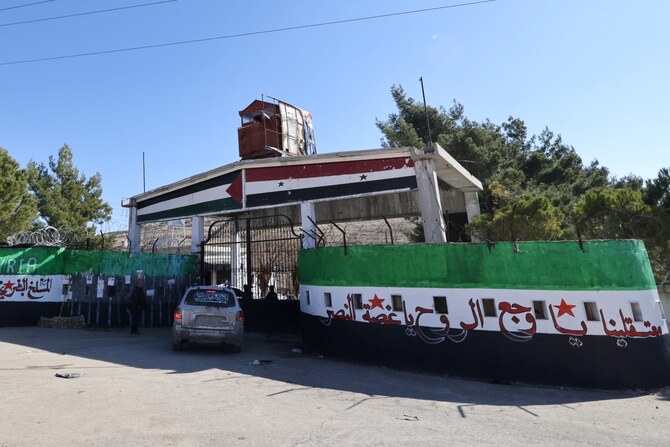
DAMASCUS: Families of missing persons have urged Syria’s new authorities to protect evidence of crimes under president Bashar Assad, after outrage over volunteers painting over etchings on walls inside a former jail.
Thousands poured out of prisons after Islamist-led rebels toppled Assad last month, but many Syrians are still looking for traces of tens of thousands of relatives and friends who went missing.
In the chaos following his ouster, with journalists and families rushing to detention centers, official documents have been left unprotected, with some even looted or destroyed.
Rights groups have stressed the urgent need to preserve “evidence of atrocities,” which includes writings left by detainees on the walls of their cells.
But a video appearing to show young volunteers paint over such writings at an unnamed detention center with white paint and adorning its walls with the new Syrian flag, the depiction of a fireplace or broken chains has circulated on social media in recent days, angering activists.
“Painting the walls of security branches is disgraceful, especially before the start of new investigations into human rights violations” there, said Diab Serriya, a co-founder of Association of Detainees and Missing Persons of Saydnaya Prison (ADMSP).
It is “an attempt to destroy the signs of torture or enforced disappearance and hampers efforts to... gather evidence,” he said.
Jomana Hasan Shtiwy, a Syrian held in three different facilities under Assad, often changing cells, said the writings on the walls held invaluable information.
“On the walls are names and telephone numbers to contact relatives and inform them about the fate of their children,” she said on Facebook.
In each new cell, “we would write a memory so that those who followed could remember us,” she said.
A petition appeared on Tuesday calling for the new Syrian authorities to better protect evidence, and give investigating the fate of those forcibly disappeared under Assad “the highest priority.”
It slammed what it called “the insensitive treatment of the sanctity” of former detention centers.
“Some have gone as far as to paint cells, obscuring their features, which for us represents... a great wronging of detainees,” said signatories, including ADMSP.
The president of the International Committee for the Red Cross said last week determining the fate of those who went missing during Syria’s civil war would be a “huge challenge.”
Mirjana Spoljaric said the ICRC was following 43,000 cases, but that was probably just a fraction of the missing.
The Syrian Observatory for Human Rights, a Britain-based war monitor, says more than 100,000 people have died in detention from torture or dire health conditions across Syria since 2011.

Syrians in uproar after volunteers paint over prison walls
Short Url
https://arab.news/j8kka
Syrians in uproar after volunteers paint over prison walls
Clashes in Syria’s Aleppo deepen rift between government, Kurdish forces
ALEPPO: Fierce fighting in Syria’s northern city of Aleppo between government forces and Kurdish fighters drove thousands of civilians from their homes on Wednesday, with Washington reported to be mediating a de-escalation. The violence, and statements trading blame over who started it, signaled that a stalemate between Damascus and Kurdish authorities that have resisted integrating into the central government was deepening and growing deadlier. Deadly clashes broke out on Tuesday between Syrian government troops and the Kurdish-led Syrian Democratic Forces (SDF).
After relative calm overnight, shelling resumed on Wednesday and intensified in the afternoon, Reuters reporters in the city said.
A spokesperson for Aleppo’s health directorate told Reuters that four civilians had been killed on Tuesday and more than two dozen wounded on Tuesday and Wednesday. Security sources separately told Reuters that two fighters had also been killed.
The health directorate said there were no civilian fatalities on Wednesday, and that it was not authorized to comment on deaths among fighters.
By Wednesday evening, fighting had subsided, the Reuters reporters said. Ilham Ahmed, who heads the foreign affairs department of the Kurdish administration, told Reuters that international mediation efforts were underway to de-escalate. A source familiar with the matter told Reuters the US was mediating.
THOUSANDS OF CIVILIANS FLEE
The directorate for social affairs said on Wednesday night that more than 45,000 people had been displaced from Aleppo city, most of them heading northwest toward the enclave of Afrin.
The Syrian army announced that military positions in the Kurdish-held neighborhoods of Sheikh Maqsoud and Ashrafiyah were “legitimate military targets.” Two Syrian security officials told Reuters that they expected a significant military operation in the city.
The government opened humanitarian corridors for civilians to flee flashpoint neighborhoods, ferrying them out on city buses.
“We move them safely to the places they want to go to according to their desire or to displaced shelters,” said Faisal Mohammad Ali, operations chief of the civil defense force in Aleppo.
The latest fighting has disrupted civilian life in what is a leading Syrian city, closing the airport and a highway to Turkiye, halting operations at factories in an industrial zone and paralysing major roads into the city center.
The Damascus government said its forces were responding to rocket fire, drone attacks and shelling from Kurdish-held neighborhoods. Kurdish forces said they held Damascus “fully and directly responsible for ... the dangerous escalation that threatens the lives of thousands of civilians and undermines stability in the city.” During Syria’s 14-year civil war, Kurdish authorities began running a semi-autonomous zone in northeast Syria, as well as in parts of Aleppo city.
They have been reluctant to give up those zones and integrate fully into the Islamist-led government that took over after ex-President Bashar Assad’s ousting in late 2024.
Last year, the Damascus government reached a deal with the SDF that envisaged a full integration by the end of 2025, but the two sides have made little progress, each accusing the other of stalling or acting in bad faith.
The US has stepped in as a mediator, holding meetings as recently as Sunday to try to nudge the process forward. Sunday’s meetings ended with no tangible progress.
Failure to integrate the SDF into Syria’s army risks further violence and could potentially draw in Turkiye, which has threatened an incursion against Kurdish fighters it views as terrorists.
After relative calm overnight, shelling resumed on Wednesday and intensified in the afternoon, Reuters reporters in the city said.
A spokesperson for Aleppo’s health directorate told Reuters that four civilians had been killed on Tuesday and more than two dozen wounded on Tuesday and Wednesday. Security sources separately told Reuters that two fighters had also been killed.
The health directorate said there were no civilian fatalities on Wednesday, and that it was not authorized to comment on deaths among fighters.
By Wednesday evening, fighting had subsided, the Reuters reporters said. Ilham Ahmed, who heads the foreign affairs department of the Kurdish administration, told Reuters that international mediation efforts were underway to de-escalate. A source familiar with the matter told Reuters the US was mediating.
THOUSANDS OF CIVILIANS FLEE
The directorate for social affairs said on Wednesday night that more than 45,000 people had been displaced from Aleppo city, most of them heading northwest toward the enclave of Afrin.
The Syrian army announced that military positions in the Kurdish-held neighborhoods of Sheikh Maqsoud and Ashrafiyah were “legitimate military targets.” Two Syrian security officials told Reuters that they expected a significant military operation in the city.
The government opened humanitarian corridors for civilians to flee flashpoint neighborhoods, ferrying them out on city buses.
“We move them safely to the places they want to go to according to their desire or to displaced shelters,” said Faisal Mohammad Ali, operations chief of the civil defense force in Aleppo.
The latest fighting has disrupted civilian life in what is a leading Syrian city, closing the airport and a highway to Turkiye, halting operations at factories in an industrial zone and paralysing major roads into the city center.
The Damascus government said its forces were responding to rocket fire, drone attacks and shelling from Kurdish-held neighborhoods. Kurdish forces said they held Damascus “fully and directly responsible for ... the dangerous escalation that threatens the lives of thousands of civilians and undermines stability in the city.” During Syria’s 14-year civil war, Kurdish authorities began running a semi-autonomous zone in northeast Syria, as well as in parts of Aleppo city.
They have been reluctant to give up those zones and integrate fully into the Islamist-led government that took over after ex-President Bashar Assad’s ousting in late 2024.
Last year, the Damascus government reached a deal with the SDF that envisaged a full integration by the end of 2025, but the two sides have made little progress, each accusing the other of stalling or acting in bad faith.
The US has stepped in as a mediator, holding meetings as recently as Sunday to try to nudge the process forward. Sunday’s meetings ended with no tangible progress.
Failure to integrate the SDF into Syria’s army risks further violence and could potentially draw in Turkiye, which has threatened an incursion against Kurdish fighters it views as terrorists.
© 2026 SAUDI RESEARCH & PUBLISHING COMPANY, All Rights Reserved And subject to Terms of Use Agreement.