Pakistan to cut tariff for electric vehicle charging stations by 45%

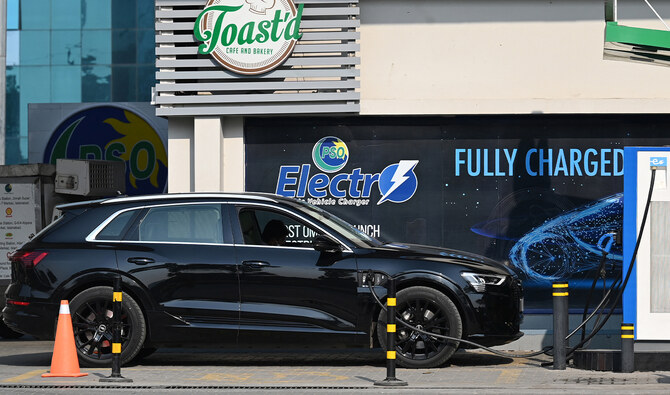
An electic car is being charged at a charging station in Islamabad on February 16, 2022. (AFP/File)
Short Url
Updated 15 January 2025
Follow

Pakistan to cut tariff for electric vehicle charging stations by 45%

  • The government aims for 30% of vehicles to run on electricity by 2030
  • It has announced a 15-day registration process for charging stations

KARACHI: Prime Minister Shehbaz Sharif has decided a 45 percent reduction in electricity tariffs for electric vehicle (EV) charging stations, cutting rates from Rs71.10 per unit to Rs39.70 per unit, said Pakistan’s Energy Minister Awais Ahmad Khan Leghari on Wednesday.
Pakistan has actively promoted EV adoption to combat environmental challenges, reduce reliance on imported fossil fuels and improve urban air quality. Under its Electric Vehicle Policy 2019-2024, the government aims for 30 percent of vehicles to run on electricity by 2030.
However, inadequate charging infrastructure, frequent power outages and the high cost of EVs have hindered progress.
“Today, the prime minister has decided that including taxes, we were charging a tariff of Rs71.10 [$0.26] to these charging stations,” Leghari told reporters in Islamabad. “What the distribution companies used to charge them, we are reducing it approximately by 45 percent and announcing a tariff of Rs39.70 [$0.18] today.”
Leghari said that there were no charging stations for motorbikes, three-wheelers and rickshaws in Pakistani neighborhood.
“And the reason for that absence is the high cost of electricity,” he added. “And the absence of laws and regulations on the basis of which this business can start.”
A statement issued by the power division said the country’s first-ever regulations for establishing EV charging stations and battery swapping points was being implemented under the National Energy Conservation Authority, with an official gazette notification issued.
It highlighted the economic benefits of these measures, saying that switching motorcycles to electric technology at an average cost of Rs50,000 could save $6 billion annually on fuel.
Similarly, electrifying three-wheeled rickshaws could significantly reduce urban travel costs and help combat air pollution.
The reduced EV charging costs are also expected to lower transportation expenses, positively impacting goods delivery and essential commodity prices.
The government has decided to support these initiatives through a one-window registration process for setting up charging stations and battery points, allowing approvals within 15 days.
Registration fees have been set at Rs50,000 to encourage local and foreign investment.
Prime Minister Sharif, while presiding over a meeting in Islamabad, also praised the power division’s policy on electric vehicles, describing it as “highly encouraging.”
He emphasized that the adoption of electric vehicles would reduce foreign exchange expenditure on petrol and diesel imports while providing an environmentally friendly mode of transportation.
The PM also directed the relevant authorities to actively promote the government’s policy on electric vehicles.



Pakistan parliament demands national response against ‘external sponsors’ of terror after Balochistan attacks

Updated 10 sec ago
Follow

Pakistan parliament demands national response against ‘external sponsors’ of terror after Balochistan attacks

ISLAMABAD: Pakistan’s National Assembly adopted a resolution on Tuesday condemning recent militant attacks in the southwestern Balochistan province, calling for an immediate national response against “external sponsors” of terror in the country. 

Separatist militants launched coordinated gun and bomb attacks across multiple districts in Balochistan on Friday and Saturday, targeting security installations and government facilities. Pakistan’s State Minister for Interior Tallal Chaudry said 50 people were killed in the attacks, which included 33 civilians and 17 law enforcement personnel. Meanwhile, Pakistan’s state media said on Monday that security forces have killed 177 militants since Friday. 

Pakistan’s Interior Minister Mohsin Naqvi said last week that the militant attacks, which were claimed by the separatist Baloch Liberation Army, were planned by India. New Delhi denied the allegations as “baseless,” saying it was an attempt by Islamabad to deflect from its internal failings. Pakistan regularly accuses India of funding militants in its Balochistan and northwestern Khyber Pakhtunkhwa provinces, charges New Delhi has always denied. 

The resolution, tabled by Minister for Parliamentary Affairs Dr. Tariq Fazal Chaudhry, said that in several militant attacks, evidence has shed light on the “external patronage” of militants and drawn attention to “serious concerns, particularly regarding the role of India.”

“This house demands that an immediate, comprehensive, coordinated and multi-dimensional national response be ensured against these external sponsors and internal facilitators, including funding, smuggling, and propaganda networks, bringing together the political, diplomatic, military, intelligence, legal and narrative fronts,” a copy of the resolution seen by Arab News stated. 


The resolution said “terrorism” in Pakistan is being facilitated through logistical and operational support, financial assistance, training, medical treatment and propaganda networks by certain neighboring countries. 

It expressed solidarity with the victims and relatives of the Balochistan attacks, praising Pakistan’s security forces for taking effective action against militants. The resolution also expressed concern over militant networks using women in the attacks. 

“This house expresses profound grief, sorrow, and concern over the fact that terrorist networks are attempting to exploit women and use them against the state and society through coercion, psychological pressure and blackmail,” it said. 

The resolution called for national unity and rising above political differences. It vowed that the state will not compromise on the protection of its people and national security. 

Balochistan, Pakistan’s largest province by land area, has long been gripped by a separatist insurgency that has intensified in recent years. Militants frequently target security forces, government officials, infrastructure projects, foreigners and non-local workers in the area.

Balochistan is home to vast reserves of minerals and hydrocarbons, and also to the multibillion-dollar China-Pakistan Economic Corridor (CPEC), a flagship component of China’s Belt and Road Initiative.

Separatist militant groups such as the BLA blame Islamabad for exploiting Balochistan’s natural resources and denying locals a share in them. The military and civilian government reject these allegations and say they are investing in the province’s development.