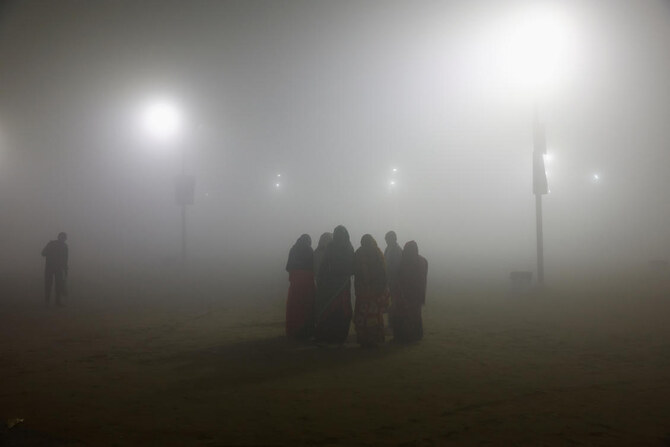
Dense fog over Indian capital delays flights, trains

Devotees stand on the banks of river Ganga during the “Maha Kumbh Mela,” or the Great Pitcher Festival on a foggy evening in Prayagraj, India, January 14, 2025. (REUTERS)
Short Url
Updated 15 January 2025
Follow

Dense fog over Indian capital delays flights, trains

  • Delhi was ranked as the world’s most polluted city in live rankings by Swiss group IQAir

Dense fog and cold weather delayed train and flight departures in several parts of northern India, including its capital New Delhi, on Wednesday.
India’s weather office issued an orange alert for Delhi, the second highest warning level, forecasting dense to very dense fog in many areas.
Visibility at Delhi’s main airport was between zero to 100 meters (328.08 ft), the weather office said, and more than 40 trains across northern India were delayed because of fog, local media reported.
Some aircraft departures from Delhi were delayed, airport authorities said on social media platform X, warning that flights lacking the CAT III navigation system that enables landing despite low visibility would face difficulties. Delhi’s main airport handles about 1,400 flights every day.
“Low visibility and fog over Delhi may lead to some delays,” the country’s largest airline IndiGo said in a social media post.
Local media showed images of vehicles crawling along highways through the fog, and people huddled indoors as the temperature dipped to 7 degrees Celsius (44.6 degrees Fahrenheit).
Delhi was ranked as the world’s most polluted city in live rankings by Swiss group IQAir on Wednesday, with a reading of 254, ranked as “very unhealthy.”
The Indian capital has been battling poor air quality and smog since the beginning of winter.


Greenland prepares next generation for mining future

Updated 8 sec ago
Follow

Greenland prepares next generation for mining future

SISIMIUT: At the Greenland School of Minerals and Petroleum, a dozen students in hi-viz vests and helmets are out for the day learning to operate bulldozers, dump trucks, excavators and other equipment.
The Greenlandic government is counting on this generation to help fulfill its dream of a lucrative mining future for the vast Arctic territory coveted by US President Donald Trump.
Founded in 2008, the school, based in El-Sisimiut in the southwest of the island, offers students from across Greenland a three-year post-secondary vocational training.
Apart from their practical classes, the students, aged 18 to 35, also learn the basics of geology, rock mechanics, maths and English.
Teacher Kim Heilmann keeps a watchful eye on his students as they learn to maneuver the heavy equipment.
“I want them to know it’s possible to mine in Greenland if you do it the right way,” he told AFP.
“But mostly the challenge is to make them motivated about mining,” he added.
The remote location of Greenland’s two operational mines, and the ensuing isolation, puts many people off, the school’s director Emilie Olsen Skjelsager said.
A Danish autonomous territory, Greenland gained control over its raw materials and minerals in 2009.
The local government relies heavily on Danish subsidies to complement its revenues from fishing, and is hoping that mining and tourism will bring it financial independence in the future so that it can someday cut ties with Denmark.
“The school was created because there is hope for more activities in mining, but also to have more skilled workers in Greenland for heavy machine operating and drilling and blasting, and exploration services,” Olsen Skjelsager said.
By the end of their studies, some of the students — “a small number, maybe up to five” — will go on to work in the mines.
The rest will work on construction sites.

- Lack of skills -

Greenland is home to 57,000 people, and has historically relied on foreign workers to develop mining projects due to a lack of local know-how.
“We have some good people that can go out mining and blasting and drilling and all that kind of stuff,” explained Deputy Minister of Minerals Resources, Jorgen T Hammeken-Holm.
“But if you have a production facility close to the mining facility, then you need some technical skills in these processing facilities,” he said.
“There is a lack of educated people to do that.”
Going forward, geologists, engineers and economists will be needed, especially as Greenland’s traditional livelihoods of hunting and fishing are expected to gradually die out as professions.
The students’ tuition is paid by the Greenland government, which also gives them a monthly stipend of around 5,000 kroner ($800).
Inside the school, a glass case displays some of the minerals that lie — or are believed to lie — under Greenland, including cryolite, anorthosite and eudialyte, which contains rare earth elements essential to the green and digital transitions.
“New mine sites have been searched (for) all over Greenland,” said Angerla Berthelsen, a 30-year-old student who hopes to find a job in the mining sector one day.
There are “lots of possibilities” in Greenland, he said, sounding an optimistic note.

- Doubts over deposits -

But questions remain about Greenland’s actual resources, with the existence and size of the deposits still to be confirmed.
According to the Geological Survey of Denmark and Greenland (GEUS), Greenland is home to 24 of the 34 critical raw materials identified by the EU as essential for the green and digital transitions.
“A large variety of geological terrains exists, which have been formed by many different processes. As a result, Greenland has several types of metals, minerals and gemstones,” it says in a document on its website.
“However, only in a few cases have the occurrences been thoroughly quantified, which is a prerequisite for classifying them as actual deposits,” it stressed.
Deputy minister Hammeken-Holm said it was “more or less a guess” for now.
“Nobody knows actually.”
In addition, the island — with its harsh Arctic climate and no roads connecting its towns — currently doesn’t have the infrastructure needed for large-scale mining.
There are currently only two operational mines on the island — one gold mine in the south, and one for anorthosite, a rock containing titanium, on the west coast.