ISLAMABAD: Top Pakistani and Bangladeshi military commanders have stressed the need for an enduring partnership between the two countries to remain “resilient against external influences,” the Pakistani military said on Tuesday, amid a thaw between the two countries since the ouster of Sheikh Hasina.
Pakistan and Bangladesh were once one nation, but they split in 1971 as a result of a bloody civil war, which saw the part previously referred to as East Pakistan seceding to form the independent nation of Bangladesh.
In the years since, Bangladeshi leaders, particularly former prime minister Hasina, chose to maintain close ties with India. Ties between Pakistan and Bangladesh have warmed up since Hasina’s ouster as a result of a student-led uprising in August, witnessing a marked improvement.
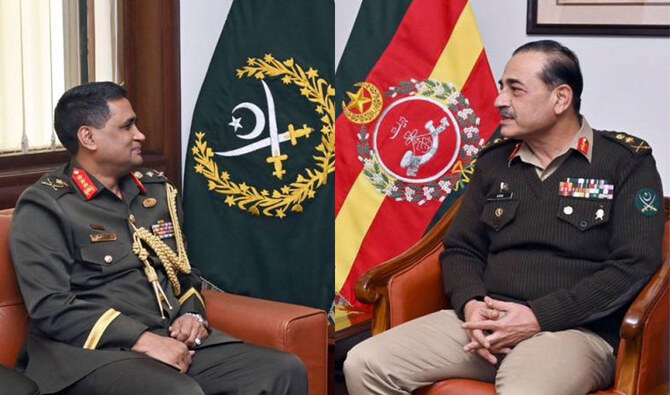
Amid the thaw, Lt. Gen. S M Kamr-ul-Hassan, principal staff officer (PSO) of the Armed Forces Division of Bangladesh, met Pakistan Chief of Army Staff (COAS) General Asim Munir in Rawalpindi, according to the Inter-Services Public Relations (ISPR), the Pakistani military’s media wing.
“During their meeting, both held extensive discussions on the evolving security dynamics in the region and explored further avenues for enhancing bilateral military cooperation,” the ISPR said in a statement.
“The COAS and the PSO underscored the importance of a stronger defense relationship, emphasizing that the enduring partnership between the two brotherly nations must remain resilient against external influences.”
On the occasion, the Pakistan army chief reiterated the significance of joint efforts to promote peace and stability in South Asia and the broader region, while ensuring that both nations continue to contribute to regional security through “collaborative defense initiatives,” according to the ISPR.
Lt. Gen. Hassan acknowledged the sacrifices made by Pakistani armed forces in their fight against militancy, noting that their efforts serve as a beacon of “courage and determination.”
Earlier in the day, Pakistan and Bangladesh signed a landmark agreement to establish a joint business council, the Federation of Pakistan Chambers of Commerce and Industry (FPCCI) said, amid efforts to enhance trade and economic cooperation between the two countries.
“The establishment of the Pakistan-Bangladesh Business Council is a milestone for trade relations between the two countries,” FPCCI President Atif Ikram Sheikh said after signing the agreement in Dhaka, along with representatives of the Administrative Federation of the Bangladesh Chamber of Commerce.
During the visit, the FPCCI chief led a Pakistani business delegation that held meetings with their counterparts in Bangladesh to discuss ways to enhance trade ties. The Trade Corporation of Pakistan also signed a memorandum of understanding for rice export to Bangladesh on Tuesday.
Pakistan’s Deputy Prime Minister Ishaq Dar is also scheduled to visit Dhaka in the beginning of February to further consolidate the relations between the two countries.


![]()

Pakistan, Bangladesh commanders underscore enduring partnership for resilience against ‘external influences’
Short Url
https://arab.news/2eq3n
Pakistan, Bangladesh commanders underscore enduring partnership for resilience against ‘external influences’
- Pakistan and Bangladesh were once one nation, but split in 1971 as a result of a bloody civil war
- Ties between both nations have warmed up since PM Hasina’s ouster due to an uprising in Aug.
Latest updates


© 2026 SAUDI RESEARCH & PUBLISHING COMPANY, All Rights Reserved And subject to Terms of Use Agreement.