

Saudis top Qatar’s 5m tourist arrivals in 2024

More than 5 million tourists visited Qatar in 2024, with the presence of more than 1 million Saudis reflecting close ties between the neighboring countries.
Short Url
Updated 14 January 2025
Follow

Saudis top Qatar’s 5m tourist arrivals in 2024

Saudis made up the largest proportion of tourists to Qatar in 2024 at nearly a quarter of arrivals, a Visit Qatar spokesperson told Arab News.

The peninsular state bordering Saudi Arabia is pushing to boost its tourism numbers in the years following the FIFA World Cup 2022, which brought millions of visitors from around the world.

“Visitors from Saudi Arabia remain the top source market for international visitors this year, contributing around a quarter of all arrivals,” said Dr. Buthaina Mohammed Al-Janahi, media relations and communications senior manager at Visit Qatar.

More than 5 million tourists visited Qatar in 2024, officials said, with the presence of more than 1 million Saudis reflecting close ties between the neighboring countries three years after the end of a diplomatic rift.

Both countries regularly host bilateral official visits and enjoy booming trade, which has seen around $10 billion worth of contracts signed, Reuters reported.

Qatar aims to raise its tourist numbers to 6 million annually, raise tourism spending to 12 percent of GDP and create 250,000 jobs by 2030.

The World Cup saw 3.4 million people from around the world attending — the biggest influx of visitors to Qatar in the country’s history.

There was much speculation at the time about how the extensive infrastructure built for the tournament would go on to serve the country’s needs after the 3.4 million had left.

One stadium — the 974 stadium — was built to be eventually disassembled and relocated. Another, Al-Bayt stadium, is set to be converted into a luxury hotel and shopping center to serve Qatar’s growing tourist numbers as well as residents.

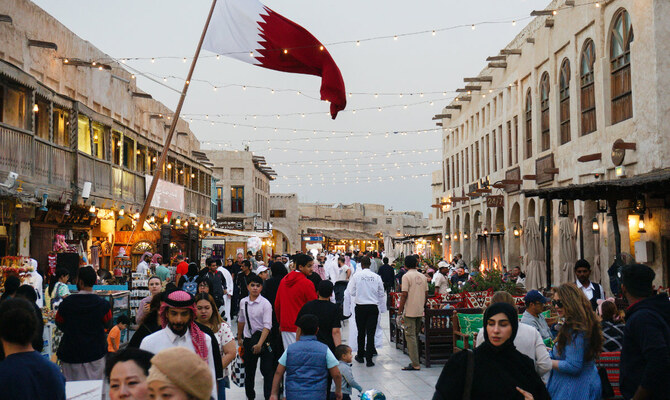
Today, the streets of Doha are still adorned with banners from 2022, thus far the peak of the city’s tourism.

With the unprecedented global visibility that the World Cup offered, officials are hoping to build on the success of the tournament, with the number of hotel rooms exceeding 40,061 in 2024.

Having made history as the city where Lionel Messi first led his Argentine squad to victory, football fans from South America are still flocking to the popular Souq Waqif to pick up a version of the bisht cloak that was draped around the striker’s shoulders by Sheikh Tamim bin Hamad Al-Thani.

New developments like Habitas Ras Al-Abrouq — developed by government-owned Qatar Airways and launched early 2024 — aim to attract high-wealth tourists.

The hi-tech Msheireb Downtown planned city is another draw for tourists, with its hydrogen-powered tram and luxury eateries.

The district is based in one of Qatar’s most historic areas, and the redevelopment was opened in 2021.

In a prime example of how the country deploys opulent spending in order to reimagine its heritage, the Katara Cultural Village offers such attractions as the Blue Mosque and the marble amphitheater.


Schneider Electric to advance energy technology to power intelligence at Innovation Summit Middle East & Africa

Updated 01 March 2026
Follow

Schneider Electric to advance energy technology to power intelligence at Innovation Summit Middle East & Africa

Schneider Electric, a global energy technology leader, has announced that the second edition of the Innovation Summit Middle East & Africa will be held in Abu Dhabi on April 28–29. 

The summit will bring together global energy and technology leaders as well as government officials to advance the regional shift toward energy intelligence, as data center growth, AI adoption, and national visions place unprecedented demands on energy systems.

Schneider Electric is advancing its energy technology ambitions with the integration of electrification, automation and digital intelligence, deployed across buildings, data centers, industrial applications and power grids to unlock the full value of energy, and ensure efficiency and sustainability for all.

This year’s summit arrives at a pivotal moment for the Middle East and Africa, as the region experiences exponential growth driven by national visions, giga-projects, and rapid expansion in AI, data centers, and digital infrastructure. 

Saudi Arabia stands out within this landscape as one of the most dynamic markets in terms of investment in digital infrastructure and sustainable energy. 

With global electricity demand projected to grow at a strong compound annual growth rate of 3.6% over the 2026–2030 period and global AI workloads projected to lead a 160% increase in data center power demand, the imperative for intelligent, sustainable energy solutions has never been more critical.

“Energy today is the foundation of national resilience and competitiveness. With electricity consumption in the Middle East and North Africa having tripled since 2000 and on course to grow at an incremental 3-4% every year to register a whopping 50% by 2035 – driven by surging cooling, desalination, and urbanization demands, the region is at an inflection point,” said Walid Sheta, Zone president, Middle East and Africa, Schneider Electric. 

“Innovation Summit Middle East & Africa underscores our dedication to accelerating energy technology innovation and powering energy intelligence throughout the region. This edition will emphasize our emergence as the trusted energy technology partner guiding the region’s next phase of transformation. " 

This year’s summit will highlight regional benchmarks from 80+ countries, from the 100% elimination of SF6 and Carbon footprint reduction for fruit producers in South Africa to the savings that EcoStruxure Power & Grid is enabling for the National Electricity Company, Senegal – ensuring recovery times of 3 minutes versus 3 hours earlier.

Blending high-impact programming and latest product launches that position Schneider Electric at the center of MEA's energy transition story, key agenda items include:

CEO Forum in partnership with Forbes Middle East: An exclusive C-suite initiative bringing together 100 business leaders to address strategic imperatives in energy intelligence.

Keynote and Thought Leadership sessions: Featuring executive speakers from industry-leading companies and insights from strategic partners, including Bain & Company.

Innovation Hub experience: Guided tours and live demonstrations, as well as tailored customer experiences of Schneider Electric’s most innovative and integrated energy technology solutions addressing critical challenges in energy efficiency, grid modernization, and digital infrastructure across a 3,000 square feet immersive space.

Stakeholder recognition: Schneider Electric’s dedicated partners will be honored with 20 Cluster awards and five Middle East and Africa awards across four categories – Growth Award, Efficiency Award, Innovation Award, and Sustainability Award, on Day 2 of the Summit. 

"Across the Gulf, energy intelligence is becoming the operational reality as public and private sector enterprises race to align with national visions for a decarbonized and sustainable future,” said Amel Chadli, president, Gulf Cluster at Schneider Electric.

“As one of the most local of global companies, Schneider Electric is empowering customers to move beyond electrification and implement AI‑driven, software‑defined energy systems that deliver efficiency, resilience, and sustainability at a national scale. This summit offers a roadmap of what’s next as we continue to redefine the relationship between energy and digital capability.”

With AI, cloud, and high-performance computing becoming foundational to national competitiveness, energy technologies today must evolve and become resilient, sustainable and scalable to meet modern intelligence demands. 

Schneider Electric's refreshed positioning as an energy technology partner reflects the company's approach to supporting the region's transformation. 

Schneider Electric’s Innovation Summit Middle East & Africa highlights real-world applications across key sectors, including utilities, data centers, commercial buildings, industrial facilities, and critical infrastructure — demonstrating how intelligent energy management enables operational excellence, resilience, and sustainability across the region's most vital projects.