Saudi Arabia chairs Arab media talks in Tunisia

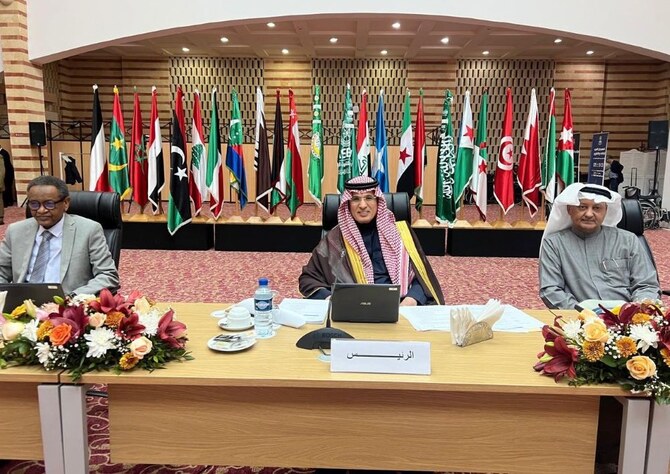
Mohammed bin Fahad Al-Harthi, president of the Arab States Broadcasting Union, attended the meeting in Tunisia. (X:@mfalharthi)
Short Url
Updated 14 January 2025
Follow

Saudi Arabia chairs Arab media talks in Tunisia

  • Mohammed bin Fahad Al-Harthi highlighted the importance of enhancing Arab media cooperation to address development issues and convey the voice of Arab people globally
  • Meeting was a key step toward unifying media efforts among member states, with a strategic vision focused on promoting Arab identity

RIYADH: Saudi Arabia chaired the 112th executive council meeting of the Arab States Broadcasting Union in Hammamet, Tunisia, on Tuesday, with the presence of member states and the union’s president, Mohammed bin Fahad Al-Harthi.

Al-Harthi highlighted the importance of enhancing Arab media cooperation to address development issues and convey the voice of Arab people globally, according to the Saudi Press Agency.

The meeting was a key step toward unifying media efforts among member states, with a strategic vision focused on promoting Arab identity, shared values and keeping pace with global media developments in line with the needs of Arab societies, he said.

Al-Harthi also highlighted investment projects to provide the union with sustainable financial resources, ensuring its flexibility and continuity, including the creation of a company to serve as the union’s investment arm.

The meeting reviewed the union’s achievements over the past year, discussed challenges facing Arab media and explored investment opportunities to support media integration.

It also covered preparations for the Arab Media Conference, expected to be held in Iraq later this year, which will serve as a platform for exchanging expertise and fostering media collaboration among member states.

The meeting concluded by stressing the importance of continued joint efforts to achieve the union’s objectives, elevate Arab media’s global status and present a positive, comprehensive image of the Arab world.


Western media refute Trump’s claims Iran possesses Tomahawk missiles

Updated 10 March 2026
Follow

Western media refute Trump’s claims Iran possesses Tomahawk missiles

  • Speaking to journalists, Trump suggested Tehran used US-made cruise missile in school attack that killed over 170, calling the weapon ‘very generic’
  • CNN, Sky News and analysts said that ‘neither Israel nor Iran use Tomahawk missiles,’ urged accurate identification to ensure credibility in public discourse

LONDON: Western media outlets and defense analysts have pushed back against claims by US President Donald Trump that Iran possesses Tomahawk cruise missiles, after he raised the possibility while discussing a recent strike on an Iranian school that has drawn international scrutiny.

Speaking to reporters on Monday, Trump suggested Iran may have used Tomahawks in the attack, calling the weapon “very generic” and implying that multiple countries, including Iran, could have access to the system.

However, journalists and weapons experts swiftly disputed that assertion. They noted that Tomahawk missiles are US-manufactured cruise missile systems that Washington supplies only to a small number of close allies, primarily the UK and Australia. There is no credible evidence that Iran has ever obtained the weapon.

CNN anchor Erin Burnett referenced an investigation by correspondent Isobel Yeong that concluded “neither Israel nor Iran use Tomahawk missiles, according to experts.” Sky News and other Western outlets also challenged Trump’s remarks.

Analysts pointed out that Iran has developed its own domestic cruise missile systems, such as the Soumar and Hoveyzeh, which are believed to be based partly on older Soviet-era designs.

While these systems resemble cruise missiles in concept, experts say they differ significantly from the Tomahawk in design, propulsion configuration and operational characteristics.

While Iran has made substantial advances in ballistic and domestically produced cruise missiles over the past two decades, defense analysts said there is no verified evidence that Tehran holds the American-made system.

The episode reflects a broader pattern in which statements about military technology are rapidly scrutinized by open-source investigators and defense experts.

Experts say the distinction is important: accurately identifying the type of missile used in a strike can provide clues about the likely actor responsible, the launch platform involved and the broader geopolitical consequences of a strike.

Analysts also say that accurate identification of military systems remains essential for avoiding misinformation and for maintaining credibility in public discourse surrounding regional security.

Despite the growing body of evidence, the precise circumstances of the school attack nonetheless remain unclear, with investigators hampered by a lack of weapons fragments and limited access to the site.

Norway-based rights group Hengaw said the school was holding its morning session at the time of the reported attack and had at least 168 children and 14 teachers.

Trump said the US was continuing to investigate the incident. “Whatever the report shows, I’m willing to live with that report,” he said.