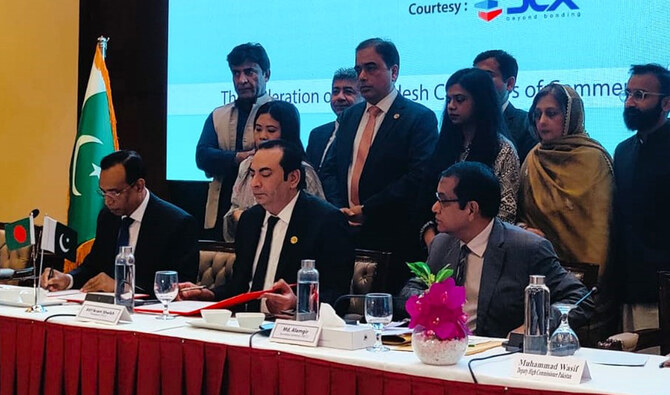
ISLAMABAD: A landmark agreement to establish a joint business council was signed with Bangladesh on Tuesday, marking a “milestone” in efforts to enhance trade and economic cooperation between between the two states, the Federation of Pakistan Chambers of Commerce and Industry (FPCCI) said.
Both countries share a complicated history, having once been a single entity known as East and West Pakistan until Bangladesh gained independence in 1971 following a war of liberation backed by India, Pakistan’s arch-rival.
Relations reached a new low in 2016 when Bangladesh executed several Jamaat-e-Islami leaders for alleged war crimes during the 1971 conflict, a move Pakistan condemned as “politically motivated,” saying the executions targeted individuals with a pro-Pakistan stance during the war.
Ties have warmed in recent months after former Prime Minister Sheikh Hasina was ousted last year following violent student-led protests. Her subsequent flight to India strained Dhaka’s relations with New Delhi, with Dhaka repeatedly demanding her extradition.
“The establishment of the Pakistan-Bangladesh Business Council is a milestone for trade relations between the two countries,” FPCCI President Atif Ikram Sheikh said after signing an agreement to that effect with representatives of the Administrative Federation of the Bangladesh Chamber of Commerce.
During the visit, the FPCCI chief led a Pakistani business delegation that held meetings with their counterparts in Bangladesh to discuss ways to enhance trade ties.
Speaking at a business forum hosted by the Bangladesh Chamber of Commerce and Industry, he also praised Bangladesh as a major economic power in South Asia.
“Strengthening trade relations requires mutual cooperation between the business communities of both nations,” Sheikh said, emphasizing the need to address key issues such as air connectivity, visa facilitation and prioritizing trade partnerships.
“There are vast opportunities for collaboration in agriculture, education, textiles and other sectors. The large populations of both countries should not be seen as a challenge but as an opportunity to drive economic growth,” he added.
Sheikh also reiterated his commitment to keeping the council active and fostering stronger links between the business communities of both nations.
The Trade Corporation of Pakistan also signed a memorandum of understanding for rice export to Bangladesh on Tuesday.
Pakistan’s Deputy Prime Minister Ishaq Dar is also scheduled to visit Dhaka in the beginning of February to further consolidate the relations between the two countries.


![]()

Pakistan and Bangladesh establish business council in ‘milestone’ agreement
Short Url
https://arab.news/pspk8
Pakistan and Bangladesh establish business council in ‘milestone’ agreement
- FPCCI chief says strengthening trade relations requires cooperation between both business communities
- Pakistan’s deputy PM is also scheduled to visit Dhaka next month to further consolidate bilateral ties
Latest updates


© 2026 SAUDI RESEARCH & PUBLISHING COMPANY, All Rights Reserved And subject to Terms of Use Agreement.