

New border crossing with Iran to boost legal trade and curb smuggling, Pakistan says

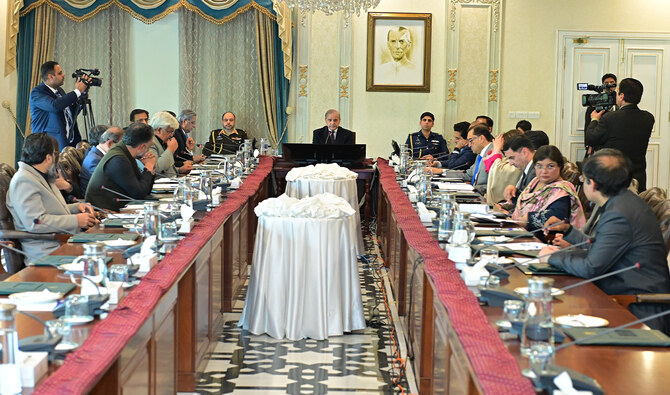
Pakistan's Prime Minister Shehbaz Sharif chairs a meeting in Islamabad, Pakistan, on 13 January 2025. (PID/File)
Short Url
Updated 14 January 2025
Follow

New border crossing with Iran to boost legal trade and curb smuggling, Pakistan says

  • Pakistan and Iran have tried to boost trade by setting up border markets, implementing barter system
  • International sanctions on Iran have hampered economic collaboration between the two countries

ISLAMABAD: Prime Minister Shehbaz Sharif on Tuesday expressed hope a newly inaugurated border crossing between Pakistan and Iran in Panjur would encourage legal trade between the two neighboring states and help curb smuggling, which has long plagued the region.

Pakistan and Iran have intensified efforts in recent years to expand bilateral trade by establishing border markets and implementing barter trade mechanisms.

In April last year, Iran’s late President Ebrahim Raisi described the existing trade volume between the two countries as “not acceptable” during his visit to Pakistan. He said his government had agreed with Islamabad to boost bilateral trade to $10 billion within the foreseeable future.

In the absence of adequate formal trade, smuggling has become a significant issue along the porous 959-kilometer border, where local communities on both sides often rely on the illicit trade of goods, particularly Iranian fuel.

“A new crossing has been inaugurated at the Pakistan-Iran border in Panjgur, which will promote legal trade and help curb smuggling,” Sharif said during a federal cabinet meeting in Islamabad, referring to the new opening this month in the Kohak-Cheedgi area of Panjgur. “I thank our brotherly country Iran for their full cooperation in this regard.”

International sanctions, particularly those imposed by the United States, have significantly hampered economic collaboration between the two countries. This is particularly evident in the shape of the stalled Iran-Pakistan gas pipeline project. While Iran completed its section in 2011, Pakistan halted construction due to fears of US sanctions, stalling a project that could have alleviated Pakistan’s energy shortages.

According to the Institute for Strategic Studies, Research and Analysis, a local think tank in Islamabad, trade between the two countries has also suffered owing to the same reason.

Iran’s exports to Pakistan were approximately $1.4 billion in 2022, while Pakistan’s exports to Iran stood at $842.8 million.

The think tank also says Iran’s exports to Pakistan have grown at an annual rate of 13.5 percent over the past 24 years, whereas Pakistan’s exports to Iran have declined by up to 44 percent annually.

During Raisi’s visit, both sides signed memoranda of understanding and agreements covering fields such as trade, science, technology, agriculture, health and culture.

The visit was also seen as a step toward mending fences between the two nations, which had experienced strained ties following unprecedented tit-for-tat missile strikes earlier that year.


Pakistan PM to attend World Economic Forum’s annual meeting in Switzerland next month

Updated 29 December 2025
Follow

Pakistan PM to attend World Economic Forum’s annual meeting in Switzerland next month

  • The WEF meeting, scheduled to be held in Davos on Jan. 19-23, will focus on global challenges, public-private dialogue and cooperation
  • Government, business, civil society and academia leaders will engage in forward-looking discussions to address these issues, set priorities

ISLAMABAD: Pakistan Prime Minister Shehbaz Sharif will travel to Switzerland next month to attend the 56th annual meeting of the World Economic Forum (WEF), Pakistani state media reported on Monday.

The WEF annual meeting, themed as ‘A Spirit of Dialogue,’ will be held from Jan. 19 to Jan. 23 in Davos, where world leaders from government, business, civil society and academia will engage in forward-looking discussions to address global issues and set priorities.

Prime Minister Sharif is expected to interact with global leaders and investors on economic challenges, regional and international issues and various opportunities for cooperation.

On Monday, Deputy PM Ishaq Dar presided over a meeting in Islamabad to oversee preparations for Sharif’s upcoming visit to Switzerland to attend the WEF meeting, the Radio Pakistan broadcaster reported.

“Dar instructed to maximize the engagements with the incoming Heads of States, Governments and senior leadership of economic, business and financial institutions,” the report read.

The WEF meeting program will be structured around key global challenges where public-private dialogue and cooperation, involving all stakeholders, is necessary for progress, according to the WEF website.

In addressing these challenges, growth, resilience and innovation will serve as cross-cutting imperatives, guiding how leaders engage with today’s complexity and pursue tomorrow’s opportunities.

Pakistani foreign ministry officials briefed the deputy PM about preparations for the WEF meeting, according to Radio Pakistan. The participants of Monday’s meeting in Islamabad discussed in detail the bilateral component and media engagements during the visit.

“He [Dar] further stressed that opportunities be explored to foster collaboration with private sector business entities,” the state broadcaster said.