

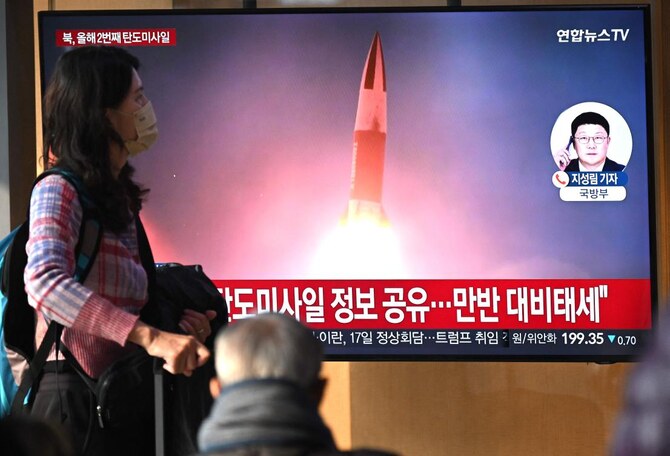

SEOUL: North Korea fired several short-range ballistic missiles into the sea Tuesday, according to Seoul’s military, in what experts said could be a message to US President-elect Donald Trump’s incoming administration.
The launch comes as Japanese Foreign Minister Takeshi Iwaya visits South Korea for a series of meetings with top officials, with the Asian neighbors seeking to boost bilateral ties before Trump returns to office next week.
“The South Korean military detected several short-range ballistic missiles fired into the East Sea,” Seoul’s military said, referring to the body of water also known as the Sea of Japan.
It said the launch took place around 9:30 am (0030 GMT) near North Korea’s Ganggye area, with the missiles flying 250 kilometers (155 miles) before landing in the sea.
“The intelligence authorities of South Korea and the US have detected and monitored North Korea’s missile launch preparations in advance, and immediately detected and tracked them at the time of launch,” the military said.
It said it was maintaining “full readiness” and sharing information with the United States and Japan while “strengthening surveillance and alertness” for more launches.
Seoul’s acting President Choi Sang-mok slammed the launch, saying it violated UN Security Council resolutions.
“Seoul will respond more strongly to North Korea’s provocations based on its strong security posture and alliance with the US,” he said.
Experts said the latest launch could be intended as a message to the incoming Trump administration.
“It could be aimed at the US,” said Yang Moo-jin, president of the University of North Korean Studies in Seoul.
“It may indicate an intention to put pressure ahead of the Trump administration’s second term.”
ASSERT PRESENCE
Ahn Chan-il, a defector-turned-researcher who runs the World Institute for North Korea Studies, told AFP the test launch “appears to be an intention to assert presence ahead of the Trump administration.”
He said it could also be aimed at “destabilising South Korea during Seoul’s own period of turmoil,” as suspended President Yoon Suk Yeol faces an impeachment trial that begins Tuesday in the Constitutional Court after a failed martial law bid last month.
Relations between the two Koreas have been at one of their lowest points in years, with the North launching a flurry of ballistic missiles last year in violation of UN sanctions.
The Tuesday launch is Pyongyang’s second this year, after it fired last week what it said was a new hypersonic missile system.
The location of the test site was undisclosed but images released by North Korean state media KCNA showed leader Kim Jong Un observing last week’s launch with his teenage daughter Ju Ae.
KCNA cited the use of a “new compound of carbon fiber” in the missile’s engine, which experts warned could allow Pyongyang to hit further targets with technology to which only the United States, Russia and China currently have access.
Last week’s alleged hypersonic missile launch came as US Secretary of State Antony Blinken was visiting South Korea.
While in Seoul, Blinken said Russia was increasing cooperation with Pyongyang, adding they were working ever more closely on advanced space technology.
Ahn said another reason for Tuesday’s launch may be the testing of “missiles for export to Russia to be used in Ukraine.”
RUSSIAN SUPPORT
Blinken also voiced renewed concern that Russia, a veto-wielding UN Security Council member, would formally accept North Korea as a nuclear state in a blow to global consensus that Pyongyang must end its program.
In late October, North Korea test-fired what it said was its most advanced and powerful solid-fuel intercontinental ballistic missile (ICBM). Days later, it fired a salvo of short-range ballistic missiles.
US and South Korean intelligence also believe that North Korea in October started to send thousands of troops to fight against Ukraine and has since suffered hundreds of casualties.
But neither North Korea nor Russia has officially confirmed that Pyongyang’s forces are fighting for Moscow.
On Monday, a South Korean lawmaker said around 300 North Korean soldiers have been killed and 2,700 wounded while fighting in Russia’s war against Ukraine, citing information from Seoul’s spy agency.
Over the weekend Ukrainian President Volodymyr Zelensky said Kyiv had captured two North Korean soldiers, releasing video of the injured combatants being interrogated.


