

Pakistani commerce minister in Iraq for key trade talks after over two decades

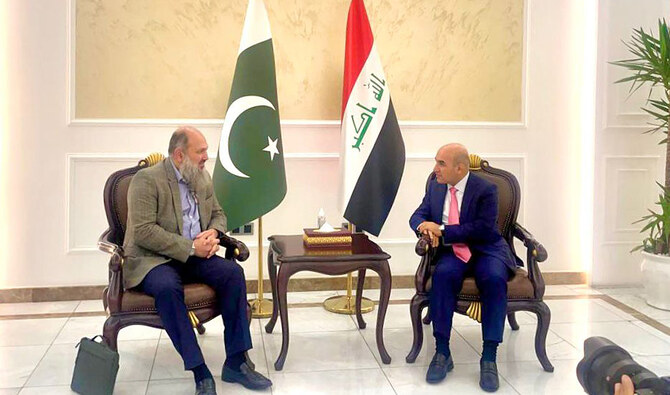
Pakistan’s Commerce Minister, Jam Kamal (left), Iraqi Minister for Housing and Construction, Bangen Rekani, on January 13, 2025. (Pakistan's Commerce Minister)
Short Url
Updated 14 January 2025
Follow

Pakistani commerce minister in Iraq for key trade talks after over two decades

  • Relations between Pakistan and Iraq have received a boost with a number of ministerial-level exchanges in recent years
  • The 9th Joint Ministerial Commission session, the first since 2001, will focus on deepening bilateral economic partnership

ISLAMABAD: Pakistan Commerce Minister Jam Kamal arrived in Baghdad on Monday to lead the Pakistani delegation at key trade talks that are being held after more than two decades, the Pakistani commerce ministry said.

Kamal will lead the Pakistani side at the 9th session of the Joint Ministerial Commission (JMC), marking a significant step in strengthening bilateral relations between Pakistan and Iraq. This is the first session to take place since the previous JMC meeting held in Islamabad in 2001.

Upon his arrival at the Baghdad International Airport, the Pakistani commerce minister was received by Iraq’s Minister for Housing and Construction Bangen Rekani, Pakistan Ambassador to Iraq Muhammad Zeeshan Ahmed, and Pakistani Ministry of Economic Affairs Secretary Dr. Kazim Niaz.

“The 9th JMC session, scheduled during Mr. Jam Kamal’s visit, is expected to open new avenues for economic collaboration and further solidify the longstanding friendship between the two nations,” the Pakistani commerce ministry said.

“This visit underscores Pakistan’s commitment to fostering stronger ties with Iraq in various domains, including trade, infrastructure, and regional development.”

Relations between Pakistan and Iraq have received a boost with a number of ministerial-level exchanges in recent years. The two countries have held discussions on enhancing defense and law enforcement cooperation, focusing on counterterrorism, counternarcotics and intelligence-sharing.

The Pakistani commerce ministry said the historic nature of the JMC session highlights mutual determination of both countries to deepen their economic partnership after a hiatus of over two decades.

Kamal also discussed a range of topics of mutual interest, including enhancing trade ties, boosting economic cooperation and fostering closer collaboration in key sectors, in his meeting with the Iraqi housing and construction minister.

“Both sides expressed optimism about revitalizing bilateral engagements and addressing shared challenges,” the commerce ministry added.


Pakistan seeks operationalization of World Bank’s $20 billion framework to advance reform priorities

Updated 25 February 2026
Follow

Pakistan seeks operationalization of World Bank’s $20 billion framework to advance reform priorities

  • Pakistan’s finance chief meets World Bank Country Director Bolormaa Amgaabazar in the capital
  • The Bank’s 10-year Country Partnership Agreement for Pakistan was approved in January last year

ISLAMABAD: Pakistan’s Finance Minister Muhammad Aurangzeb on Wednesday called for the operationalization of the World Bank Country Partnership Framework (CPF) to advance the government’s key reform priorities during a meeting with the Bank’s country director, according to a statement.

The Bank’s Board of Directors approved a 10-year CPF deal with Pakistan, indicating $20 billion in financing for Pakistan under the framework. The amount will include public and private financing from the World Bank Group, with roughly half expected to come from private-sector operations led by the International Finance Corporation (IFC).

“The Finance Minister emphasized the importance of effective operationalization of the CPF, particularly in priority areas such as population management and climate change,” the finance ministry said in a statement after Aurangzeb’s meeting with the Bank’s Country Director Bolormaa Amgaabazar.

“He underscored the need for strong coordination between federal and provincial governments to ensure coherence in policy design and implementation.”

Discussions focused on population, human capital development, climate resilience, agricultural reform and energy sector sustainability, it added.

The ministry said both sides exchanged views on enhancing institutional coordination, improving transparency in project design and strengthening monitoring mechanisms to deliver intended outcomes. It highlighted that the World Bank expressed readiness to continue supporting agricultural transformation efforts in collaboration with the IFC.

“Both sides agreed to continue technical-level engagements to explore feasible solutions in line with Pakistan’s reform agenda and fiscal framework,” the finance ministry added.

Climate resilience and population control are major concerns for policymakers in Pakistan, a country whose population exceeds 241 million, making it the world’s sixth-most populous country. Limited infrastructure, health care, and educational opportunities place added strain on public services, contributing to unemployment and poverty.

The South Asian nation is also among the countries most affected by climate change. Unusually heavy monsoon rains in 2022 killed more than 1,700 people and caused over $30 billion in damages. Torrential rains and floods since late June last year have claimed more than 1,000 lives, as authorities continue surveys to assess the full extent of the destruction.