

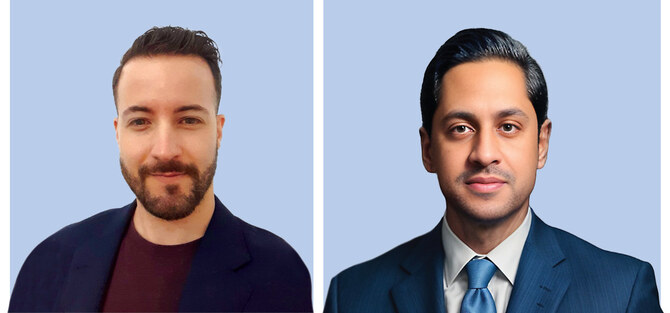
Unlocked Sport announces strategic entry into Saudi market

Jason Turnbull, left, is chairman and CEO of Unlocked Sport and Atif Karim is the COO and head of sports business. (Supplied)
Short Url
Updated 13 January 2025
Follow

Unlocked Sport announces strategic entry into Saudi market

Unlocked Sport, an Australian business with a presence in the US and Latin American markets, has announced its entry into the Saudi sports market. This move aligns with the Kingdom’s commitment to impactful commercial and investment deals that foster community development, highlighting Unlocked Sport’s dedication to leveraging sports for economic and social progress.

The global sports market is projected to reach an impressive $117.90 billion in 2025, showcasing the immense potential sports can offer economies worldwide. Unlocked Sport’s unique sports ecosystem concierge approach helps stakeholders, sports entities, businesses, and investors capitalize on the future of major sporting events globally and in Saudi Arabia over the next decade and beyond. This approach ensures all parties can maximize their potential and contribute to a thriving sports ecosystem. 


The King Saud University Stadium in Riyadh, set to be a venue for the 2034 FIFA World Cup. Unlocked Sport is committed to unlocking the full potential of the Saudi sports sector. (Supplied)

Jason Turnbull, chairman and CEO of Unlocked Sport, said: “At Unlocked Sport, we pride ourselves on being your ‘Sports Ecosystem Concierge,’ facilitating deeper connections between sports stakeholders and the communities they serve. Our mission is to transform ideas into scalable and impactful assets, providing comprehensive support that includes opportunity promotion, project management, and business concierge services.”

According to Turnbull, the development model and attraction strategy that Saudi Arabia is undertaking offer a once-in-a-lifetime opportunity to globally showcase how sports can be a major driver of national and economic development. “It is exciting to see this initiative engage all generations around a unifying vision, demonstrating the power of sports to bring about positive change,” he said.

Atif Karim, COO and head of sports business at Unlocked Sport, said: “Saudi Arabia’s Vision 2030 presents an unparalleled operational opportunity. The Kingdom’s ambitious plans for economic diversification and community development through sports align perfectly with our mission to create impactful and sustainable sports ecosystems. We are excited to be part of this transformative journey.”

Unlocked Sport is committed to working closely with Saudi Arabian stakeholders to unlock the full potential of the sports sector, contributing to the Kingdom’s Vision 2030 and beyond.


Jameel Research project at MIT tackles antimicrobial resistance

The ambitious project is led by Professor James J. Collins, third from left. Professor Collins and his team at MIT will develop
Updated 31 January 2026
Follow

Jameel Research project at MIT tackles antimicrobial resistance

Jameel Research, part of Abdul Latif Jameel International network, is sponsoring a research project in the Department of Biological Engineering and Institute for Medical Engineering and Science at the Massachusetts Institute of Technology, aimed at tackling the global public health crisis of antimicrobial resistance.
This ambitious, multi-disciplinary project is led by Professor James J. Collins, Termeer professor of medical engineering and science at MIT and faculty lead for life sciences at the MIT Jameel Clinic, the epicenter of artificial intelligence and health at MIT.
The project, spanning at least three years, will leverage the Collins’ lab’s cutting-edge strengths in synthetic biology and AI to create next-generation diagnostics.
The growing prevalence of antibiotic-resistant superbugs and a declining antibiotic pipeline has led to a global public health crisis. The US Centers for Disease Control and Prevention has predicted some 2 million infections and 23,000 deaths occur each year in the US alone, costing $55 billion. The World Bank predicts that up to $100 trillion of economic output may be at risk by 2050. The UK government-commissioned Review on Antimicrobial Resistance is projecting more than 10 million deaths worldwide per year by 2050 if the crisis is not addressed.
Professor Collins and his team at MIT are setting out to develop the next generation of antibacterials and rapid diagnostics to overcome AMR — using synthetic biology and advanced generative AI to deliver faster results and help control the use of antibiotics to where they can be effective.
With support from Jameel Research, the first phase of this project will develop and validate programmable antibacterials to overcome AMR in a range of bacterial pathogens. These AI-designed minibinders will be delivered by engineered microbes to neutralize key toxins and protein targets.
This directed design and engineering approach to antibiotic development technology advances a long-term vision to create programmable antibacterials to address the AMR crisis. This would then offer the potential for the more rapid development of medical countermeasures to emerging and re-emerging pathogens and a swifter response to future outbreaks and pandemics.
Mohammed Abdul Latif Jameel, KBE, chairman of Abdul Latif Jameel, said: “Antimicrobial resistance is one of the most urgent challenges we face today and addressing it will require ambitious science and sustained collaboration. We are pleased to support this new research, building on our long-standing relationship with MIT and our commitment to advancing research across the world, to strengthen global health and contribute to a more resilient future.”
“This project reflects my belief that tackling AMR requires both bold scientific ideas and a pathway to real-world impact,” Professor Collins said. “Jameel Research is keen to address this crisis by supporting innovative, translatable research at MIT.”
Jameel Research is advancing the work of pioneering pathfinders to create an extraordinary impact on a global scale.
This initial project holds the promise of rapidly developing medical countermeasures for emerging and re-emerging pathogens, offering a rapid response to future outbreaks and pandemics.
The new research project builds on the close and long-standing relationship between MIT and the Jameel family. This includes the MIT Jameel Clinic, which was co-founded in 2018 by MIT and Community Jameel, the international nonprofit organization founded by Mohammed Jameel, KBE, to advance science and learning for communities to thrive, and one of the Jameel family’s philanthropies.