

Croatia populist president re-elected in landslide

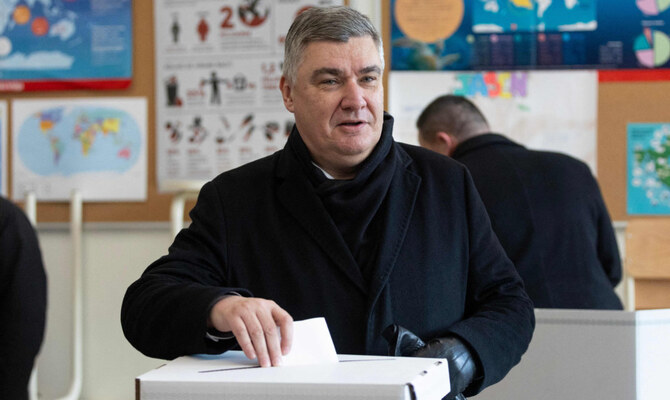
Croatia's outgoing President and Social Democratic Party (SDP) presidential candidate Zoran Milanovic casts his ballot to vote in the country's presidential elections at a polling station in Zagreb on January 12, 2025. Zoran Milanovic faces conservative rival Dragan Primorac in an election run-off. (AFP)
Short Url
Updated 13 January 2025
Follow

Croatia populist president re-elected in landslide

  • It was the highest score achieved by a presidential candidate since the former Yugoslav republic’s independence in 1991

ZAGREB: Croatia’s populist President Zoran Milanovic was re-elected in a landslide, defeating his conservative rival in Sunday’s run-off, official results showed.
Milanovic took more than 74 percent of the vote and Dragan Primorac, backed by the center-right HDZ party that governs Croatia, almost 26 percent, with nearly all the votes counted.
It was the highest score achieved by a presidential candidate since the former Yugoslav republic’s independence in 1991.
While the role of the president is largely ceremonial in Croatia, Milanovic’s wide victory is the latest setback for the HDZ and Prime Minister Andrej Plenkovic — Milanovic’s political arch-rival — after a high-profile corruption affair in November.
“Croatia, thank you!,” Milanovic told his supporters who gathered at a Zagreb art and music club to celebrate his success.
“I see this victory as a recognition of my work in the last five years and a plebiscite message from Croatian people to those who should hear it,” he said in a reference to the HDZ-led government.
The outspoken Milanovic, backed by the left-wing opposition, won more than 49 percent of the vote in the contest’s first round two weeks ago — narrowly missing an outright victory.
Turnout Sunday was nearly 44 percent, slightly lower than in the first round, the electoral commission said.
The vote was held as the European Union member nation of 3.8 million people struggles with the highest inflation rate in the eurozone, endemic corruption and a labor shortage.

Even with its limited roles, many Croatians see the presidency as key to providing a political balance by preventing one party from holding all the levers of power.
Croatia has been mainly governed by the HDZ since independence.
The party “has too much control and Plenkovic is transforming into an autocrat,” Mia, a 35-year-old administrator from Zagreb who declined to give her last name, told AFP explaining her support for the incumbent.
Milanovic, a former left-wing prime minister, won the presidency in 2020 with the backing of the main opposition Social Democrats (SDP) party.
A key figure in the country’s political scene for nearly two decades, he has increasingly employed offensive, populist rhetoric during frequent attacks aimed at EU and local officials.
“Milanovic is a sort of a political omnivore,” political analyst Zarko Puhovski told AFP, saying the president was largely seen as the “only, at least symbolic, counterbalance to the government and Plenkovic’s power.”
His no-holds-barred speaking style has sent Milanovic’s popularity soaring and helped attract the backing of right-wing supporters.
Earlier Sunday, after voting in Zagreb, Milanovic criticized Brussels as “in many ways autocratic and non-representative,” run by officials who are not elected.
The 58-year-old also regularly pans the HDZ over the party’s perennial problems with corruption, while also referring to Plenkovic as “Brussels’ clerk.”

Primorac, a former education and science minister returning to politics after a 15-year absence, has campaigned as a unifier for Croatia. The 59-year-old also insisted on patriotism and family values.
“With my program, I wanted to send a clear message that Croatia can and deserves better,” he told supporters on Sunday evening as the official results confirmed his crushing defeat.
But critics were saying Primorac lacked political charisma and failed to rally the HDZ base behind him.
He accused Milanovic of being a “pro-Russian puppet” who has undermined Croatia’s credibility in NATO and the European Union.
Milanovic condemned Russia’s invasion of Ukraine but has also criticized the West’s military support for Kyiv.
He is also a prominent opponent of a program that would have seen Croatian soldiers help train Ukrainian troops in Germany.
“The defense of democracy is not to tell everyone who doesn’t think like you that he’s a ‘Russian player’,” Milanovic told reporters on Sunday.
Such a communication style is “in fact totalitarian,” he added.
Meanwhile, young Croatians voiced frustration over lack of discussion among political leaders over the issues that interest them, such as housing or students’ standard of living.
“We hear them (politicians) talking mostly about old, recycled issues. What’s important to young people doesn’t even cross their minds,” student Ivana Vuckovic, 20, told AFP.


At top UN court, Myanmar denies deadly Rohingya campaign amounts to genocide

Updated 57 min ago
Follow

At top UN court, Myanmar denies deadly Rohingya campaign amounts to genocide

  • The country defended itself Friday at the United Nations top court against allegations of breaching the genocide convention
  • Myanmar launched the campaign in Rakhine state in 2017 after an attack by a Rohingya insurgent group

THE HAGUE: Myanmar insisted Friday that its deadly military campaign against the Rohingya ethnic minority was a legitimate counter-terrorism operation and did not amount to genocide, as it defended itself at the top United Nations court against an allegation of breaching the genocide convention.
Myanmar launched the campaign in Rakhine state in 2017 after an attack by a Rohingya insurgent group. Security forces were accused of mass rapes, killings and torching thousands of homes as more than 700,000 Rohingya fled into neighboring Bangladesh.
“Myanmar was not obliged to remain idle and allow terrorists to have free reign of northern Rakhine state,” the country’s representative Ko Ko Hlaing told black-robed judges at the International Court of Justice.
Gambia filed genocide case in 2019
African nation Gambia brought a case at the court in 2019 alleging that Myanmar’s military actions amount to a breach of the Genocide Convention that was drawn up in the aftermath of World War II and the Holocaust.
Some 1.2 million members of the Rohingya minority are still languishing in chaotic, overcrowded camps in Bangladesh, where armed groups recruit children and girls as young as 12 are forced into prostitution. The sudden and severe foreign aid cuts imposed last year by US President Donald Trump shuttered thousands of the camps’ schools and have caused children to starve to death.
Buddhist-majority Myanmar has long considered the Rohingya Muslim minority to be “Bengalis” from Bangladesh even though their families have lived in the country for generations. Nearly all have been denied citizenship since 1982.
Myanmar denies Gambia claims of ‘genocidal intent’
As hearings opened Monday, Gambian Justice Minister Dawda Jallow said his nation filed the case after the Rohingya “endured decades of appalling persecution, and years of dehumanizing propaganda. This culminated in the savage, genocidal ‘clearance operations’ of 2016 and 2017, which were followed by continued genocidal policies meant to erase their existence in Myanmar.”
Hlaing disputed the evidence Gambia cited in its case, including the findings of an international fact-finding mission set up by the UN’s Human Rights Council.
“Myanmar’s position is that the Gambia has failed to meet its burden of proof,” he said. “This case will be decided on the basis of proven facts, not unsubstantiated allegations. Emotional anguish and blurry factual pictures are not a substitute for rigorous presentation of facts.”
Aung San Suu Kyi represented Myanmar at court in 2019. Now she’s imprisoned
Nobel Peace Prize winner Aung San Suu Kyi represented her country at jurisdiction hearings in the case in 2019, denying that Myanmar armed forces committed genocide and instead casting the mass exodus of Rohingya people from the country she led as an unfortunate result of a battle with insurgents.
The pro-democracy icon is now in prison after being convicted of what her supporters call trumped-up charges after a military takeover of power.
Myanmar contested the court’s jurisdiction, saying Gambia was not directly involved in the conflict and therefore could not initiate a case. Both countries are signatories to the genocide convention, and in 2022, judges rejected the argument, allowing the case to move forward.
Gambia rejects Myanmar’s claims that it was combating terrorism, with Jallow telling judges on Monday that “genocidal intent is the only reasonable inference that can be drawn from Myanmar’s pattern of conduct.”
In late 2024, prosecutors at another Hague-based tribunal, the International Criminal Court, requested an arrest warrant for the head of Myanmar’s military regime for crimes committed against the country’s Rohingya Muslim minority. Senior Gen. Min Aung Hlaing, who seized power from Suu Kyi in 2021, is accused of crimes against humanity for the persecution of the Rohingya. The request is still pending.