

Saudi ambassador to Kabul meets Afghan foreign minister, discusses bilateral relations

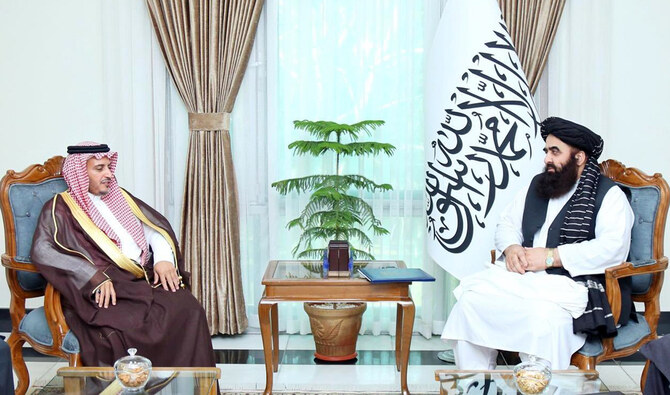
Saudi Arabia’s Ambassador to Afghanistan Faisal bin Talaq Al-Baqmi meets Afghan Foreign Minister Mawlawi Amir Khan Muttaqi (right), in Kabul on January 12, 2025. (Photo Courtesy: @KSAembassyAFG/X)
Short Url
Updated 12 January 2025
Follow

Saudi ambassador to Kabul meets Afghan foreign minister, discusses bilateral relations

  • The development comes week after the Kingdom’s embassy in Kabul resumed its diplomatic activities in Afghanistan
  • Afghan official says the two sides discussed ways to capitalize on existing opportunities to enhance cooperation

ISLAMABAD: Saudi Arabia’s Ambassador to Afghanistan Faisal bin Talaq Al-Baqmi has met Afghan Foreign Minister Mawlawi Amir Khan Muttaqi and discussed with him bilateral relations between the two countries, the Saudi embassy said on Sunday.
The development comes week after the Kingdom’s embassy in the Afghan capital of Kabul resumed diplomatic activities to provide services to the Afghan people.
The Afghan foreign ministry had welcomed Saudi Arabia’s decision to resume diplomatic operations in Kabul, more than three years after Riyadh withdrew its staff during the Taliban takeover of Afghanistan.
The meeting between the Saudi ambassador and the Afghan foreign minister was held in Kabul, according to the Saudi embassy. It was also attended by Deputy Head of Mission Mishaal Mutlaq Al-Shammari.
“The meeting discussed bilateral relations, ways to enhance them, and topics of common interest,” the Saudi embassy said on X.

Hafiz Zia Ahmad, a deputy spokesman at the Afghan foreign ministry, said the meeting underlined matters related to expanding bilateral relations between Afghanistan and Saudi Arabia, delivering consular services to Afghan nationals residing in the Kingdom, and capitalizing on existing opportunities to enhance cooperation.
“FM Muttaqi underscored the need to increase the exchange of delegations between the two countries,” Ahmad said on X. “Additionally, FM Muttaqi also expressed hope that the Saudi government would consider increasing the quota for Hajj & Umrah for Afghan pilgrims & extending support for the provision of consular services to Afghan nationals residing in Saudi Arabia.”
The Saudi ambassador affirmed the Kingdom’s commitment to extending support to Afghans and said the resumption of diplomatic activities in Kabul was aimed at “maximizing all the existing opportunities available,” Ahmad added.
Ties between Saudi Arabia and Afghanistan date back to 1932, when the Kingdom became the first Islamic country to provide aid to the Afghan people during their ordeals.
In recent years, Saudi Arabia has launched numerous projects in Afghanistan through the King Salman Humanitarian Aid & Relief Center (KSrelief), focusing on health, education services, water and food security. Riyadh has also participated in all international donor conferences and called for establishing security and stability in Afghanistan following years of armed conflicts.
Saudi Arabia has continued to provide consular services in Afghanistan since November 2021 and provided humanitarian aid through KSrelief.


About 400 immigrant children were detained longer than the recommended limit, ICE admits

Updated 8 sec ago
Follow

About 400 immigrant children were detained longer than the recommended limit, ICE admits

  • A Dec. 1 report from ICE indicated that about 400 immigrant children were held in custody for more than the 20-day limit during the reporting period from August to September
  • Advocates documented injuries suffered by children and a lack of access to sufficient medical care

TEXAS, USA: Hundreds of immigrant children across the nation were detained for longer than the legal limit this summer, US Immigration and Customs Enforcement has admitted in a court filing, alarming legal advocates who say the government is failing to safeguard children.
In a court filing Monday evening, attorneys for detainees highlighted the government’s own admissions to longer custody times for immigrant children, unsanitary conditions reported by families and monitors at federal facilities, and a renewed reliance on hotels for detention.
The reports were filed as part of an ongoing civil lawsuit launched in 1985 that led to the creation of the 1990s cornerstone policy known as the Flores Settlement Agreement, which limits the time children can spend in federal custody and requires them to be kept in safe and sanitary conditions. The Trump administration is attempting to end the agreement.
A Dec. 1 report from ICE indicated that about 400 immigrant children were held in custody for more than the 20-day limit during the reporting period from August to September. They also told the court the problem was widespread and not specific to a region or facility. The primary factors that prolonged their release were categorized into three groups: transportation delays, medical needs, and legal processing.
Legal advocates for the children contended those reasons do not prove lawful justifications for the delays in their release. They also cited examples that far exceeded the 20-day limit, including five children who were held for 168 days earlier this year.
ICE did not immediately respond to a request for comment Tuesday.
Hotel use for temporary detention is allowed by the federal court for up to 72 hours, but attorneys questioned the government’s data, which they believe did not fully explain why children were held longer than three days in hotel rooms.
Conditions at the detention facilities continued to be an ongoing concern since the family detention site in Dilley, Texas, reopened this year.
Advocates documented injuries suffered by children and a lack of access to sufficient medical care. One child bleeding from an eye injury wasn’t seen by medical staff for two days. Another child’s foot was broken when a member of the staff dropped a volleyball net pole, according to the court filing. “Medical staff told one family whose child got food poisoning to only return if the child vomited eight times,” the advocates wrote in their response.
“Children get diarrhea, heartburn, stomach aches, and they give them food that literally has worms in it,” one person with a family staying at the facility in Dilley wrote in a declaration submitted to the court.
Chief US District Judge Dolly Gee of the Central District of California is scheduled to have a hearing on the reports next week, where she could decide if the court needs to intervene.