

Sri Lankans rally to stop deportation of Rohingya refugees to Myanmar

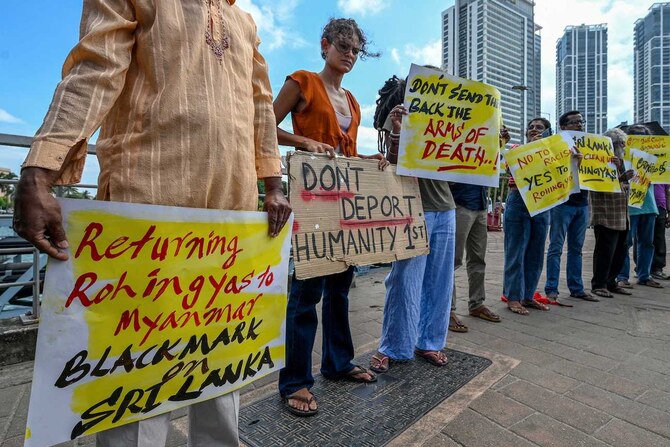
Sri Lankan rights activists demonstrate in front of the president’s office in Colombo on Jan. 10, 2025. (AFP)
Short Url
Updated 12 January 2025
Follow

Sri Lankans rally to stop deportation of Rohingya refugees to Myanmar

  • Activists stage protests in northeastern Mullaitivu district and capital Colombo
  • Rohingya risk deadly sea crossings as fighting intensifies in Myanmar

COLOMBO: Sri Lankan civil society groups and activists are mobilizing to save more than 100 Rohingya refugees rescued off the Indian Ocean island nation last month following a government announcement that they will be deported. 

A group of about 100 Rohingya refugees, which reportedly included over two dozen children, was rescued off the coast of the northeastern Mullaitivu district on Dec. 19. 

Several protests were recently organized in Mullaitivu and the capital Colombo after Sri Lanka’s Minister of Public Security and Parliamentary Affairs Ananda Wijepala announced on Jan. 3 that the government was in talks with Myanmar authorities over the deportation of the Rohingya refugees. 

“These are stateless people, they don’t have a home to go to,” social activist Thasneema Dahlan, who took part in a protest in Colombo on Friday, told Arab News.

“The Rohingya are massacred and chased and terrorized in their own home, and that is why they fled their own country looking for greener pastures elsewhere.”  

The mostly Muslim Rohingya — the “world’s most persecuted minority,” according to the UN — have faced decades of oppression in Myanmar. 

In 2017, more than 730,000 Rohingya from Rakhine State were forced to flee to neighboring Bangladesh to escape a brutal military crackdown that UN experts have referred to as a “genocidal campaign,” amid evidence of ethnic cleansing, mass rape, and killings. 

As Rakhine became a focal point in Myanmar’s intensifying nationwide civil war, hundreds of Rohingya have been fleeing the country in recent weeks through dangerous sea crossings, often on rickety boats. Last year, more than 7,800 people made such attempts, according to the UN refugee agency — an 80 percent increase compared with 2023. 

“Their objective wasn’t to get to Sri Lanka. Their objective was to get somewhere, anywhere where they could survive,” Dahlan said. “We are urging the government to … please not send them back, not repatriate them, not deport them, because that is just sending them back to death.”

Sri Lanka, which is not a signatory to the 1951 UN Refugee Convention and its 1967 protocol, is a transit point for refugees until the UNHCR helps them resettle in another country. 

In 2022, its navy also rescued about 100 Rohingya refugees, who have been under the care of local NGOs as they await resettlement. 

Sri Lankan activists have also filed petitions with the government, urging authorities to relocate the new group of refugees from the Keppapulavu Air Force base in Mullaitivu, where they have stayed since Dec. 23. According to protesters, aid agencies, including the UN, have been stopped from meeting the Rohingya. 

“Sheltering the refugees under a militarized environment is incompatible with international humanitarian norms and basic human values,” the North-East Coordinating Committee, which organized the Mullaitivu protest on Thursday, said in a letter. 

Ruki Fernando, a human rights activist based in Colombo, said the Rohingya refugees should be “kept in a place under civil administration,” not military. 

“Many Sri Lankans have been refugees. We need to help others. It’s our legal obligation … under customary international law, non-refoulement is prohibited. It means no one fleeing a well-founded fear of persecution should be sent back,” Fernando told Arab News, referring to the hundreds of thousands of Sri Lankan Tamils who fled the country’s civil war between 1983 and 2009. 

“We also have moral, ethical obligations to welcome, care and support those in distress. Our religious and spiritual values teach us this.”  


Pakistan killed over 80 militants in strikes on TTP camps in Afghanistan — official

Updated 23 February 2026
Follow

Pakistan killed over 80 militants in strikes on TTP camps in Afghanistan — official

  • Saturday’s airstrikes followed a series of attacks inside Pakistan amid a surge in militancy
  • The Afghan Taliban authorities accuse Pakistani forces of killing civilians in the airstrikes

ISLAMABAD: Pakistan’s airstrikes in Afghanistan destroyed seven Tehreek-e-Taliban Pakistan (TTP) camps and killed over 80 militants, a Pakistani security official said on Sunday, with the Afghan Taliban accusing Pakistani forces of killing civilians in the assault.

Saturday’s airstrikes followed a series of attacks inside Pakistan amid a surge in militancy. Authorities say the attacks, particularly in Khyber Pakhtunkhwa province and the Pakistani capital of Islamabad, were carried out by the TTP and allied groups that Islamabad alleges are operating from sanctuaries in Afghanistan. Kabul denies this.

According to Pakistan’s information ministry, recent incidents included a suicide bombing at a Shiite mosque in Islamabad, separate attacks in Bajaur and Bannu, and another recent incident in Bannu during the holy month of Ramadan, which started earlier this week. The government said it had “conclusive evidence” linking the attacks to militants directed by leadership based in Afghanistan.

“Last night, Pakistan’s intelligence-based air strikes destroyed seven centers of Fitna Al-Khawarij TTP in three provinces of Nangarhar, Paktika and Khost, in which more than eighty Khawarij (TTP militants) have been confirmed killed, while more are expected,” a Pakistani security official, who spoke on condition of anonymity, told Arab News.


An earlier statement from Pakistan’s information ministry said the targets included a camp of a Daesh regional affiliate, the Islamic State Khorasan Province (ISKP), which claimed a suicide bombing at an Islamabad Shiite mosque that killed 32 people this month.

In an X post, Afghan government spokesperson Zabihullah Mujahid said Pakistani forces had violated Afghan territory.

“Pakistani special military circles have once again trespassed into Afghan territory,” Mujahid said. “Last night, they bombed our civilian compatriots in Nangarhar and Paktika provinces, martyring and wounding dozens of people, including women and children.”

 The Afghan Taliban’s claims of civilian casualties could not be independently verified. Pakistan did not immediately comment on the allegation that civilians had been killed in the strikes.

In a post on X, Afghanistan’s foreign ministry said it had summoned Pakistan’s charge d’affaires to Afghanistan Ubaid-ur-Rehman Nizamani and lodged protest through a formal démarche in response to the Pakistani military strikes.

“IEA-MoFA (The Islamic Emirate of Afghanistan’s Ministry of Foreign Affairs) vehemently condemns the violation of Afghanistan’s airspace and the targeting of civilians, describing it as a flagrant breach of Afghanistan’s territorial integrity & a provocative action,” it said in a statement.

“The Pakistani side was also categorically informed that safeguarding Afghanistan’s territorial integrity is the religious responsibility of the Islamic Emirate of Afghanistan; henceforth, the responsibility for any adverse consequences of such actions will rest with the opposing side.”

Tensions between Islamabad and Kabul have escalated since the Afghan Taliban returned to power in 2021. Pakistan says cross-border militant attacks have increased since then and has accused the Taliban of failing to honor commitments under the 2020 Doha Agreement to prevent Afghan soil from being used for attacks against other countries. The Taliban deny allowing such activity and have previously rejected similar accusations.

Saturday’s exchange of accusations marks one of the most direct confrontations between the two neighbors in recent months and risks further straining already fragile ties along the volatile border.