

Pakistan minister says private sector plays ‘pivotal role’ in promoting trade with UAE

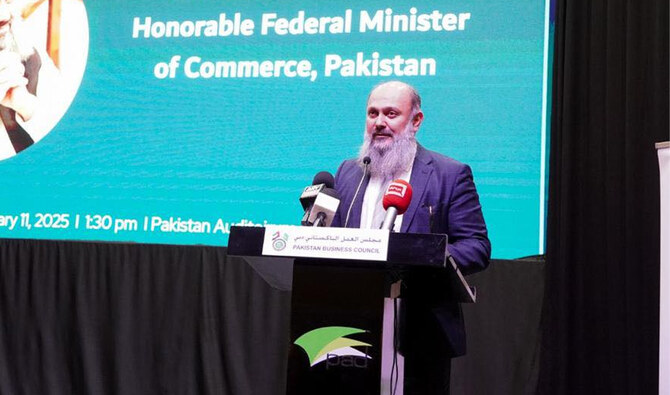
Pakistan’s Commerce Minister Jam Kamal Khan speaks at an event hosted by the Pakistan Business Council (PBC) in Dubai on January 11, 2025. (Photo Courtesy: Facebook/@jamkamalofficial)
Short Url
Updated 12 January 2025
Follow

Pakistan minister says private sector plays ‘pivotal role’ in promoting trade with UAE

  • Pakistan-UAE ties based on mutual trust, respect and shared aspirations, says commerce minister
  • UAE is Pakistan’s close ally and its third-largest trading partner after China and the United States

ISLAMABAD: Pakistan’s Commerce Minister Jam Kamal Khan this week highlighted the pivotal role played by the private sector in promoting the country’s trade and investment with the United Arab Emirates (UAE), saying that their ties were rooted in shared aspirations and mutual respect. 

Khan was speaking at a luncheon in Dubai on Saturday that was hosted by the Pakistan Business Council (PBC) Dubai at the Pakistan Association Dubai (PAD).

The event brought together over 100 guests including prominent Pakistani businessmen, VIPs, members of the PBC and officials from the Pakistan Consulate Dubai. It provided a platform to discuss investment opportunities, enhance exports, and bolster bilateral trade relations, the commerce ministry said. 

“Pakistan’s Federal Minister for Commerce, Jam Kamal Khan, emphasized the critical role of the private sector in strengthening trade and investment ties between Pakistan and the UAE,” the commerce ministry said. 

The minister lauded the newly elected PBC board, expressing confidence in its ability to work in collaboration with the Pakistan Consulate to advance Pakistan-UAE trade relations. 

“Highlighting the deep-rooted ties between the two nations, he described them as built on mutual respect, trust, and shared aspirations,” the statement added. 

Khan acknowledged the Pakistani diaspora in UAE for fostering economic prosperity and growth.

“The private sector plays a pivotal role in leading and solidifying trade and investment initiatives between Pakistan and the UAE,” the minister said. 

He urged business leaders to capitalize on opportunities to boost bilateral trade and unlock new avenues for economic development. 

The UAE is Pakistan’s third-largest trading partner after China and the United States (US), and a major source of foreign investment, valued at over $10 billion in the last 20 years, according to the UAE foreign ministry. It is also home to more than a million Pakistani expatriates. 

Policymakers in Pakistan consider the UAE an optimal export destination due to its geographical proximity, which minimizes transportation and freight costs while facilitating commercial transactions.

In January last year, Pakistan and the UAE signed multiple agreements worth more than $3 billion for cooperation in railways, economic zones and infrastructure, a Pakistani official said, amid Pakistani caretaker prime minister Anwaar-ul-Haq Kakar’s visit to Davos, Switzerland to attend 54th summit of the World Economic Forum (WEF).


Pakistan PM calls for faster CPEC implementation, pledges security for Chinese workers

Updated 27 February 2026
Follow

Pakistan PM calls for faster CPEC implementation, pledges security for Chinese workers

  • Shehbaz Sharif pushes expanded cooperation in agriculture, IT and mining under CPEC phase two
  • Chinese envoy reaffirms Beijing’s support for Pakistan’s sovereignty and economic development

ISLAMABAD: Prime Minister Shehbaz Sharif on Friday called for speeding up projects under the China-Pakistan Economic Corridor (CPEC) and pledged stronger security guarantees for Chinese workers and investments, during a meeting with China’s ambassador in Islamabad.

Sharif made the remarks as the two countries strive to launch the second phase of CPEC, a multibillion-dollar infrastructure and energy initiative launched in 2015 as part of China’s Belt and Road Initiative (BRI).

CPEC’s first phase focused largely on power generation and transport infrastructure aimed at easing Pakistan’s chronic energy shortages and improving connectivity. The second phase seeks to expand cooperation into industrial development, with an emphasis on special economic zones and export-oriented growth.

“While highlighting the importance of accelerating ongoing CPEC projects, the Prime Minister stressed on the need to enhance cooperation in agriculture and IT and mining & minerals,” said a statement circulated by the PM Office after the meeting.

“He also underscored Pakistan’s resolve to provide a secure and conducive environment for Chinese personnel, investments, and institutions in Pakistan,” it added.

Chinese nationals and projects in Pakistan have faced security threats in the past, including attacks by militant groups targeting infrastructure sites and convoys. Islamabad has repeatedly vowed to tighten security and has deployed special protection units for Chinese workers.

China is Pakistan’s closest ally in the region and a key economic partner, with CPEC widely regarded by Islamabad as central to long-term economic growth.

During the meeting, the prime minister conveyed greetings to Chinese President Xi Jinping and Premier Li Qiang, particularly on the occasion of the Chinese New Year.

China’s Ambassador to Pakistan, Jiang Zaidong, reiterated Beijing’s support for Pakistan’s sovereignty and socioeconomic development, according to the statement. Both sides also exchanged views on regional and international issues and agreed to maintain close coordination.