Food lovers relish international flavors, global cuisines at Karachi Eat 2025

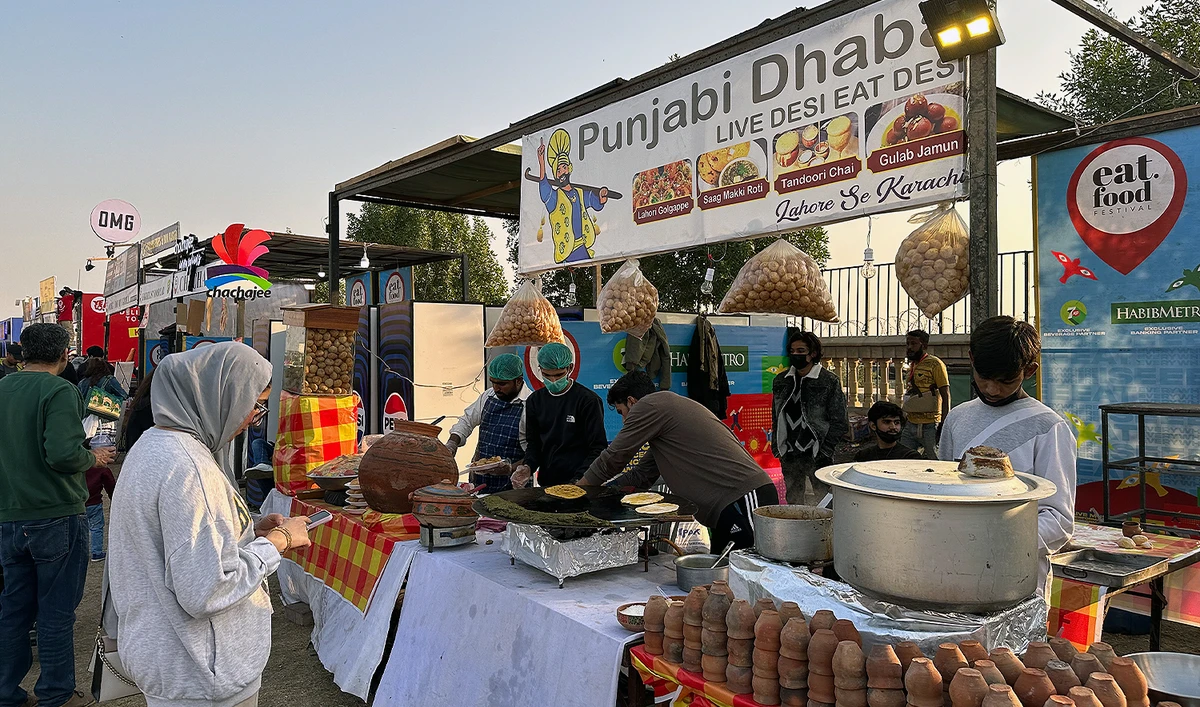
Visitors attend Karachi Eat festival in Karachi, Pakistan, on January 11, 2025. (AN photo)
Short Url
Updated 12 January 2025
Follow

Food lovers relish international flavors, global cuisines at Karachi Eat 2025

  • Three-day annual Karachi Eat festival features cuisines from Middle East, Turkiye and Italy
  • Food stall owners say festival helps them bring global cuisines to Pakistani audiences 

KARACHI: The air at Beach View Park in Pakistan’s southern port city of Karachi was filled with the enticing aroma of Sicilian slow-cooked beef, Arabic Paratha, beefy Chapli Kebabs from Peshawar and mouthwatering Chicken Tikka. 

Welcome to Karachi Eat 2025, Pakistan’s biggest annual food festival. The three-day festival has been taking place in the ‘City of Lights’ every year in January since 2014. This year’s festival, set to conclude today, Sunday, also features hundreds of eateries and offers a variety of cuisines to visitors.

According to Ticket Wala, a platform that sells tickets for entertainment events, chefs from Indonesia, Singapore, Turkiye, Romania, Malaysia, France and other countries visited Karachi for the festival. 

Sarah Aziz, a food stall owner passionately selling Sicilian cuisine, told Arab News she wanted to bring international cuisine to Pakistanis who could not travel to countries around the world. 

“We want to bring the flavors out there for everyone who can’t go to Sicily, Portugal, or Malta,” she said. “We want to bring the food here, so they can also cherish and enjoy it.”

Aziz said she wanted to “convert” her cuisine, which was for a niche market, so that many people in Pakistan can enjoy and develop a taste for it. 

“So, the menu is basically based on slow-cooked beef with lamb fat,” she said. “We are doing handmade pesto with garlic paste.”

For others like Muhammad Ismail, 28, the festival provided an opportunity for him to indulge in his love for Arabic cuisine. 

“I just had Arabic Paratha here,” Ismail, a banker by profession, told Arab News. “I have it there [Saudi Arabia] too but this one tastes exactly like the authentic one you get in Saudi Arabia, and it’s absolutely amazing,” he said. 
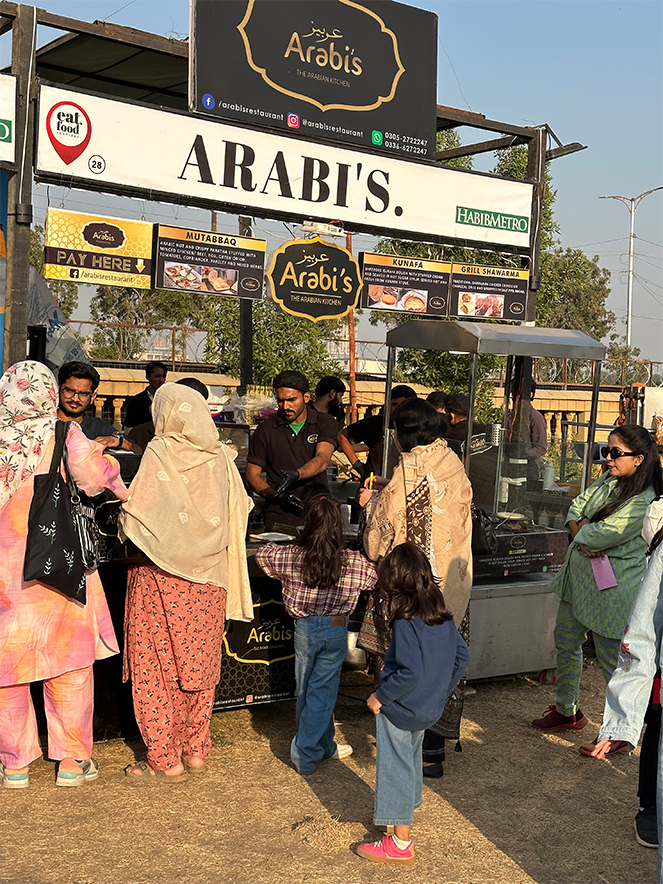


Visitors gather around "Arabi's" food stall at the Karachi Eat festival in Karachi, Pakistan, on January 11, 2025. (AN photo)

Shaikh Ameen, the owner of Arabi’s, a restaurant in Karachi that offers Arabic cuisine, said there was a growing appreciation for Middle Eastern cuisine in Pakistan. 

“We offer authentic shawarma, mutabbaq and kunafa, so we’re serving these authentic dishes here,” Ameen said. 

“There are quite a few people from the Middle East, especially families, who are familiar with this food, and they really enjoy it. Moreover, people’s tastes have evolved, and they really like these flavors now.”

Kashaf Noman, a textile designer in her 20s, expressed her enthusiasm for the festival. 

“I am loving it, it’s very really organized and I have many more options here than at other festivals, so it’s really nice, I’m having fun,” she said. 

Noman said she had relished fish gyozas, waffles and a Mexican drink.

CHAPLI KEBABS AND BOHRA CUISINES

While the festival featured a plethora of international flavors, it also celebrated local specialties like the Chapli Kebab, Bohra cuisines and dishes from Pakistan’s northern mountainous regions.

Bohra cuisine comprises of food items made famous by the Bohra community, a Shiite Muslim sect. 
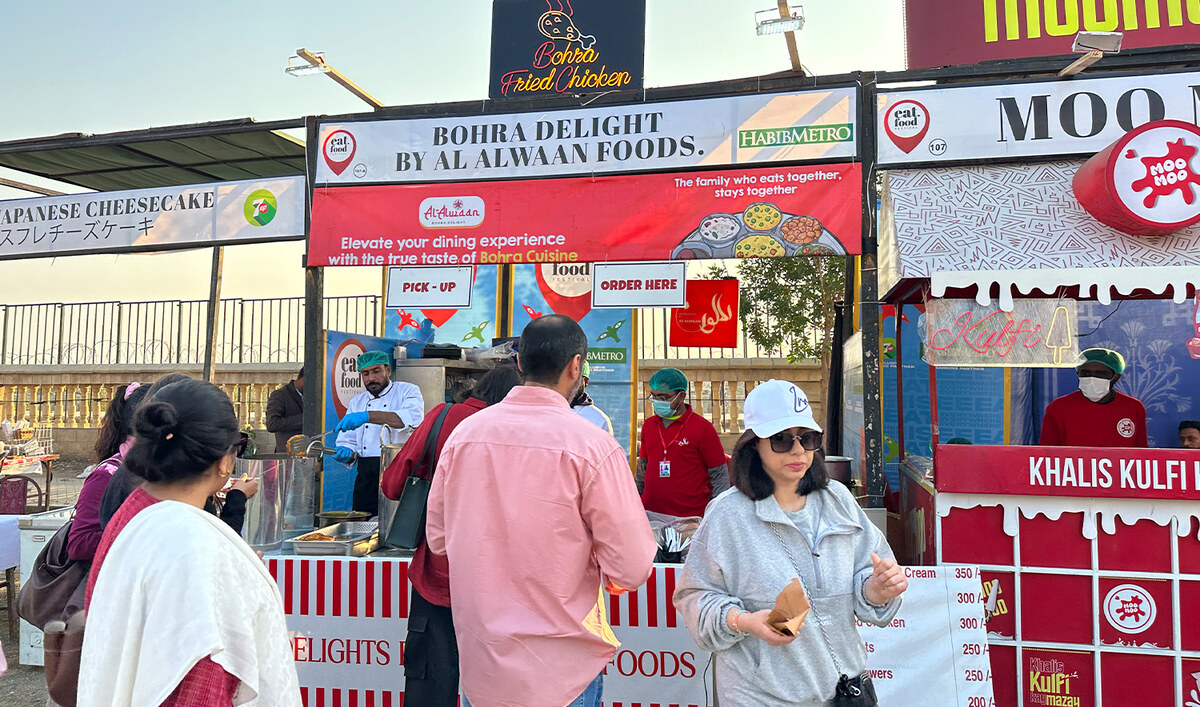


Visitors gather around "Bohra Delights" food stall at the Karachi Eat festival in Karachi, Pakistan, on January 11, 2025. (AN photo)

The festival also provided a platform for lesser-known regional cuisines to showcase their items. Zaeem Ud Din, 25, a student and stall owner, introduced the traditional Chapshoro dish from the northern Gilgit-Baltistan region. 

“Our Chapshoro is not spicy; people’s taste buds aren’t the same but we still wanted to bring a tradition with us,” he said. 

“We aimed to introduce something unique from Gilgit-Baltistan as not everyone can travel there.”

There were also some outlets from Pakistan’s second-largest city Lahore, which enjoys a food rivalry with Karachi. 

Despite the general perception that Lahore’s food is inferior to that of Karachi in terms of taste, Lahore-based food stalls attracted a significant crowd at the festival.

“If someone says you can’t find anything like Karachi in Lahore, they should definitely try Arif Chatkhara,” Mirza Zaidan Baig, owner of the popular Lahore eatery “Arif Chatkhara,” told Arab News. 

And for those who did not like Arif Chatkhara’s sumptuous items, Baig had a generous offer. 

“If they don’t like it, we will send them back with double the amount they paid,” he said. 

‘Look ahead or look up?’: Pakistan’s police face new challenge as militants take to drone warfare

Updated 14 January 2026
Follow

‘Look ahead or look up?’: Pakistan’s police face new challenge as militants take to drone warfare

  • Officials say militants are using weapons and equipment left behind after allied forces withdrew from Afghanistan
  • Police in northwest Pakistan say electronic jammers have helped repel more than 300 drone attacks since mid-2025

BANNU, Pakistan: On a quiet morning last July, Constable Hazrat Ali had just finished his prayers at the Miryan police station in Pakistan’s volatile northwest when the shouting began.

His colleagues in Bannu district spotted a small speck in the sky. Before Ali could take cover, an explosion tore through the compound behind him. It was not a mortar or a suicide vest, but an improvised explosive dropped from a drone.

“Now should we look ahead or look up [to sky]?” said Ali, who was wounded again in a second drone strike during an operation against militants last month. He still carries shrapnel scars on his back, hand and foot, physical reminders of how the battlefield has shifted upward.

For police in the northwestern Khyber Pakhtunkhwa (KP) province, the fight against militancy has become a three-dimensional conflict. Pakistani officials say armed groups, including the Tehreek-e-Taliban Pakistan (TTP), are increasingly deploying commercial drones modified to drop explosives, alongside other weapons they say were acquired after the US military withdrawal from neighboring Afghanistan.

Security analysts say the trend mirrors a wider global pattern, where low-cost, commercially available drones are being repurposed by non-state actors from the Middle East to Eastern Europe, challenging traditional policing and counterinsurgency tactics.

The escalation comes as militant violence has surged across Pakistan. Islamabad-based Pakistan Institute for Conflict and Security Studies (PICSS) reported a 73 percent rise in combat-related deaths in 2025, with fatalities climbing to 3,387 from 1,950 a year earlier. Militants have increasingly shifted operations from northern tribal belts to southern KP districts such as Bannu, Lakki Marwat and Dera Ismail Khan.

“Bannu is an important town of southern KP, and we are feeling the heat,” said Sajjad Khan, the region’s police chief. “There has been an enormous increase in the number of incidents of terrorism… It is a mix of local militants and Afghan militants.”

In 2025 alone, Bannu police recorded 134 attacks on stations, checkpoints and personnel. At least 27 police officers were killed, while authorities say 53 militants died in the clashes. Many assaults involved coordinated, multi-pronged attacks using heavy weapons.

Drones have also added a new layer of danger. What began as reconnaissance tools have been weaponized with improvised devices that rely on gravity rather than guidance systems.

“Earlier, they used to drop [explosives] in bottles. After that, they started cutting pipes for this purpose,” said Jamshed Khan, head of the regional bomb disposal unit. “Now we have encountered a new type: a pistol hand grenade.”

When dropped from above, he explained, a metal pin ignites the charge on impact.

Deputy Superintendent of Police Raza Khan, who narrowly survived a drone strike during construction at a checkpoint, described devices packed with nails, bullets and metal fragments.

“They attach a shuttlecock-like piece on top. When they drop it from a height, its direction remains straight toward the ground,” he said.

TARGETING CIVILIANS

Officials say militants’ rapid adoption of drone technology has been fueled by access to equipment on informal markets, while police procurement remains slower.

“It is easy for militants to get such things,” Sajjad Khan said. “And for us, I mean, we have to go through certain process and procedures as per rules.”

That imbalance began to shift in mid-2025, when authorities deployed electronic anti-drone systems in the region. Before that, officers relied on snipers or improvised nets strung over police compounds.

“Initially, when we did not have that anti-drone system, their strikes were effective,” the police chief said, adding that more than 300 attempted drone attacks have since been repelled or electronically disrupted. “That was a decisive moment.”

Police say militants have also targeted civilians, killing nine people in drone attacks this year, often in communities accused of cooperating with authorities. Several police stations suffered structural damage.

Bannu’s location as a gateway between Pakistan and Afghanistan has made it a security flashpoint since colonial times. But officials say the aerial dimension of the conflict has placed unprecedented strain on local forces.

For constables like Hazrat Ali, new technology offers some protection, but resolve remains central.

“Nowadays, they have ammunition and all kinds of the most modern weapons. They also have large drones,” he said. “When we fight them, we fight with our courage and determination.”