

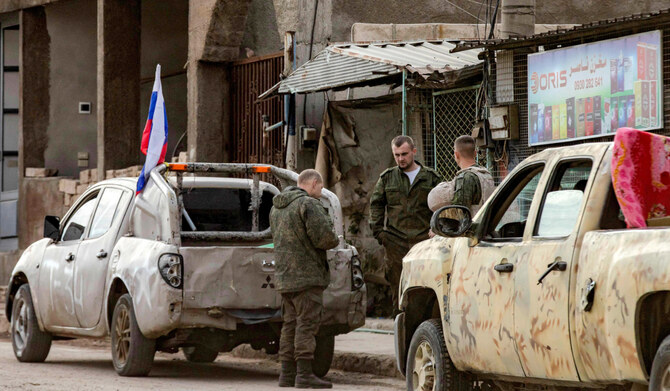

PARIS: The fall of Russian ally Bashar Assad in Syria has disrupted the Kremlin’s strategy not only for the Mediterranean but also for Africa, pushing it to focus on Libya as a potential foothold, experts say.
Russia runs a military port and an air base on the Syrian coast, designed to facilitate its operations in the Mediterranean, the Middle East, and sub-Saharan Africa, especially the Sahel, Sudan, and the Central African Republic.
However, this model is in jeopardy with the abrupt departure of the Syrian ruler.
Although Syria’s new leader, Ahmed Al-Sharaa, has called Russia an “important country,” saying “we do not want Russia to leave Syria in the way that some wish,” the reshuffling of cards in Syria is pushing Russia to seek a strategic retreat toward Libya.
In Libya, Russian mercenaries already support Khalifa Haftar, a field marshal controlling the east of the country, against the Tripoli-based Government of National Unity (GNU) which has UN recognition and is supported by Turkiye.
“The goal is notably to preserve the ongoing Russian missions in Africa,” said Jalel Harchaoui at the RUSI think tank in the UK.
“It’s a self-preservation reflex” for Russia which is anxious “to mitigate the deterioration of its position in Syria,” he told AFP.
In May 2024, Swiss investigative consortium “All Eyes On Wagner” identified Russian activities at around 10 Libyan sites, including the port of Tobruk, where military equipment was delivered in February and April of last year.
There were around 800 Russian troops present in February 2024, and 1,800 in May.
On December 18 the Wall Street Journal, citing Libyan and American officials, said there had been a transfer of Russian radars and defense systems from Syria to Libya, including S-300 and S-400 anti-aircraft batteries.
Since Assad’s fall on December 8, “a notable volume of Russian military resources has been shipped to Libya from Belarus and Russia,” said Harchaoui, adding there had been troop transfers as well.
Ukrainian intelligence claimed on January 3 that Moscow planned “to use Sparta and Sparta II cargo ships to transport military equipment and weapons” to Libya.
Beyond simply representing a necessary replacement of “one proxy with another,” the shift is a quest for “continuity,” said expert Emadeddin Badi on the Atlantic Council’s website, underscoring Libya’s role as “a component of a long-standing strategy to expand Moscow’s strategic foothold in the region.”
According to Badi, “Assad offered Moscow a foothold against NATO’s eastern flank and a stage to test military capabilities.”
Haftar, he said, presents a similar opportunity, “a means to disrupt western interests, exploit Libya’s fractured politics, and extend Moscow’s influence into Africa.”
The Tripoli government and Italy, Libya’s former colonial master, have expressed concern over Russian movements, closely observed by the European Union and NATO.
Several sources say the United States has tried to persuade Haftar to deny the Russians a permanent installation at the port of Tobruk that they have coveted since 2023.
It seems already clear the Kremlin will struggle to find the same level of ease in Libya that it had during Assad’s reign.
“Syria was convenient,” said Ulf Laessing, the Bamako-based head of the Sahel program at the Konrad Adenauer Foundation.
“It was this black box with no Western diplomats, no journalists. They could basically do what they wanted,” he told AFP.
“But in Libya, it will be much more complicated. It’s difficult to keep things secret there and Russian presence will be much more visible,” he said.
Moscow will also have to contend with other powers, including Turkiye, which is allied with the GNU, as well as Egypt and the United Arab Emirates, who are patrons of Haftar.
In Libya, torn into two blocs since the ouster of longtime leader Muammar Qaddafi in February 2011, “everybody’s trying to work with both sides,” said Laessing.
Over the past year, even Turkiye has moved closer to Haftar, seeking potential cooperation on economic projects and diplomatic exchanges.
Russia will also be mindful to have a plan B should things go wrong for its Libyan ally.
“We must not repeat the mistake made in Syria, betting on a local dictator without an alternative,” said Vlad Shlepchenko, military correspondent for the pro-Kremlin media Tsargrad.
Haftar, meanwhile, is unlikely to want to turn his back on western countries whose tacit support he has enjoyed.
“There are probably limits to what the Russians can do in Libya,” said Laessing.


