



ISLAMABAD: Prime Minister Shehbaz Sharif on Saturday urged international organizations and philanthropists to join hands to find sustainable solutions for the education of girls as Pakistan opened a two-day conference to discuss girls’ education among Muslim communities.
The global summit, which aims to find ways to advance girls’ education across the Muslim world, is being attended by over 150 dignitaries from 44 Muslim and other friendly states, according to Pakistan’s foreign office.
In his keynote address at the opening session, the prime minister said ensuring equitable access to education for girls is one of the most “pressing challenges” facing the world.
“I call upon both global and Pakistani organizations, philanthropists and entrepreneurs to join us in creating scalable and sustainable solutions for girls’ education,” he told the gathering.
“Over the next decade, millions of young girls will enter the job markets [so] as they do so, they have the potential not just to lift themselves, their families and their nations out of poverty, but also to enrich the global economy, create new markets and find innovative solutions to our shared challenges.”
The Pakistan premier thanked Saudi Arabia’s King Salman and Crown Prince Crown Prince Mohammed bin Salman for their support and patronage of the conference.
“The pursuit of knowledge is a sacred duty for every Muslim, regardless of gender, as emphasized by Prophet Muhammad (Peace Be Upon Him),” he said.
“His (PBUH) awe-inspiring message was preached in a society which was still in darkness and even in denial of the basic rights of women to exist in the world. In response to these great injustices, Islam introduced a transformative social paradigm.”
Sharif said the Muslim world, including Pakistan, faces significant challenges in ensuring equitable access to education for girls.
He said that women make up more than half of the total population in his country, yet the female literacy rate stands at only 49 percent and alarmingly, around 22.8 million children in the age bracket of five to 16 years are out of school, with a disproportionate number being girls.
“Denying education to girls is tantamount to denying them their voice and their choice, while depriving them of their right to a bright future,” he continued, highlighting various initiatives undertaken by his administration for the education of girls.
The Pakistan premier gave the examples of Fatimah Jinnah, sister of the country’s founder Muhammad Ali Jinnah, along with Benazir Bhutto, first woman PM in the Muslim world, and Maryam Nawaz Sharif, first woman chief minister of a Pakistani province, saying they all inspired women participation in politics and socio-economic future of the country.
“History is witness to the determination and resilience of women who have thrived even within the limited spaces afforded to them, breaking the shackles of societal servitude and leaving an indelible mark on society,” he added.
Several dignitaries, including Organization of Islamic Cooperation (OIC) Secretary-General Hissein Brahim Taha, Muslim World League Secretary-General Sheikh Dr. Muhammad bin Abdul Kareem Al Issa and Egyptian Grand Mufti Dr. Nazir Mohamed Ayad attended event.
Speaking to the participants, the OIC chief congratulated Pakistan for holding the conference while also expressing concern for the well being of women being killed in Gaza by Israeli forces.
“We are very worried about the situation of women in Palestine who not only find themselves in a position where they cannot have education but are also facing financial problems and problems at their homes,” he said. “The international community must assume its responsibility and stop this [Israeli] aggression in the region and guarantee the humanitarian aid to reach Palestine.”
On Saturday, Nobel Peace Prize laureate Malala Yousafzai also reached Islamabad, saying she was “overwhelmed” to be back in her native country to discuss girls’ education.
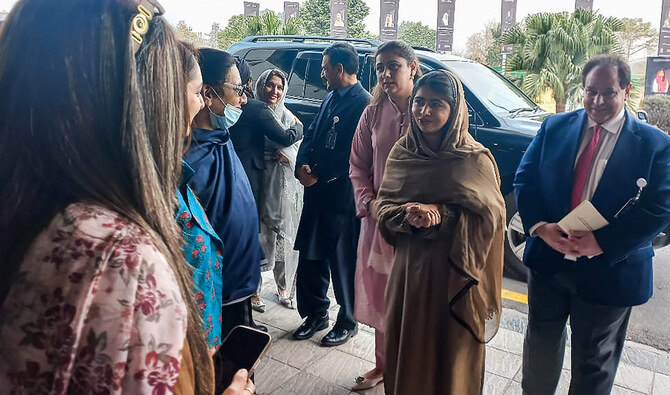
Nobel Peace Prize Laureate Malala Yousafzai (2R) arrives to attend an international summit on ‘Girls’ Education in Muslim Communities’, in Islamabad on January 11, 2025. (AFP)
Pakistan Army’s first female Lt. Gen. Nigar Johar also addressed the inaugural session of the conference, saying women must be given education and involved in the decision- and policy-making processes. She maintained that women’s education must be made an integral part of the national budget.
Pakistan’s education minister Khalid Maqbool Siddiqui told AFP the government had “extended an invitation to Afghanistan but no one from the Afghan government was at the conference.”
Since the Taliban’s return to power in 2021, at least 1.4 million Afghan girls have been denied access to secondary education, according to a report by the United Nations International Children’s Emergency Fund (UNICEF) released in August last year.
An “Islamabad Declaration” will be announced at the end of the conference on Sunday that would outline decisive steps to transform girls’ education in Islamic countries.
With additional comments from AFP


