Pakistan receives over 22,000 applications for 4,500 scholarships for Afghan students

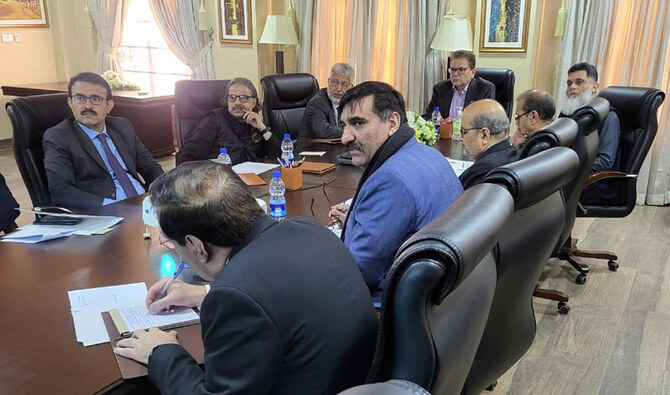
Pakistan’s Special Representative for Afghanistan, Mohammad Sadiq (center), chairs a meeting of Afghanistan, Central Asia, Azerbaijan Inter-governmental Coordination Cell (ACICC) to announce the launch of the second tranche of third phase of the Allama Iqbal Scholarships Programme for Afghan students on January 10, 2025. (Photo Courtesy: X/@AmbassadorSadiq)
Short Url
Updated 10 January 2025
Follow

Pakistan receives over 22,000 applications for 4,500 scholarships for Afghan students

  • The scholarships were announced in July last year under the Allama Iqbal Scholarship program, amid ongoing tensions between the two countries
  • The program, which covers tuition fees, accommodation and monthly stipend, offers scholarships in medical, engineering, agriculture and other fields

ISLAMABAD: Pakistan has received more than 22,000 applications for 4,500 scholarships it announced for Afghan students last year, Pakistan’s special representative for Afghanistan said on Friday.
The scholarships were announced in July last year under the Allama Iqbal Scholarship program, amid ongoing tensions between the two countries that prompted Islamabad to launch a deportation drive targeting unregistered Afghans in late 2023.
The program, which covers tuition fees, accommodation and a monthly stipend for undergraduate, graduate and doctoral studies at Pakistani universities, was introduced in 2009 to strengthen bilateral ties between the two neighboring states.
In a statement issued from his office, Pakistan’s special representative Sadiq Khan said this is the third phase of the program that will offer fully funded scholarships in medical, engineering, agriculture and other fields over the next three years.
“This month, over 22,000 applicants will take an online test, followed by interviews for final selection. The entire process will conclude within 45 days,” he said.
“Notably, 33 percent of the scholarship seats are reserved for female students.”
Pakistan last year announced the scholarships on the same day its federal cabinet approved the extension of registration cards for 1.5 million Afghan refugees for another year.
Ties between the two countries have been strained because of a surge in militant attacks in Pakistan’s western regions that border Afghanistan.
The attacks particularly surged after the breakdown of a fragile truce between the Pakistani government and the outlawed Tehreek-e-Taliban Pakistan (TTP) in Nov. 2022.
Pakistan has frequently accused neighboring Afghanistan of sheltering and supporting militant groups that launch cross-border attacks. Afghan officials deny involvement, insisting Pakistan’s security issues are an internal matter of Islamabad.
The two countries also conducted cross-border strikes in each other’s territory last month in the latest escalation of hostilities along the border.


Pakistan, China to sign multiple MoUs at major agriculture investment conference today

Updated 18 January 2026
Follow

Pakistan, China to sign multiple MoUs at major agriculture investment conference today

  • Hundreds of Chinese and Pakistani firms to attend Islamabad event
  • Conference seen as part of expanding CPEC ties into agriculture, trade

KARACHI: Islamabad and Beijing are set to sign multiple memorandums of understanding (MoUs) to boost agricultural investment and cooperation at a major conference taking place in the capital today, Monday, with hundreds of Chinese and Pakistani companies expected to participate.

The conference is being billed by Pakistan’s Ministry of National Food Security and Research as a platform for deepening bilateral agricultural ties and supporting broader economic engagement between the two countries.

“Multiple memorandums of understanding will be signed at the Pakistan–China Agricultural Conference,” the Ministry of National Food Security said in a statement. “115 Chinese and 165 Pakistani companies will participate.”

The conference reflects a growing emphasis on expanding Pakistan-China economic cooperation beyond the transport and energy foundations of the flagship China-Pakistan Economic Corridor (CPEC) into agriculture, industry and technology.

Under its first phase launched in 2015, CPEC, a core component of China’s Belt and Road Initiative, focused primarily on transportation infrastructure, energy generation and connectivity projects linking western China to the Arabian Sea via Pakistan. That phase included motorways, power plants and the development of the Gwadar Port in the country's southwest, aimed at helping Pakistan address chronic power shortages and enhance transport connectivity.

In recent years, both governments have formally moved toward a “CPEC 2.0” phase aimed at diversifying the corridor’s impact into areas such as special economic zones, innovation, digital cooperation and agriculture. Second-phase discussions have highlighted Pakistan’s goal of modernizing its agricultural sector, attracting Chinese technology and investment, and boosting export potential, with high-level talks taking place between planning officials and investors in Beijing.

Agri-sector cooperation has also seen practical collaboration, with joint initiatives examining technology transfer, export protocols and value-chain development, including partnerships in livestock, mechanization and horticulture.

Organizers say the Islamabad conference will bring together government policymakers, private sector investors, industry associations and multinational agribusiness firms from both nations. Discussions will center on investment opportunities, technology adoption, export expansion and building linkages with global buyers within the framework of Pakistan-China economic cooperation.