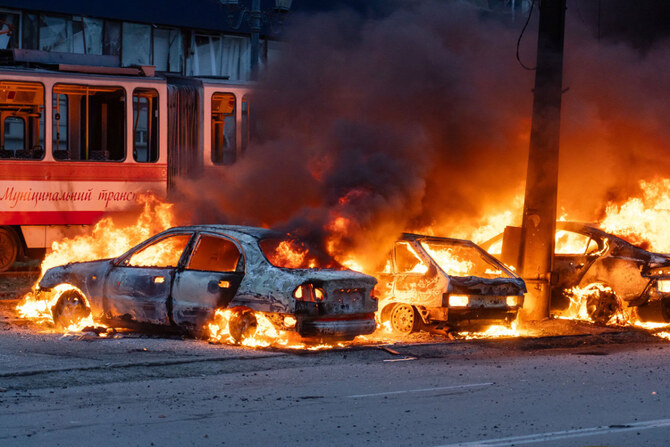
KYIV: A daytime Russian missile attack on the southern Ukraine city of Zaporizhzhia killed at least 13 civilians and wounded about 30 others on Wednesday, officials said.
Footage posted on Ukrainian President Volodymyr Zelensky’s Telegram channel shows civilians lying in a city street littered with debris. The post shows them being treated by emergency services and taken away on gurneys.
Russia has frequently launched aerial attacks on civilian areas during the almost three-year war. Thousands of civilians have been killed in Europe’s biggest conflict since World War II.
Zelensky and regional Gov. Ivan Fedorov said Wednesday’s attack killed at least 13 civilians. Minutes before the attack, Fedorov had warned of a threat of high-speed missiles and devastating glide bombs being fired at the Zaporizhzhia region.
Russian troops started launching the glide bombs at Zaporizhzhia in the middle of the afternoon, and at least two bombs struck residential buildings in the city, Fedorov said.
He announced that Thursday would be a day of mourning in the region.
“There is nothing more brutal than aerial bombing of a city, knowing that ordinary civilians will suffer,” Zelensky wrote on Telegram.
Zelensky said earlier Wednesday that countries wanting to end the war should offer Ukraine assurances about its future defense. Kyiv officials fear that any ceasefire or peace deal will just give the Kremlin time to rearm and invade again unless it is deterred by military force.
“To be honest, I believe that we have a right to demand serious security guarantees from … the countries that aim for the peace in the world,” Zelensky said.
Zelensky was responding at a news conference in Kyiv to comments the previous day by President-elect Donald Trump that he understood Russia’s opposition to neighboring Ukraine joining NATO.
The United States, Germany, Hungary and Slovakia have stood in the way of Ukraine immediately joining the 32-nation alliance, Zelensky noted. The alliance has said only that the country is on an “irreversible path” to membership.
Earlier, the Ukrainian military said it struck a fuel storage depot deep inside Russia, causing a huge blaze at the facility that supplies an important Russian air base.
Russian officials acknowledged a major drone attack in the area, and said that authorities had set up an emergency command center to fight the fire.
Ukraine’s General Staff said the assault hit the storage facility near Engels, in Russia’s Saratov region, about 600 kilometers (370 miles) east of the Ukrainian border. The depot supplied a nearby airfield used by aircraft that launch missiles across the border into Ukraine, a statement on Facebook said.
Ukraine has been developing its arsenal of domestically produced long-range missiles and drones capable of reaching deep behind the front line as it faces restrictions on the range that its military can fire its Western-supplied missiles into Russia.
The attacks have disrupted Russian logistics in the war, which began on Feb. 24, 2022, and embarrassed the Kremlin.
Zelensky said last year that his country has developed a weapon that could hit a target 700 kilometers (400 miles) away. Some Ukrainian drone attacks have hit targets more than 1,000 kilometers (600 miles) away.
The governor of the Saratov region, Roman Busargin, said that an unspecified industrial plant in Engels sustained damage from the falling drone debris that sparked a fire, but nobody was hurt.
Engels, which has a population of more than 220,000, is on the left bank of the Volga River, and is home to multiple industrial plants. Saratov, a major industrial city of about 900,000, faces Engels across the river.
“The damage to the oil base creates serious logistical problems for the strategic aviation of the Russian occupiers and significantly reduces their ability to strike peaceful Ukrainian cities and civilian objects. To be continued,” the statement from Ukraine’s General Staff said.
Russian authorities restricted flights early Wednesday at the airports of Saratov, Ulyanovsk, Kazan and Nizhnekamsk, in an apparent response to the Ukrainian attack.
The main base of Russia’s nuclear-capable strategic bombers is just outside Engels. It has come under Ukrainian drone attacks since the early stages of the war, forcing the Russian military to relocate most of the bombers to other areas.


![]()
![]()

A Russian missile attack in southern Ukraine has killed at least 13 civilians, officials say

Short Url
https://arab.news/4fv4c
A Russian missile attack in southern Ukraine has killed at least 13 civilians, officials say
- Russia has frequently launched aerial attacks on civilian areas during its almost three-year war with Ukraine
- “There is nothing more brutal than aerial bombing of a city, knowing that ordinary civilians will suffer,” Ukraine President Zelensky wrote on Telegram


Latest updates


Recommended


© 2026 SAUDI RESEARCH & PUBLISHING COMPANY, All Rights Reserved And subject to Terms of Use Agreement.