

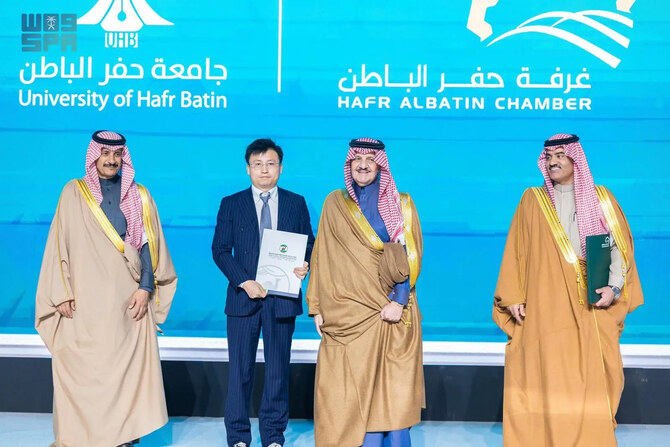

RIYADH: The Hafr Al-Batin Investment Forum 2025, held in Saudi Arabia’s Eastern Province, concluded with the signing of seven agreements totaling SR17 billion ($4.5 billion) across key sectors, underscoring the region’s growing economic potential.
The event, organized by the Hafr Al-Batin Chamber of Commerce in collaboration with the Federation of Saudi Chambers and hosted at the University of Hafr Al-Batin, aimed to position the province as a competitive hub for both local and international investors, in alignment with Saudi Arabia’s Vision 2030.
The forum was inaugurated by Eastern Province Gov. Prince Saud bin Nayef Al-Saud, who emphasized the province’s strategic advantages for investors.
He highlighted Hafr Al-Batin’s competitive investment landscape, noting its diversified economic opportunities and advantageous location, making it an ideal destination for investors looking to capitalize on sustainable growth prospects.
He also underscored the region’s infrastructure developments, which are critical for attracting investment and creating job opportunities for Saudi nationals.
The agreements signed during the forum marked a significant milestone in Hafr Al-Batin’s economic development, with the forum serving as an important platform for showcasing the region’s investment opportunities.
These agreements are expected to contribute to the province’s growing role in the Kingdom’s economic agenda, aligning with Vision 2030’s objectives of economic diversification and job creation. The event also highlighted Hafr Al-Batin’s efforts to attract foreign capital and foster local content within its industries.
In conjunction with the forum, the Eastern Province Development Authority launched a master plan for Hafr Al-Batin aimed at attracting SR47 billion in private sector investments. This plan is projected to contribute SR11 billion to Saudi Arabia’s gross domestic product and create more than 60,000 job opportunities for local residents.
One of the key announcements at the forum was the unveiling of the Middle East’s largest livestock city, a SR9 billion project designed to support Saudi Arabia’s goals of achieving self-sufficiency in livestock production and enhancing food security.
The city, backed by the Hafr Al-Batin Livestock and Marketing Association, will be developed on an expansive 11 million sq. meter site. Once operational, the project is expected to meet 30 percent of Saudi Arabia’s demand for red meat while generating over 13,000 jobs.
It will include state-of-the-art livestock farms, fodder production plants, a veterinary hospital, and advanced meat processing facilities. Sustainability will be a core feature, with the city powered by renewable energy, generating 15 billion kilowatt-hours of green electricity annually, producing 140,000 liters of milk per day, and 100 tonnes of fodder per hour. The facility will also feature an automated abattoir spanning 170,000 sq. meters, contributing 1.5 million sq. meters of leather production each year.
The forum drew a wide range of participants, including Prince Abdulrahman bin Abdullah bin Faisal, governor of Hafr Al-Batin, as well as high-ranking officials, business leaders, and investors from across the globe. The event was designed to showcase the province’s investment potential in sectors such as agriculture, livestock, healthcare, logistics, and infrastructure—critical areas for the region’s economic transformation.
Hassan Al-Huwaizi, chairman of the Federation of Saudi Chambers, emphasized the forum’s importance in advancing the Kingdom’s economic goals.
He pointed to the growth of Saudi Arabia’s trade and commerce ecosystem, driven in large part by Vision 2030’s transformative strategies, and highlighted the role of the Hafr Al-Batin Investment Forum as a vital platform for introducing the region’s opportunities to both national and international investors.
Sulaiman Al-Aqil, chairman of the Hafr Al-Batin Chamber of Commerce, described the forum as a pivotal moment in the province’s economic evolution.
The event featured participation from 24 government and private entities from 12 countries, four panel discussions with 19 speakers, and the release of a comprehensive economic study on Hafr Al-Batin’s investment potential.
With these agreements and initiatives, the forum not only highlighted the region’s expanding role in Saudi Arabia’s economic future but also reaffirmed the Kingdom’s commitment to becoming a leading global investment hub in line with Vision 2030’s objectives.


