

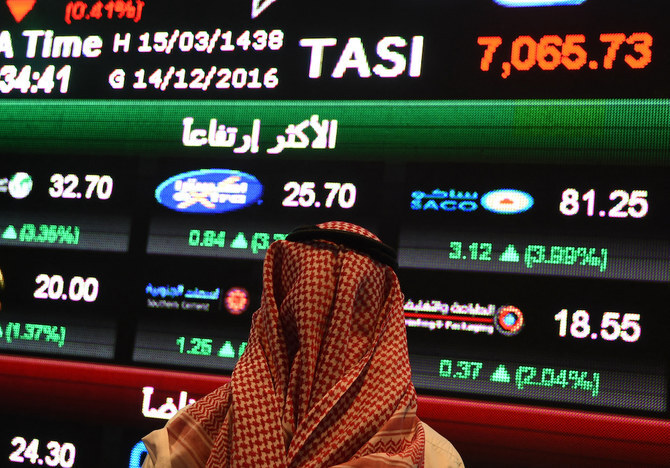
Closing Bell: Saudi main index slides to close at 12,088

The benchmark index saw a trading turnover of SR7 billion ($1.86 billion), with 127 stocks advancing and 112 declining. AFP
Short Url
Updated 08 January 2025
Follow

Closing Bell: Saudi main index slides to close at 12,088

RIYADH:  Saudi Arabia’s Tadawul All Share Index edged lower on Wednesday, dropping by 24.55 points, or 0.20 percent, to close at 12,088.74. The benchmark index saw a trading turnover of SR7 billion ($1.86 billion), with 127 stocks advancing and 112 declining.

The Kingdom’s parallel market, Nomu, also experienced a slight decline, falling by 32.97 points, or 0.11 percent, to settle at 30,776.15. Of the stocks listed on Nomu, 41 advanced while 42 retreated.

The MSCI Tadawul Index dropped 7.53 points, or 0.50 percent, to close at 1,506.86.

Among the top performers of the day was Nice One Beauty Digital Marketing Co., which made its debut on the main market on Jan. 8. The company’s share price surged by 30 percent, reaching SR45.50.

Other notable gainers included Al-Mawarid Manpower Co., which saw its stock rise 7.82 percent to SR135.20, and Al-Baha Investment and Development Co., which saw its share price climb 6.98 percent.

On the downside, National Co. for Learning and Education recorded the largest drop, falling 4.24 percent to SR185.20. Almoosa Health Co. also saw a decline of 3.84 percent, ending the session at SR140.40, while Alinma Retail REIT Fund Yanbu saw a 3.45 percent drop to SR4.76.

On the announcements front, Nice One Beauty Digital Marketing Co. revealed it is offering 34.65 million shares at SR35 each. SNB Capital is serving as the lead manager for the offering.

United Electronics Co. announced its estimated financial results for the year ending Dec. 31, 2024. The company reported a net profit of SR534.53 million, marking a 36.8 percent increase compared to 2023. The growth was driven by higher revenues and improved gross profits, thanks to a better sales mix and expansion in the consumer finance sector, despite an increase in selling, distribution, and administrative expenses. Extra’s stock ended the day at SR95.60, up 2.13 percent.

United International Holding Co. also posted its financial results for the period ending Dec. 31, 2024. The company recorded a net profit of SR222.38 million, a 4.8 percent increase over the previous year. This growth was attributed to higher credit loss provisions and increased selling, general, and administrative expenses. The company’s shares closed at SR187.80, down 2.60 percent.

Meanwhile, the Kingdom’s Capital Market Authority announced that Rawasi Albina Investment Co. is planning to issue up to SR500 million in debt instruments. The company's stock finished the session at SR4.35, down 1.15 percent.


Emerging markets driving global growth despite rising risks: Saudi finance minister 

Updated 41 sec ago
Follow

Emerging markets driving global growth despite rising risks: Saudi finance minister 

RIYADH: Emerging markets now account for a growing share of global output and are driving the bulk of world economic expansion, Saudi Arabia’s finance minister said, even as those economies grapple with rising debt and mounting geopolitical risks. 

Speaking at the opening of the annual AlUla Conference for Emerging Market Economies on Feb. 8, Mohammed Al-Jadaan said the role of emerging and developing nations in the global economy has more than doubled since 2000, underscoring a structural shift in growth away from advanced economies.

The meeting comes as policymakers in developing markets try to keep growth on track while controlling inflation, managing capital flows and repairing public finances after years of heavy borrowing. Saudi Arabia has positioned the forum as a platform to coordinate policy responses and strengthen the voice of emerging economies in global financial discussions. 

“This conference takes place at a moment of profound transition in the global economy. Emerging markets and developing economies now account for nearly 60 percent of the global gross domestic product in purchasing power terms and 70 percent of global growth,” Al-Jadaan said. 

He added: “Today, the 10 emerging economies and the G20 alone account for more than half of the world’s growth. Yet, emerging markets face a more complex and fragmented environment, elevated debt levels, slower trade growth and increasing exposure to geopolitical shocks.” 

According to Al-Jadaan, more than half of low-income nations face the risk of debt distress, while global trade growth has slowed to around half its pre-pandemic pace. 

Launched in 2025, the conference this year brings together economic decision-makers, finance ministers, central bank governors, leaders of international financial institutions, and a select group of experts and specialists from around the world. 

Al-Jadaan said credible fiscal frameworks and disciplined debt management are essential for long-term growth, pointing to Saudi Arabia’s own reform experience. 

“Macroeconomic stability is not the enemy of growth; it is actually the foundation. Credible fiscal framework, clear medium-term anchors, and disciplined debt management create the space for investment and reform, especially in volatile global conditions,” he said. 

The minister stressed that policy credibility depends on execution rather than plans, adding that structural reforms succeed only when institutions are able to deliver. 

The importance of multilateral cooperation is rising as the global system becomes more divided, he said, calling for stronger international financial safety nets for developing economies. 

“International cooperation matters more, not less, in a fragmented world. Strong multilateral institutions, effective surveillance and adequate global financial safety nets are essential, particularly for emerging and developing economies,” Al-Jadaan said. 

Kristalina Georgieva, managing director of the International Monetary Fund, said emerging markets are growing faster than advanced economies but remain vulnerable to future shocks. 

“Growth still lags pre-pandemic levels, and this is doubly concerning as we will surely experience more shocks, but face them with depleted fiscal buffers in many places, with high spending pressures practically everywhere, and rising debt levels in many countries,” she said. 


Georgieva outlined two policy priorities emerging economies should embrace to sustain growth. 

“First priority, unleash private sector-led growth by cutting red tape, deepening financial markets, strengthening institutions and improving governance,” she said.  

Georgieva added: “Second priority is stepping up integration. In a world of shifting alliances and trade partners, there are new opportunities for cooperation at the regional and cross-regional levels.”  

Lan Fo’an, China’s finance minister, said the world has entered a period of turbulence marked by unilateralism and geopolitical conflict. 

“A cold wave of deglobalization is sweeping across the globe, and the world once again stands at a crucial crossroads,” he said, adding that the global economy expanded 3.3 percent in 2025, below the pre-pandemic average of 3.7 percent. 

He called for reforms to global economic governance and greater attention to the needs of developing countries. 

“We should improve the global economic governance system through reforms. We should add dialogue over confrontation. We should practice multilateralism to ensure that our countries, regardless of their size or wealth, can participate, make decisions and benefit on an equal footing.” 

According to Fo’an, China has joined hands with the Global South to advance cooperation in food security, development financing and climate change.
