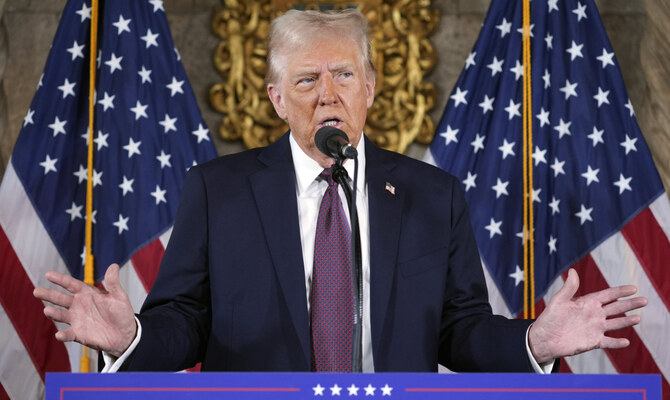
PALM BEACH, Florida: President-elect Donald Trump on Tuesday said he would not rule out the use of military force to seize control of the Panama Canal and Greenland, as he declared US control of both to be vital to American national security.
Speaking to reporters less than two weeks before he takes office on Jan. 20 and as a delegation of aides and advisers that includes Donald Trump Jr. is in Greenland, Trump left open the use of the American military to secure both territories. Trump’s intention marks a rejection of decades of US policy that has prioritized self-determination over territorial expansion.
“I’m not going to commit to that,” Trump said, when asked if he would rule out the use of the military. “It might be that you’ll have to do something. The Panama Canal is vital to our country.” He added, “We need Greenland for national security purposes.”
Greenland, home to a large US military base, is an autonomous territory of Denmark, a longtime US ally and a founding member of NATO. Trump cast doubts on the legitimacy of Denmark’s claim to Greenland.
The Panama Canal has been solely controlled by the eponymous country for more than 25 years. The US returned the Panama Canal Zone to the country in 1979 and ended its joint partnership in controlling the strategic waterway in 1999.
Addressing Trump’s comments in an interview with Danish broadcaster TV2, Prime Minister Mette Frederiksen called the United States Denmark’s “most important and closest ally,” and that she did not believe that the United States will use military or economic power to secure control over Greenland.
Frederiksen repeated that she welcomed the United States taking a greater interest in the Arctic region, but that it would “have to be done in a way that is respectful of the Greenlandic people,” she said.
“At the same time, it must be done in a way that allows Denmark and the United States to still cooperate in, among other things, NATO,” Frederiksen said.
Earlier, Trump posted a video of his private plane landing in Nuuk, the Arctic territory’s capital, in a landscape of snow-capped peaks and fjords.
“Don Jr. and my Reps landing in Greenland,” Trump wrote. “The reception has been great. They, and the Free World, need safety, security, strength, and PEACE! This is a deal that must happen. MAGA. MAKE GREENLAND GREAT AGAIN!”
In a statement, Greenland’s government said Donald Trump Jr.’s visit was taking place “as a private individual” and not as an official visit, and Greenlandic representatives would not meet with him.
Trump, a Republican, has also floated having Canada join the United States as the 51st state. He said Tuesday that he would not use military force to invade the country, which is home to more than 40 million people and is a founding NATO partner.
Instead, he said, he would would rely on “economic force” as he cast the US trade deficit with Canada — a natural resource-rich nation that provides the US with commodities like crude oil and petroleum — as a subsidy that would be coming to an end.
Canadian leaders fired back after earlier dismissing Trump’s rhetoric as a joke.
“President-elect Trump’s comments show a complete lack of understanding of what makes Canada a strong country. Our economy is strong. Our people are strong. We will never back down in the face of threats,” Canadian Foreign Minister Mélanie Joly said in a post on X.
Justin Trudeau, the country’s outgoing prime minister, was even more blunt.
“There isn’t a snowball’s chance in hell that Canada would become part of the United States,” he wrote.
Promising a “Golden age of America,” Trump also said he would move to try to rename the Gulf of Mexico as the “Gulf of America,” saying that has a “beautiful ring to it.”
He also said he believes that NATO should dramatically increase its spending targets, with members of the trans-Atlantic alliance committing to spend at least 5 percent of their GDPs on defense spending, up from the current 2 percent.
In June, NATO announced a record 23 of its 32 member nations were on track to hit that target as Russia’s ongoing war in Ukraine has raised the threat of expanding conflict in Europe.
Trump also used his press conference to complain that President Joe Biden was undermining his transition to power a day after the incumbent moved to ban offshore energy drilling in most federal waters.
Biden, whose term expires in two weeks, used his authority under the federal Outer Continental Shelf Lands Act to protect offshore areas along the East and West coasts, the eastern Gulf of Mexico and portions of Alaska’s Northern Bering Sea from future oil and natural gas leasing. All told, about 625 million acres of federal waters were withdrawn from energy exploration by Biden in a move that may require an act of Congress to undo.
“I’m going to put it back on day one,” Trump told reporters. He pledged to take it to the courts “if we need to.”
Trump said Biden’s effort — part of a series of final actions in office by the Democrat’s administration — was undermining his plans for once he’s in office.
“You know, they told me that, we’re going to do everything possible to make this transition to the new administration very smooth,” Trump said. “It’s not smooth.”
But Biden’s team has extended access and courtesies to the Trump team that the Republican former president initially denied Biden after his 2020 election victory. Trump incoming chief of staff Susie Wiles told Axios in an interview published Monday that Biden chief of staff Jeff Zients “has been very helpful.”
In extended remarks, Trump also railed against the work of special counsel Jack Smith, who oversaw now-dropped prosecutions over his role in the Jan. 6 insurrection at the Capitol and possession of classified documents after he left office in 2021. The Justice Department is expected to soon release a report from Smith summarizing his investigation after the criminal cases were forced to an end by Trump’s victory in November.


![]()

Trump refuses to rule out use of military force to take control of Greenland and the Panama Canal
Short Url
https://arab.news/z32g2
Trump refuses to rule out use of military force to take control of Greenland and the Panama Canal
- Greenland, home to a large US military base, is an autonomous territory of Denmark, a longtime US ally
- The US returned the Panama Canal Zone to the country in 1979 and ended its joint partnership in controlling the strategic waterway in 1999


Latest updates


© 2026 SAUDI RESEARCH & PUBLISHING COMPANY, All Rights Reserved And subject to Terms of Use Agreement.