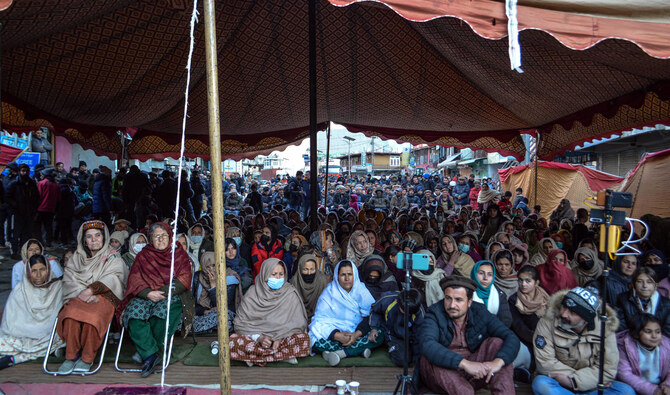
KHAPLU: Hundreds of people blocked a highway on Tuesday in Pakistan’s mountainous northern region in protest against power outages lasting longer than 20 hours, as temperatures plunged to minus 15 degrees Celsius.
Routine load-shedding is widespread across fuel-deprived Pakistan, but residents of the mountainous, snow-covered regions in Gilgit-Baltistan endure prolonged blackouts.
“We have been facing the worst kind of power cuts, we get only one or two hours of electricity during the whole day,” Baba Jan, a political activist who organized the protest, told AFP.
Around 1,000 people have joined the demonstration in the picturesque valley of Hunza since Friday, blocking a section of the 1,300-kilometer (808-mile) Karakoram Highway and preventing dozens of freight trucks from crossing into China.
People in the region usually rely on wood to keep warm as both gas and fuel-operated generators are too expensive.
“People from all walks of life including the tourists are suffering in extremely cold weather due to the absence of electricity,” Zahoor Ali, another protest organizer told AFP.
The highway is part of the China-Pakistan Economic Corridor (CPEC) in which China has invested billions of dollars, connecting the northern border to the southern coastal city of Gwadar.
“The Karakoram Highway at Ali Abad in Hunza is completely blocked for traffic... business between Pakistan and China is suspended for days owing to the blockade,” local trader Javaid Hussain told AFP.
“For the smooth running of business between Pakistan and China, the government should take steps to end the power crisis in the region.”
Pressure on the electricity grid increases during peak winter and summer seasons, leading to planned load-shedding as the government grapples with an energy supply crisis, exacerbated by political instability and economic stagnation.
Owing to its remoteness, Gilgit-Baltistan is not connected to the national grid and fails to generate enough power from dozens of hydro plants while thermal plants have proven costly.
Kamal Khan, a senior government official in the region, told AFP by phone that negotiations were ongoing with the protesters, who have demanded that under-construction power projects be expedited and thermal generator plants activated.
“Their demands are genuine and we agreed to fulfil all of their demands except the running of thermal generators... because they are very expensive,” he said.
Public protests against rising electricity prices and load-shedding have increased over the years in the country.
Meanwhile, prices have soared to more than double their 2021 rate as the government attempts to comply with demands from the International Monetary Fund to raise revenue.


![]()

Hundreds protest power outages in Pakistan’s north for fifth consecutive day
Short Url
https://arab.news/bb85e
Hundreds protest power outages in Pakistan’s north for fifth consecutive day
- Routine load-shedding is widespread across fuel-deprived Pakistan, but residents of mountainous Gilgit-Baltistan region endure prolonged blackouts
- Senior government official in the region says negotiations are ongoing with the protesters, who demand under-construction power projects be expedited
Latest updates





© 2026 SAUDI RESEARCH & PUBLISHING COMPANY, All Rights Reserved And subject to Terms of Use Agreement.