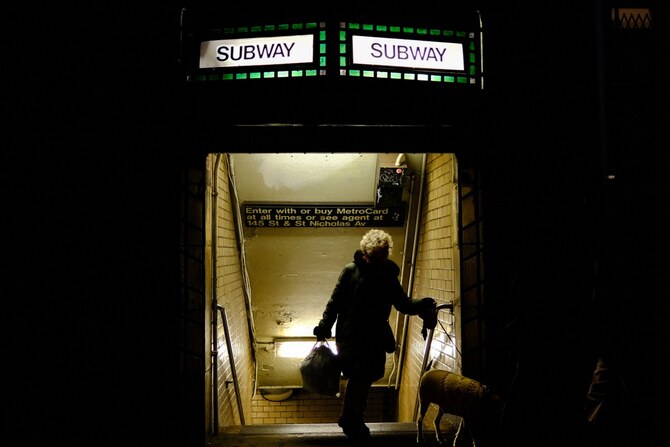
NEW YORK: The man accused of burning a sleeping woman to death inside a New York City subway train is set to be arraigned Tuesday on murder and arson charges.
Sebastian Zapeta, 33, will appear in Brooklyn court in connection with the killing of Debrina Kawam, 57.
Prosecutors say Zapeta lit the New Jersey native on fire on a stopped F train at Brooklyn’s Coney Island station on Dec. 22. Zapeta then fanned the flames with a shirt before sitting on platform bench and watching as Kawam burned, they allege.
Prosecutors say Zapeta confirmed to police he was the man in surveillance photos and videos of the fire but said he drinks a lot of alcohol and did not recall what happened.
Zapeta, a Guatemalan citizen who authorities say entered the country illegally after being deported in 2018, faces multiple counts of murder as well as an arson charge. The top charge carries a maximum sentence of life in prison without parole.
He was previously arraigned on a criminal complaint, but in New York, all felony cases require a grand jury indictment to proceed to trial unless a defendant waives that requirement.
Prosecutors with Brooklyn District Attorney Eric Gonzalez’s office announced Zapeta had been indicted in late December.
Zapeta’s lawyer didn’t respond to an email seeking comment Monday evening.
The killing has renewed discussion about safety in the nation’s largest mass transit system even as crime in the subway remains relatively rare.
Transit crime is down for the second straight year, with a 5.4 percent drop last year compared to 2023, according to data released by police Monday, which also showed a 3 percent overall drop in major crimes citywide.
Still, New York City Police Commissioner Jessica Tisch said in a Monday news conference discussing the statistics that riders simply “don’t feel safe.”
In response, she said the department will surge more than 200 officers onto subway trains and deploy more officers onto subway platforms in the 50 highest-crime stations in the city.
“We know that 78 percent of transit crime occurs on trains and on platforms, and that is quite obviously where our officers need to be,” Tisch said. “This is just the beginning.”

Man accused of burning woman to death on a New York City subway train is set to be arraigned
https://arab.news/2u3wt
Man accused of burning woman to death on a New York City subway train is set to be arraigned
- Prosecutors say Zapeta lit the New Jersey native on fire on a stopped F train at Brooklyn’s Coney Island station on Dec. 22. Zapeta then fanned the flames
- The killing has renewed discussion about safety in the nation’s largest mass transit system even as crime in the subway remains relatively rare
Bangladesh halts controversial relocation of Rohingya refugees to remote island
- Administration of ousted PM Sheikh Hasina spent about $350m on the project
- Rohingya refuse to move to island and 10,000 have fled, top refugee official says
DHAKA: When Bangladesh launched a multi-million-dollar project to relocate Rohingya refugees to a remote island, it promised a better life. Five years on, the controversial plan has stalled, as authorities find it is unsustainable and refugees flee back to overcrowded mainland camps.
The Bhasan Char island emerged naturally from river sediments some 20 years ago. It lies in the Bay of Bengal, over 60 km from Bangladesh’s mainland.
Never inhabited, the 40 sq. km area was developed to accommodate 100,000 Rohingya refugees from the cramped camps of the coastal Cox’s Bazar district.
Relocation to the island started in early December 2020, despite protests from the UN and humanitarian organizations, which warned that it was vulnerable to cyclones and flooding, and that its isolation restricted access to emergency services.
Over 1,600 people were then moved to Bhasan Char by the Bangladesh Navy, followed by another 1,800 the same month. During 25 such transfers, more than 38,000 refugees were resettled on the island by October 2024.
The relocation project was spearheaded by the government of former Prime Minister Sheikh Hasina, who was ousted last year. The new administration has since suspended it indefinitely.
“The Bangladesh government will not conduct any further relocation of the Rohingya to Bhasan Char island. The main reason is that the country’s present government considers the project not viable,” Mizanur Rahman, refugee relief and repatriation commissioner in Cox’s Bazar, told Arab News on Sunday.
The government’s decision was prompted by data from UN agencies, which showed that operations on Bhasan Char involved 30 percent higher costs compared with the mainland camps in Cox’s Bazar, Rahman said.
“On the other hand, the Rohingya are not voluntarily coming forward for relocation to the island. Many of those previously relocated have fled ... Around 29,000 are currently living on the island, while about 10,000 have returned to Cox’s Bazar on their own.”
A mostly Muslim ethnic minority, the Rohingya have lived for centuries in Myanmar’s western Rakhine state but were stripped of their citizenship in the 1980s and have faced systemic persecution ever since.
In 2017 alone, some 750,000 of them crossed to neighboring Bangladesh, fleeing a deadly crackdown by Myanmar’s military. Today, about 1.3 million of them shelter in 33 camps in the coastal Cox’s Bazar district, making it the world’s largest refugee settlement.
Bhasan Char, where the Bangladeshi government spent an estimated $350 million to construct concrete residential buildings, cyclone shelters, roads, freshwater systems, and other infrastructure, offered better living conditions than the squalid camps.
But there was no regular transport service to the island, its inhabitants were not allowed to travel freely, and livelihood opportunities were few and dependent on aid coming from the mainland.
Rahman said: “Considering all aspects, we can say that Rohingya relocation to Bhasan Char is currently halted. Following the fall of Sheikh Hasina’s regime, only one batch of Rohingya was relocated to the island.
“The relocation was conducted with government funding, but the government is no longer allowing any funds for this purpose.”
“The Bangladeshi government has spent around $350 million on it from its own funds ... It seems the project has not turned out to be successful.”


