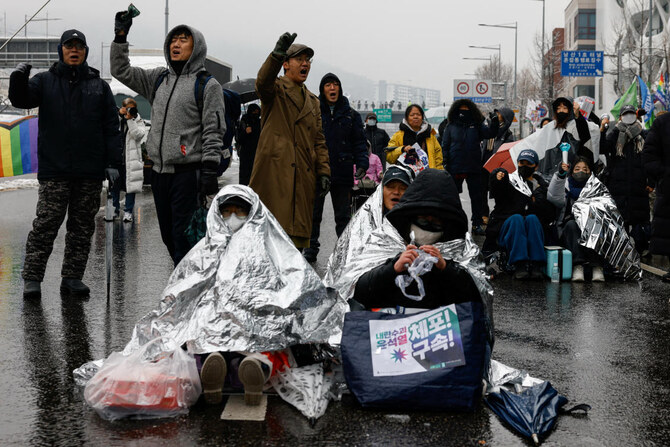
SEOUL: Hundreds of South Koreans, bundled up against freezing temperatures and snow, rallied overnight into Sunday near the residence of impeached President Yoon Suk Yeol, calling for his ouster and arrest, as authorities prepared to renew their efforts to detain him over his short-lived martial law decree.
Dozens of anti-corruption agency investigators and police attempted to execute a detainment warrant against Yoon on Friday but retreated from his residence in Seoul after a tense standoff with the presidential security service that lasted more than five hours.
The one-week warrant for his detention is valid through Monday. There were no immediate indications that anti-corruption authorities were ready to send investigators back to the residence as of Sunday afternoon. Staff from the presidential security service were seen installing barbed wire near the gate and along the hills leading up to Yoon’s residence over the weekend, possibly in preparation for another detention attempt.
A Seoul court last Tuesday issued a warrant to detain Yoon and a separate warrant to search his residence after the embattled president repeatedly defied authorities by refusing to appear for questioning and obstructing searches of his office. But enforcing them is complicated as long as Yoon remains in his official residence.
Investigators from the country’s anti-corruption agency are weighing charges of rebellion after the conservative president, apparently frustrated that his policies were blocked by a legislature dominated by the liberal opposition, declared martial law on Dec. 3 and dispatched troops to surround the National Assembly.
The Assembly overturned the declaration within hours in a unanimous vote and impeached Yoon on Dec. 14, accusing him of rebellion, while South Korean anti-corruption authorities and public prosecutors opened separate investigations into the events.
If the anti-corruption agency manages to detain Yoon, it will likely ask a court for permission to make a formal arrest. Otherwise, Yoon will be released after 48 hours.
The Corruption Investigation for High-Ranking Officials, which is leading a joint investigation with police and military investigators, says detaining Yoon would be “virtually impossible” as long as he is protected by the presidential security service. The agency has urged the country’s acting leader, Deputy Prime Minister Choi Sang-mok, to instruct the service to comply with their execution of the detainment warrant, but Choi has yet to publicly comment on the issue.
The chiefs and deputy chiefs of the presidential security service defied summonses on Saturday from police, who planned to question them over the suspected obstruction of official duty following Friday’s events.
Hundreds of anti-Yoon protesters rallied for hours near the gates of the presidential residence from Saturday evening to Sunday, voicing frustration over the failed detention attempt and demanding stronger efforts to bring Yoon into custody. Separated by police barricades and buses, pro-Yoon protesters were gathering in nearby streets, denouncing his impeachment and vowing to block any efforts to detain him.
Yoon’s lawyers have challenged the detention and search warrants against the president, saying they cannot be enforced at his residence due to a law that protects locations potentially linked to military secrets from search without the consent of the person in charge — which would be Yoon. They also argue the anti-corruption office lacks the legal authority to investigate rebellion charges and that police officers don’t have the legal authority to assist in detaining Yoon.
While the presidential security act mandates protection for Yoon, it does not authorize the presidential security service to block court-ordered detainments. The service’s attempts to block the execution of the warrant may amount to an obstruction of official duty, according to Park Sung-bae, an attorney specializing in criminal law. While the president mostly has immunity from prosecution while in office, the protection does not extend to allegations of rebellion or treason.
The agency said its outnumbered investigators had several scuffles with presidential security forces that threatened their safety and expressed “serious regret” that Yoon was not complying with the legal process.
After getting around a military unit guarding the residence’s grounds, the agency’s investigators and police were able to approach within 200 meters (yards) of Yoon’s residential building but were stopped by a barricade comprising around 10 vehicles and approximately 200 members of the presidential security forces and troops. The agency said it wasn’t able to visually confirm whether Yoon was inside the residence.
The Defense Ministry says the troops at Yoon’s official residence are under the control of the presidential security service. Kim Seon-ho, the acting defense minister, conveyed his concern to the presidential security service, saying that deploying military personnel to block the execution of the detention warrant would be “inappropriate” and requesting that the troops aren’t placed in a position where they might confront police, according to the ministry.
Yoon’s defense minister, police chief and several top military commanders have already been arrested over their roles in the period of martial law.
Yoon’s presidential powers have been suspended since the National Assembly voted to impeach him on Dec. 14. Yoon’s fate now lies with the Constitutional Court, which has begun deliberations on whether to uphold the impeachment and formally remove Yoon from office or reinstate him.


![]()

South Korean protesters brave cold to demand Yoon Suk Yeol’s ouster as detention deadline looms
Short Url
https://arab.news/4bdte
South Korean protesters brave cold to demand Yoon Suk Yeol’s ouster as detention deadline looms
- Dozens of anti-corruption agency investigators and police attempted to execute a detainment warrant against Yoon on Friday
- But there was tense standoff with the presidential security service that lasted more than five hours


Latest updates





© 2026 SAUDI RESEARCH & PUBLISHING COMPANY, All Rights Reserved And subject to Terms of Use Agreement.