

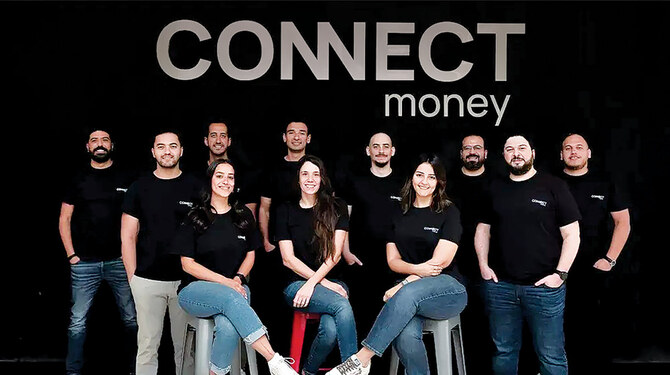

RIYADH: Saudi Arabia’s fintech growth has grabbed the attention of Egypt’s Connect Money as the company commences its expansion plan.
Founded this year by Ayman Essawy, Marwan Kenawy, and Momtaz Moussa, Connect Money provides a white-label card issuing platform that allows businesses to offer debit and credit cards to their customers without building fintech infrastructure or securing regulatory licenses.
In an interview with Arab News, Essawy, the company’s CEO, stated that Connect Money is officially planning to enter the Saudi market by mid-year 2025 and will then aim to expand to Morocco.
“We see a very big opportunity toward expansion, especially in Saudi Arabia and Morocco. Saudi Arabia is one of the hot topics in the region and fintech is growing significantly,” he said.
“We have strong connections with the whole Saudi ecosystem, and we have built a good relationship with the regulators and leading financial providers there and partner banks,” he added.
“We found that there is a need for our services to further accelerate fintech growth in Saudi Arabia,” Essawy claimed.
The CEO further said that once the expansion to Saudi Arabia begins, 80 to 90 percent of the company’s focus will be dedicated toward the Kingdom.
“We have spent the last 10 years operating on the business-to-business side in our past ventures and we claim to have very good market understanding across different sectors,” he added.
He further claims that after operating in Saudi Arabia for seven years at his first venture, Dsquares, the founder was able to carefully identify the market gaps in the financial industry.
The CEO also takes pride in being a serial entrepreneur and the founder of Egypt’s largest coupon platform Lucky ONE.
A problem to solve
Essawy explained that the company solves three critical problems for any large enterprise planning to incorporate strong fintech solutions internally.
He cited “very long compliance and regulatory cycles” for these companies as an issue, adding: “These cycles occur because they do not have the capability to build an infrastructure since they already operate a core business be it telecom, logistics, and even oil and gas.”
The CEO went on to say: “Second is the very high cost of building the infrastructure, so first, it takes a very long time to get granted a license and second is that there’s a very high cost for building and operating this part of the business.”

We have spent the last 10 years operating on the business-to-business side in our past ventures and we claim to have very good market understanding across different sectors.
Ayman Essawy, Connect Money CEO
Thirdly, Essawy explained that these entities usually look for reasons to turn cash users into cashless, a value-added service that Connect Money provides.
When asked why companies would even pursue such a solution, Essawy replied: “It’s one of two things. First, operational efficiencies, so turning cash cycles, which is very expensive in terms of efficiency and makes the business operational cycle much longer, cost of actually collecting cash or disbursing cash is already high. “So, turning this operational role or operational service into a cashless service, and that happens through issuing white-label cards.”
He added: “Second is generating new revenue streams. These come from banking services such as transactions, credit, providing credit to businesses, basically financing with businesses and so on.”
Essawy further said that the solution provided by Connect Money is basically putting all these services into a “one-stop shop” for embedded finance.
“This shop comes from getting the right approvals from regulators, issuing white-label cards, and providing a full managed service on top of that, as if I’m creating your small bank for your company,” he said.
The CEO cited the ride-hailing giant Uber as an example, stating that the solution would give the global company a small bank for its drivers to manage, open, and issue cards as well as create accounts and put incentives.
“This solution would be completely managed by Connect Money, yet the client has full ownership of the service,” he added. “Basically, as a company, you own the customers, you own the operations, and you own everything legally, but Connect Money is managing them on your behalf,” he explained.
The company has already incorporated itself into the Kingdom’s market and will soon announce the hiring of its Saudi-based founding member to lead the local office.
Business fundamentals
Connect Money has already seen significant traction in Egypt, landing eight contracts in under a year of operation. The company also has a 10-week go-to-market plan to onboard clients.
Essawy also stated that the company is currently the sole provider of such services in the region, but the founder also expects competition to increase as the market scales.
The founder explained that Saudi Arabia holds a different market segmentation, and that there is a misconception that the nation only consists of high-value customers.
“There is a lot to be tackled in the mid layers with the hyper growth that is taking place in the Kingdom,” he added.
“We believe that there is a significant opportunity for new segments and new mid-sized businesses that would require our services. We still believe that there is still a big gap between cash and cashless transactions which we aim to bridge,” he added.
He further emphasized that the market dynamics are almost completely different from Egypt.
Essawy also shared his view on the growing number of Egyptian companies expanding to Saudi Arabia, saying: “I’ve seen many companies expand to Saudi Arabia as a first choice and I don’t think this is a wise decision.”
He added: “I think each business model is dependent on what’s the end goal and where you can scale. In Saudi Arabia, you’ll find business but you’ll also find an expensive working environment.”
He further advises any company expanding to Saudi Arabia to reexamine their margins and growth pace before taking that step.


