Pakistan PM calls SMEs ‘backbone’ of national economy, seeks steps for their global integration

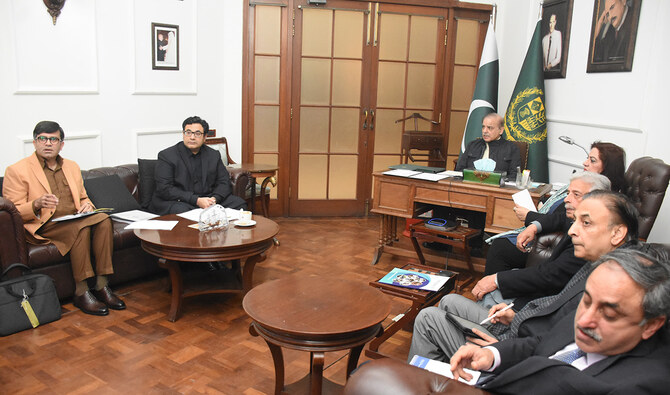
Pakistan Prime Minister Shehbaz Sharif chairs a meeting on promotion of Small and Medium Enterprises in Pakistan, in Lahore on January 4, 2025. (Photo courtesy: PMO)
Short Url
Updated 04 January 2025
Follow

Pakistan PM calls SMEs ‘backbone’ of national economy, seeks steps for their global integration

  • The government has initiated the process of hiring experts for the development of the SME sector
  • State Bank of Pakistan has also directed banks to simplify the loan application process for SMEs

ISLAMABAD: Prime Minister Shehbaz Sharif on Saturday described Pakistan’s small and medium enterprises (SMEs) as the backbone of national economy, issuing directives to take necessary measures to integrate them into the global supply chain, according to a statement from his office.
Pakistan has been striving to attract foreign investment as it recovers from a prolonged economic crisis characterized by a tough balance of payments situation, dwindling foreign currency reserves and a depreciating national currency.
While the government has signed various agreements with close allies and sought to promote business-to-business partnerships to drive growth, Sharif recently noted that foreign investment would remain elusive without first strengthening domestic investment.
“Small and medium enterprises are the backbone of the economy,” he said while presiding over a meeting in Lahore to evaluate the SME sector, according to the statement. “Comprehensive steps are needed to make Pakistani industries a part of the global supply chain.”
The prime minister received a detailed briefing on the operations of the Small and Medium Enterprise Development Authority (SMEDA) and was told its board of directors had been constituted and had started holding regular meetings.
“The process of hiring international-standard experts for the development of the SME sector has been initiated,” the official statement said.
“The State Bank of Pakistan has also instructed banks to simplify and streamline the loan application forms for SMEs,” it added.
The meeting was also informed that authorities were in the process of gathering data on SMEs across Pakistan to enable informed decision-making for the sector.


Pakistan begins talks with Saudi delegation on local vaccine manufacturing

Updated 7 sec ago
Follow

Pakistan begins talks with Saudi delegation on local vaccine manufacturing

  • Health ministry has warned vaccine import costs could rise from $400 million to $1.2 billion by 2031
  • Local vaccine manufacturing would strengthen health security and help conserve foreign exchange 

ISLAMABAD: Pakistan on Tuesday formally began discussions with a high-level Saudi delegation on establishing local vaccine manufacturing, as Islamabad seeks to reduce import dependence and prepare for the eventual end of international funding support for its national immunization program.

The talks come amid Pakistan’s broader push to strengthen health security and industrial capacity. The country of more than 240 million people currently imports all vaccines used in its national immunization campaigns, relying heavily on international partners to help cover costs.

Officials say local vaccine manufacturing would not only strengthen health security but also help conserve foreign exchange and support Pakistan’s longer-term economic stability as the country looks to cut costly imports and build export-oriented industrial capacity.

According to the Ministry of National Health Services, the eleven-member Saudi delegation is led by Nizar Al-Hariri, senior adviser to Saudi Arabia’s minister of industry, and is visiting Pakistan as part of efforts to deepen bilateral cooperation in health, pharmaceutical manufacturing and industrial collaboration.

“Practical progress is being made toward the local production of vaccines for 13 diseases in Pakistan,” the health ministry said in a statement, quoting Federal Health Minister Syed Mustafa Kamal who met the delegation in Islamabad.

Pakistani officials presented detailed briefings on current vaccine demand, existing infrastructure and production capacity.

“Collaboration between Pakistan and Saudi Arabia in the health sector will set an example for the entire region,” the ministry said.

Kamal told the visiting delegation Pakistan is the world’s fifth most populous country, with around 6.2 million children born each year, adding that the country’s annual population growth is roughly equivalent to the population of New Zealand. 

He said the government currently provides vaccines for 13 diseases free of cost but does not manufacture any of them domestically, forcing Pakistan to import vaccines at an annual cost of about $400 million.

According to the ministry, international partners currently cover 49 percent of those costs, with the remainder borne by the Pakistani government. However, Kamal warned that this external support is expected to end after 2031.

“If vaccines are not manufactured locally, the annual cost could rise to $1.2 billion by 2031, which would place a heavy burden on the national economy,” the ministry quoted him as saying.

Pakistan regularly conducts nationwide immunization campaigns against diseases including polio, measles, rubella and hepatitis. This week, it launched a seven-day polio vaccination drive aimed at inoculating more than 45 million children.