Pakistan Naval Academy graduates cadets, including officers from Iraq and Sri Lanka

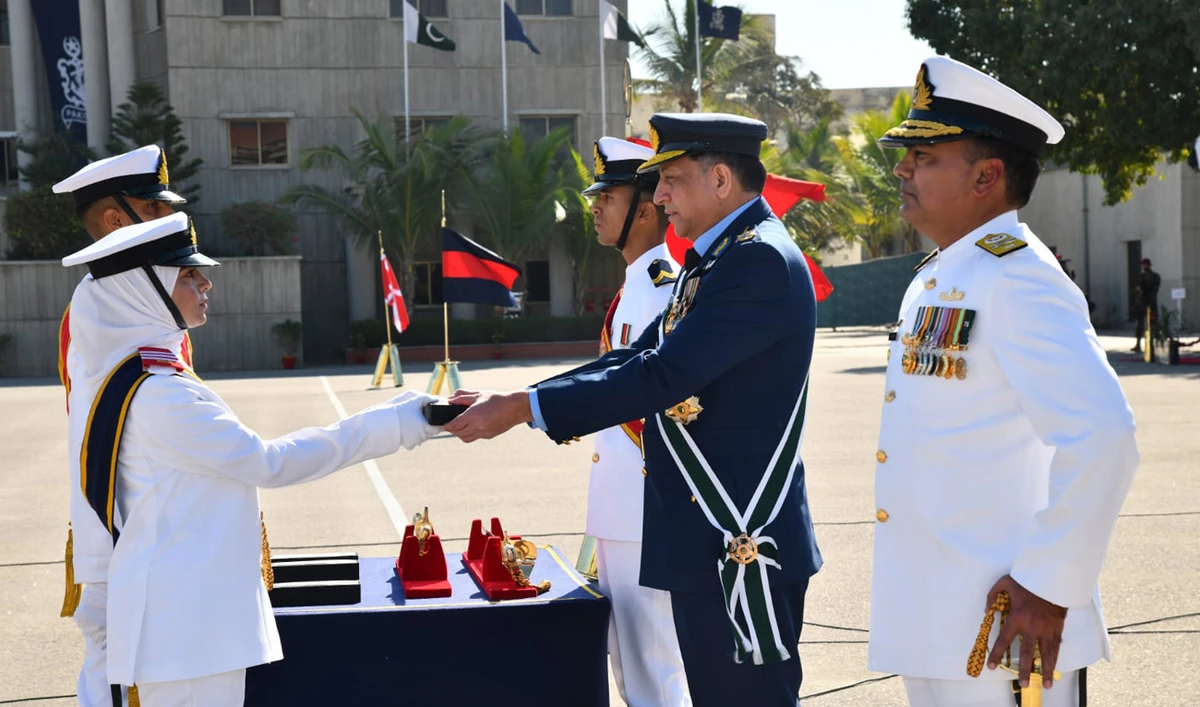
In this handout photo, released by Pakistan Navy on January 4, 2025, Chief of the Air Staff, Air Chief Marshal Zaheer Ahmed Baber Sidhu, awards Commandant Gold Medal to the best SSC cadet during the 122 Midshipmen and 30th SSC Commissioning Parade at the Pakistan Naval Academy in Karachi. (Photo courtesy: Pakistan Navy)
Short Url
Updated 04 January 2025
Follow

Pakistan Naval Academy graduates cadets, including officers from Iraq and Sri Lanka

  • Pakistan’s air chief witnessed the parade, asking future leaders to stay updated with modern technologies
  • The Pakistan military regularly trains officers and cadets of allied nations, particularly from the Gulf region

KARACHI: The Pakistan Naval Academy held a commissioning parade on Saturday to mark the graduation of 49 midshipmen and 29 short-service commissioning cadets, including officers from Iraq, Sri Lanka and other countries, according to a statement from the Pakistan Navy.
The Pakistan military regularly trains officers and cadets of allied nations, particularly from the Gulf region. The parade’s chief guest, Air Chief Marshal Zaheer Ahmed Baber Sidhu, was invited to the received by Pakistan’s top naval official Admiral Naveed Ashraf before witnessing the ceremony.
He extended congratulations to the newly commissioned officers and their parents, while specifically addressing foreign cadets and officials.
“He [the air chief] commended Pakistan Naval Academy for imparting high-quality training to cadets, including those from friendly countries,” the official statement said. “He expressed the hope that these cadets from friendly nations will serve as ambassadors, strengthening bonds of friendship and mutual respect.”
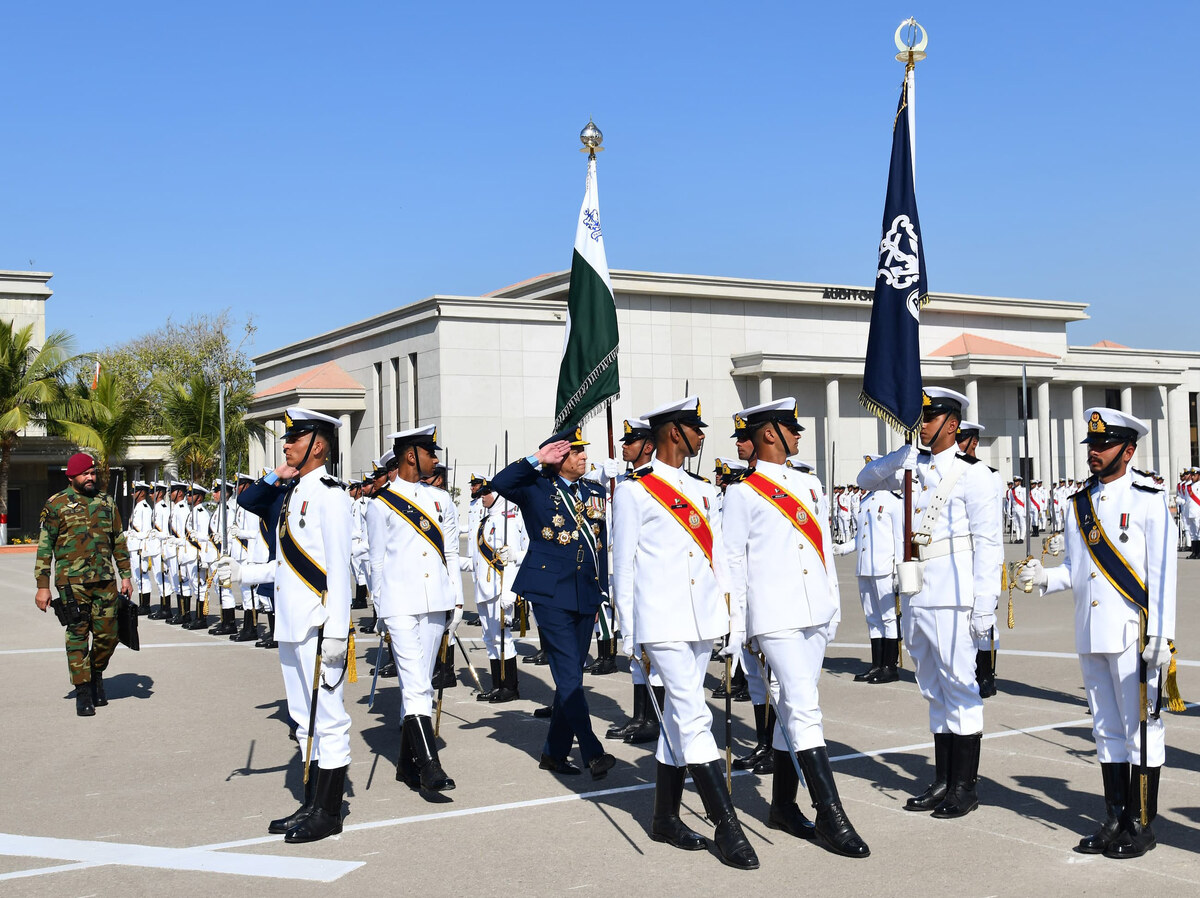


In this handout photo, released by Pakistan Navy on January 4, 2025, Chief of the Air Staff, Air Chief Marshal Zaheer Ahmed Baber Sidhu, reviews parade during the 122 Midshipmen and 30th SSC Commissioning Parade at the Pakistan Naval Academy in Karachi. (Photo courtesy: Pakistan Navy)

The air chief emphasized the need for future leaders to stay updated with modern technologies and the evolving geo-strategic landscape.
“In today’s high-tech and information-driven era, only knowledgeable leaders can effectively address emerging challenges,” he told the commissioning term.
Awards were presented to distinction holders, highlighting the diverse achievements of the graduates.
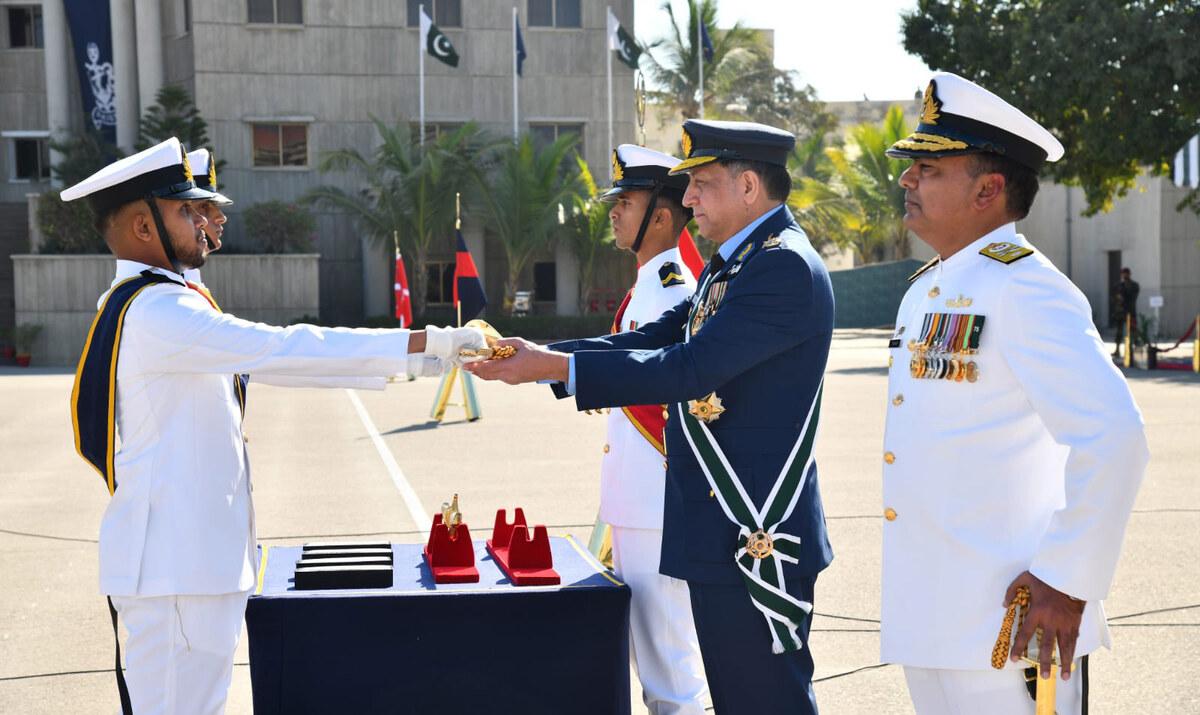


In this handout photo, released by Pakistan Navy on January 4, 2025, Chief of the Air Staff, Air Chief Marshal Zaheer Ahmed Baber Sidhu, awards Sword of Honor to the best midshipman, Sri Lanka’s Tennakoon M. L. Vimutkhi, during the 122 Midshipmen and 30th SSC Commissioning Parade at the Pakistan Naval Academy in Karachi. (Photo courtesy: Pakistan Navy)

The prestigious Sword of Honor went to Midshipman Tennakoon M.L. Vimukthi from Sri Lanka for his exceptional performance. Officer Cadet Ali Jalil Ibrahim Sharif Shuhaib Al Shabani from Iraq was awarded the Chief of the Naval Staff Gold Medal, while the Quaid-i-Azam Gold Medal was awarded to Lt. Muhammad Imad Ud Din for being the best all-round officer.
The Pakistan Naval Academy has long served as a hub for professional and academic training, equipping cadets with skills to meet modern maritime challenges.
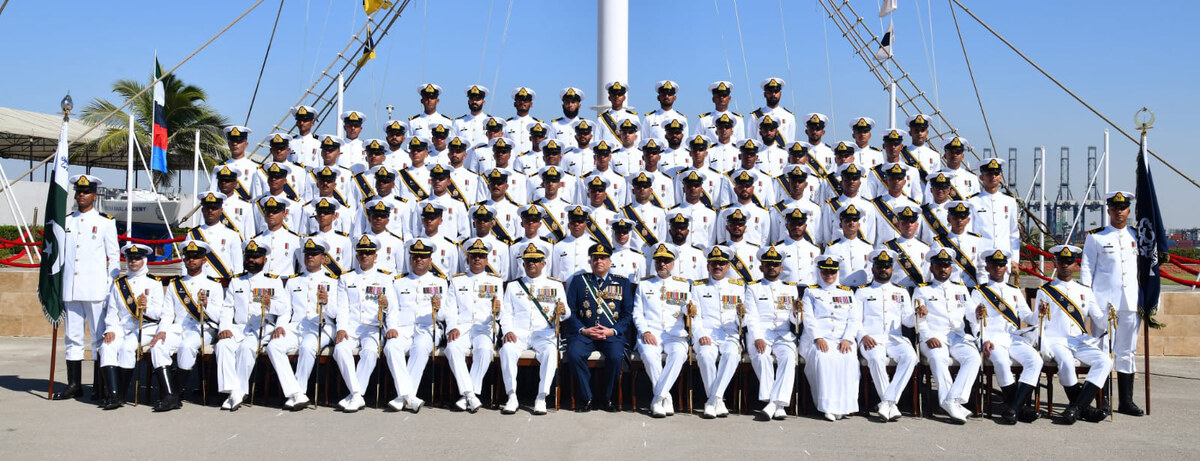


In this handout photo, released by Pakistan Navy on January 4, 2025, Chief of the Air Staff, Air Chief Marshal Zaheer Ahmed Baber Sidhu, gestures for a group photograph with graduating cadets during the 122 Midshipmen and 30th SSC Commissioning Parade at the Pakistan Naval Academy in Karachi. (Photo courtesy: Pakistan Navy)

Its programs also help foster international cooperation, as displayed by the diverse nationalities of its graduates this year.

Pakistan’s OGDC ramps up unconventional gas plans

Updated 4 sec ago
Follow

Pakistan’s OGDC ramps up unconventional gas plans

  • Pakistan has long been viewed as having potential in tight and shale gas but commercial output has yet to be proved
  • OGDC says has tripled tight-gas study area to 4,500 square km after new seismic, reservoir analysis indicates potential

ISLAMABAD: Pakistan’s state-run Oil & Gas Development Company is planning a major expansion of unconventional gas developments from early next year, aiming to boost production and reduce reliance on imported liquefied natural gas.

Pakistan has long been viewed as having potential in both tight and shale gas, which are trapped in rock and can only be released with specialized drilling, but commercial output has yet to be proved.

Managing Director Ahmed Lak told Reuters that OGDC had tripled its tight-gas study area to 4,500 square kilometers (1,737 square miles) after new seismic and reservoir analysis indicated larger potential. Phase two of a technical evaluation will finish by end-January, followed by full development plans.

The renewed push comes after US President Donald Trump said Pakistan held “massive” oil reserves in July, a statement analysts said lacked credible geological evidence, but which prompted Islamabad to underscore that it is pursuing its own efforts to unlock unconventional resources.

“We started with 85 wells, but the footprint has expanded massively,” Lak said, adding that OGDC’s next five-year plan would look “drastically different.”

Early results point to a “significant” resource across parts of Sindh and Balochistan, where multiple reservoirs show tight-gas characteristics, he said.

SHALE PILOT RAMPS UP

OGDC is also fast-tracking its shale program, shifting from a single test well to a five- to six-well plan in 2026–27, with expected flows of 3–4 million standard cubic feet per day (mmcfd) per well.

If successful, the development could scale to hundreds or even more than 1,000 wells, Lak said.

He said shale alone could eventually add 600 mmcfd to 1 billion standard cubic feet per day of incremental supply, though partners would be needed if the pilot proves viable.

The company is open to partners “on a reciprocal basis,” potentially exchanging acreage abroad for participation in Pakistan, he said.

A 2015 US Energy Information Administration study estimated Pakistan had 9.1 billion barrels of technically recoverable shale oil, the largest such resource outside China and the United States.

A 2022 assessment found parts of the Indus Basin geologically comparable to North American shale plays, though analysts say commercial viability still hinges on better geomechanical data, expanded fracking capacity and water availability.

OGDC plans to begin drilling a deep-water offshore well in the Indus Basin, known as the Deepal prospect, in the fourth quarter of 2026, Lak said. In October, Turkiye’s TPAO with PPL and its consortium partners, including OGDC, were awarded a block for offshore exploration.

A combination of weak gas demand, rising solar uptake and a rigid LNG import schedule has created a surplus of gas that forced OGDC to curb output and pushed Pakistan to divert cargoes from Italy’s ENI and seek revised terms with Qatar.