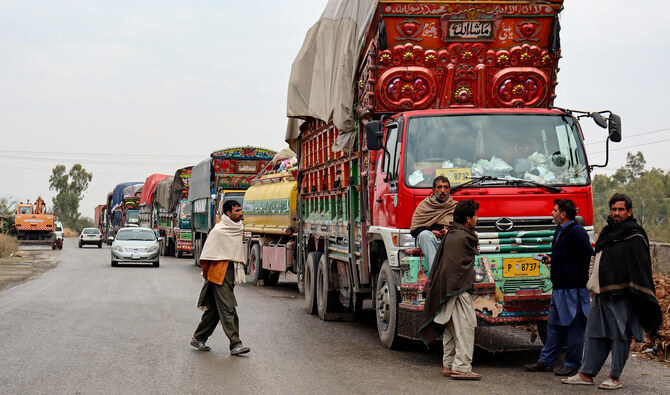
ISLAMABAD: Five people, including a top administration official, were injured after unidentified gunmen opened fire on an aid convoy en route to a restive Pakistani district that has been hit by sectarian clashes in recent weeks, officials said on Saturday.
Kurram, a northwestern district of around 600,000 people in the Khyber Pakhtunkhwa province, has been rocked by tribal and sectarian clashes since Nov. 21 when gunmen attacked a convoy of Shia passengers, killing 52.
The attack sparked further violence and blockade of a main road connecting Kurram’s main town of Parachinar with the provincial capital of Peshawar, causing medicine, food and fuel shortages in the area, as casualties surged to 136.
Saturday’s gun attack occurred near Bagan, a tense locality in the district’s center, as Deputy Commissioner (DC) Javedullah Mehsud and other officials led an aid convoy to Kurram, leaving the top officials and four security men injured.
“The deputy commissioner has been shifted from Alizai Hospital to Tal CMH [Combined Military Hospital],” said Muhammad Ali Saif, a spokesman for the KP provincial government.
“The deputy commissioner’s surgery is ongoing, but his condition is out of danger.”
Kurram police spokesman Riaz Khan told Arab News the attack injured DC Mehsud, his police guard and three members of the Frontier Corps (FC) paramilitary force.
“The deputy commissioner suffered gunshot injuries to his legs and shoulder,” the police official said.
Mehsud was leading the convoy of 17 trucks, which were carrying tents, blankets, medical kits, tarpaulins, solar lamps and sleeping bags.
“The convoy has been temporarily stopped,” Saif said. “The clearance process is ongoing, and the convoy will be sent to Kurram soon.”
Provincial authorities have previously air-dropped relief goods and airlifted ailing and injured people from Kurram to Peshawar via helicopters.
Saturday’s gun attack comes days after a grand jirga, or council of political and tribal elders formed by the KP provincial government, brokered a peace agreement between the warring Shia and Sunni tribes, following weeks of efforts.
Under the peace agreement signed on Wednesday, both sides had agreed on the demolition of bunkers and the handover of heavy weapons to the authorities within two weeks, but the attack on the aid convoy has once again cast a cloud on peace in the restive district.
“The situation is under control and security is on high alert. The government will restore peace in the region at all costs,” Saif said, urging both Sunni and Shia sides to remain peaceful and not fall prey to the “conspiracy.”
According to the peace agreement, any party that launches an attack after the signing of the deal will be considered a “terrorist” and action will be taken against it. Another point of the agreement says that a fine of Rs10 million ($35,933) will be imposed on those who would violate the terms of the deal by using weapons against each other.
Land disputes in the volatile district will be settled on a priority basis with the cooperation of local tribes and the district administration, according to the peace agreement. Opening of banned outfits’ offices will be prohibited in the district, while social media accounts spreading hate will be discouraged via collective efforts backed by the government.
Prime Minister Shehbaz Sharif and KP Chief Minister Ali Amin Gandapur condemned the shooting incident near Bagan.
“The incident is a deliberate and nefarious but unsuccessful attempt to sabotage peace efforts,” CM Gandapur was quoted as saying by his office.
“The provincial government, with the cooperation of the area elders, will continue its efforts until complete peace is restored in the area.”


![]()

Five injured in shooting at aid convoy en route to violence-hit Pakistani district
Short Url
https://arab.news/5ghhg
Five injured in shooting at aid convoy en route to violence-hit Pakistani district
- More than 130 people have died in the remote district since Nov. 21 in clashes over land, sectarian disputes
- The clashes have disconnected Kurram from the provincial capital, causing medicine, food and fuel shortages
Latest updates




© 2026 SAUDI RESEARCH & PUBLISHING COMPANY, All Rights Reserved And subject to Terms of Use Agreement.