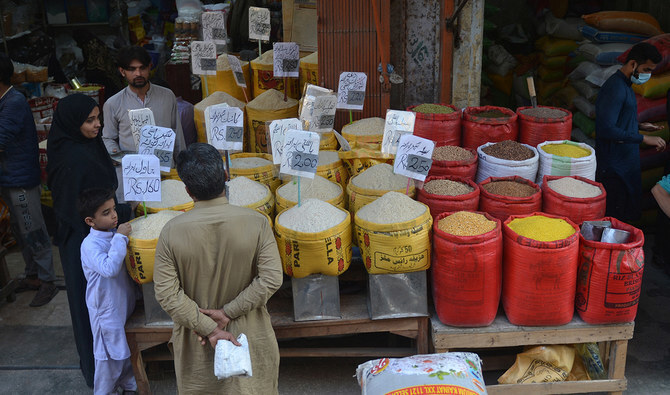
ISLAMABAD: Short-term inflation, measured by the Sensitive Price Index (SPI), has witnessed a slight decrease in Pakistan, the country’s statistics bureau said this week, after increasing for three weeks in a row.
The SPI, which comprises 51 essential items collected from 50 markets in 17 cities, is computed on a weekly basis to assess the price movement of essential commodities at a shorter interval of time to review the price situation in the country.
The SPI for the week ending on Jan. 2 decreased 0.26 percent on a week-on-week basis, according to the Pakistan Bureau of Statistics (PBS). Weekly inflation last decreased by 0.34 percent in Pakistan in the week ending on Dec. 5.
“During the week, out of 51 items, prices of 18 (35.29 percent) items increased, 10 (19.61 percent) items decreased and 23 (45.10 percent) items remained stable,” the PBS said in its report.
Major decrease was observed in the prices of tomatoes (13.48 percent), electricity charges for Q1 (7.48 percent), potatoes (5.59 percent), eggs (0.23 percent), garlic (0.21 percent), liquefied petroleum gas (0.18 percent) and wheat flour (0.09 percent).
The items whose prices increased during the week included chicken (10.28 percent), onions (4.93 percent), bananas (1.68 percent), diesel (1.18 percent), sugar (0.95 percent), jaggery (0.58 percent), vegetable ghee 2.5 Kg (0.53 percent) and petrol (0.21 percent).
Pakistan’s annual consumer inflation eased further to 4.1 percent in Dec. 2024, according to the PBS. Consumer inflation cooled from 4.9 percent in November, a sharp drop from a multi-decade high of nearly 40 percent in May 2023.


![]()

Pakistan weekly inflation records slight decrease after rising for three consecutive weeks
Short Url
https://arab.news/gkg7j
Pakistan weekly inflation records slight decrease after rising for three consecutive weeks
- Major decrease observed in prices of tomatoes, electricity, potatoes, eggs, liquefied petroleum gas and wheat flour
- Pakistan’s annual consumer inflation eased further to 4.1 percent in Dec. 2024, according to the country’s statistics bureau
Latest updates


Recommended


© 2026 SAUDI RESEARCH & PUBLISHING COMPANY, All Rights Reserved And subject to Terms of Use Agreement.