ISLAMABAD: Pakistan has condemned Israel’s “deliberate” targeting of hospitals, patients and wounded people in Gaza, and called for its accountability over attacks on health infrastructure and other crimes.
The statement came a week after Israeli forces burned Kamal Adwan Hospital in Gaza and forcefully removed patients and medical staff from the facility, hospital officials said.
In its campaign since Oct. 2023 attacks by Hamas, Israel’s military has targeted hospitals, schools and residential neighborhoods in Gaza, killing more than 45,000 people and forcing hundreds of thousands to migrate, according to Palestinian officials.
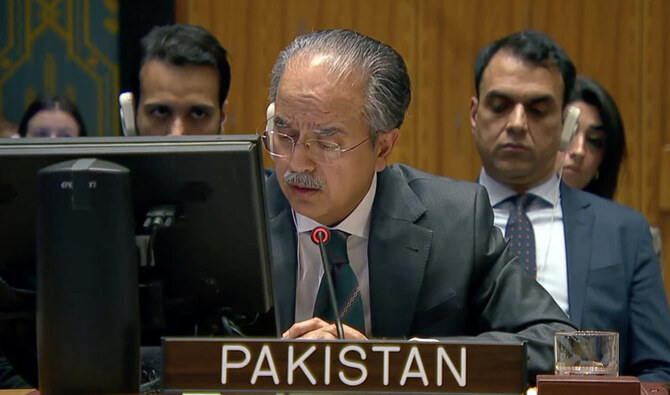
Ambassador Asim Iftikhar, Pakistan’s alternate permanent representative to the United Nations, called the destruction of Kamal Adwan Hospital, the last operational major facility in northern Gaza, an “atrocity that shocks the conscience of humanity.”
“The deliberate targeting of hospitals, medical personnel, patients and wounded defies every principle of [international] humanitarian law and has no justification whatsoever,” he told a UN Security Council session on the collapse of health services in besieged Gaza.
“Not just condemnation, there must be accountability for these crimes.”
Between Oct. 2023 and Jun. 2024, at least 136 strikes were carried out on 27 hospitals and 12 other medical facilities, according to the Pakistani diplomat. More than 500 health care workers lost their lives due to the Israeli military campaign in Gaza.
He said 22 of Gaza’s 38 hospitals were rendered non-functional by June 2024 that had left the health care system on “the verge of collapse,” calling for a “decisive action” for an immediate and unconditional ceasefire to halt bloodshed and destruction in Gaza and lifting of the enclave’s inhumane blockade to ensure the flow of food, medical supplies and humanitarian aid for those in “desperate need.”
Pakistan does not recognize nor have diplomatic relations with Israel and calls for an independent Palestinian state based on “internationally agreed parameters.”
The South Asian country has dispatched several relief consignments for Gaza, besides establishing the ‘Prime Minister’s Relief Fund’ that aims to collect public donations for the war-affected people.


![]()

Pakistan condemns Israel’s ‘deliberate’ targeting of Gaza hospitals, calls for accountability
Short Url
https://arab.news/w7g5e
Pakistan condemns Israel’s ‘deliberate’ targeting of Gaza hospitals, calls for accountability
- The statement comes a week after Israeli forces burned Kamal Adwan Hospital in Gaza, forcefully removing patients and staff
- Israel’s military campaign in Gaza has killed more than 45,000 people and forced hundreds of thousands to migrate since Oct. 2023
Latest updates



© 2026 SAUDI RESEARCH & PUBLISHING COMPANY, All Rights Reserved And subject to Terms of Use Agreement.