

Pakistan pledges support for occupied peoples as it joins Security Council as non-permanent member

Ambassador Asim Iftikhar (3L), Alternate Permanent Representative of Pakistan to the UN, joined the permanent representatives of Denmark, Greece, Somalia, and Panama for a group photo on the occasion of the flag installation ceremony at the Security Council stakeout in New York on January 2, 2024. (Photo courtesy: X/@PakistanUN_NY)
Short Url
Updated 03 January 2025
Follow

Pakistan pledges support for occupied peoples as it joins Security Council as non-permanent member

  • Senior Pakistani diplomat at the UN highlights the significance of multilateralism in tacking global challenges
  • Pakistan plans to actively pursue just solutions to issues on the council’s agenda, help with conflict prevention

ISLAMABAD: Pakistan reaffirmed its commitment to being a strong voice for people under foreign occupation as it raised its flag at the United Nations on Thursday, marking the beginning of its two-year term as a non-permanent member of the UN Security Council.
This is the eighth time Pakistan has secured a seat as a non-permanent UNSC member since joining the world body in 1947. The 15-member council comprises five permanent members — the United States, Russia, China, the United Kingdom and France — along with 10 non-permanent members elected for two-year terms.
Non-permanent members play a crucial role in shaping global discussions on peace and security and in influencing the drafting of resolutions.
“Pakistan will continue to be guided by the purposes and principles of the UN Charter, including maintenance of international peace and security and development of friendly relations among nations based on the principle of equal rights and self-determination,” Ambassador Asim Iftikhar, Pakistan’s Alternate Permanent Representative to the UN, said during the flag-raising ceremony.
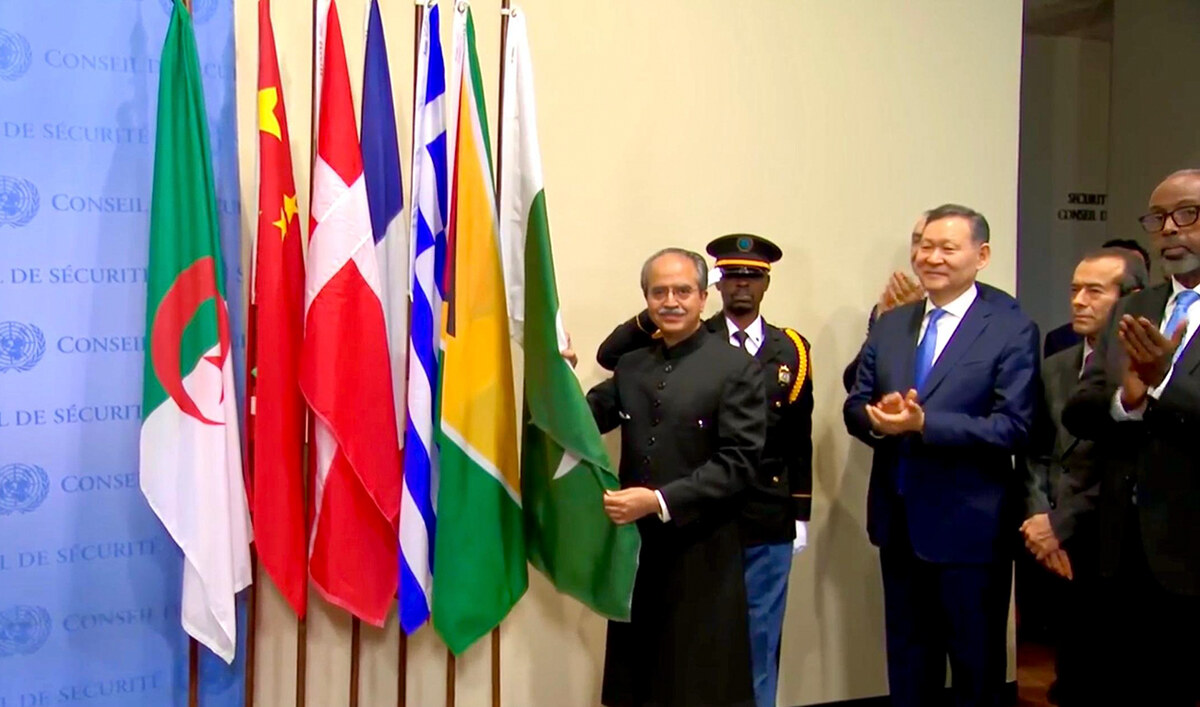


Ambassador Asim Iftikhar, Alternate Permanent Representative of Pakistan to the UN, installs Pakistani flag at the Security Council stakeout in New York on January 2, 2024. (Photo courtesy: X/@PakistanUN_NY)

“Pakistan will always remain a strong voice for peoples under foreign occupation and oppression for the realization of their right to self-determination,” he added.
Iftikhar said the flag ceremony symbolized democratic renewal through the periodic rotation of the UNSC membership, reinforcing the global aspiration for a Security Council that “is more effective, open and transparent, and accountable to the UN membership.”
He also highlighted the importance of multilateralism in tackling global challenges.
“We are convinced that cooperative multilateralism – with the UN at its core – is the best way of tackling the multifaceted challenges of today,” he said.


Ambassador Asim Iftikhar, Alternate Permanent Representative of Pakistan to the UN, speaks during the flag installation ceremony at the Security Council stakeout in New York on January 2, 2024. (Photo courtesy: X/@PakistanUN_NY)

The Pakistani diplomat called for addressing the root causes of conflicts, prioritizing dialogue and diplomacy and supporting confidence-building measures at regional and global levels to foster peace and stability.
He also pledged that his country will actively pursue just solutions to issues on the council’s agenda and to contribute to conflict prevention and peacekeeping efforts.
“Never forgetting our solemn duty toward the millions of men, women, and children suffering in conflicts, Pakistan is assuming this responsibility, fully resolved to our collective endeavor for a more peaceful and secure world,” he said.

Pakistan finance minister touts debt discipline, export focus at Davos panel

Updated 5 sec ago
Follow

Pakistan finance minister touts debt discipline, export focus at Davos panel

  • Aurangzeb says debt must fund exports, not consumption, for sustainable growth
  • He says Pakistan used fiscal buffers to respond to floods without external appeals

KARACHI: Pakistan’s Finance Minister Muhammad Aurangzeb said on Wednesday disciplined borrowing, export-led growth and careful debt management were central to stabilizing the country’s economy, as Islamabad looks to unlock new sources of growth amid rising global debt levels.

Speaking at a panel discussion on the sidelines of the World Economic Forum (WEF) in Davos, he said debt was not inherently harmful if used productively, but warned that emerging economies such as Pakistan could not afford to deploy borrowed funds for consumption.

“For countries like Pakistan, debt must be channeled into investments that generate exportable surplus,” Aurangzeb said, according to a statement circulated by the Finance Division. “It is not about the availability of debt or funding, but how wisely and effectively it is steered to create long-term economic value.”

Pakistan has been pursuing fiscal reforms as part of an International Monetary Fund-backed stabilization program, including cutting subsidies, broadening the tax base and restructuring state-owned enterprises, as the government seeks to restore macroeconomic stability and revive growth.

Aurangzeb said Pakistan had reduced its debt-to-GDP ratio to 70 percent from 75 percent, achieved a primary fiscal surplus and brought inflation down from a peak of 38 percent to single digits, allowing the central bank to cut its policy rate to 10.5 percent.

He also flagged ongoing debt-management reforms, including liability management operations and buybacks, and said Pakistan plans to enter China’s capital markets with its first Panda bond, structured as a green bond.

Addressing climate risks, Aurangzeb said building fiscal buffers had allowed Pakistan to respond to recent floods using domestic resources rather than international emergency appeals, underscoring the need for resilience in climate-vulnerable economies.

He added that public-private partnerships and capital markets were playing a growing role in financing development, citing a $3.6 billion syndicated financing for a major copper mining project expected to generate $2.8 billion in annual exports from 2028.

The finance minister is part of Pakistan’s delegation visiting Davos for the annual gathering of global leaders and investors.

The delegation is led by Prime Minister Shehbaz Sharif, who highlighted the country’s shift toward an export-driven growth model, with a focus on minerals, information technology, artificial intelligence and digital services, while speaking at a breakfast event on the sidelines of the forum.