ISLAMABAD: Prime Minister Shehbaz Sharif on Friday blamed external forces for the surge in militant violence in Pakistan, urging a unified approach involving federal and provincial authorities along with the military to tackle the crisis.
Pakistan’s northwestern Khyber Pakhtunkhwa and southwestern Balochistan provinces witnessed a spike in deadly militant attacks last year. Groups such as the Pakistani Taliban and other militant and separatist factions have targeted security convoys, checkpoints and carrying out daily killings and kidnappings of law enforcement personnel and government functionaries.
Officials in Islamabad have frequently accused Afghanistan of enabling “cross-border attacks,” a claim rejected by Kabul, which insists Pakistan’s security challenges are an internal matter.
Pakistan has also pointed fingers at India for stoking unrest in Balochistan, an allegation dismissed by New Delhi.
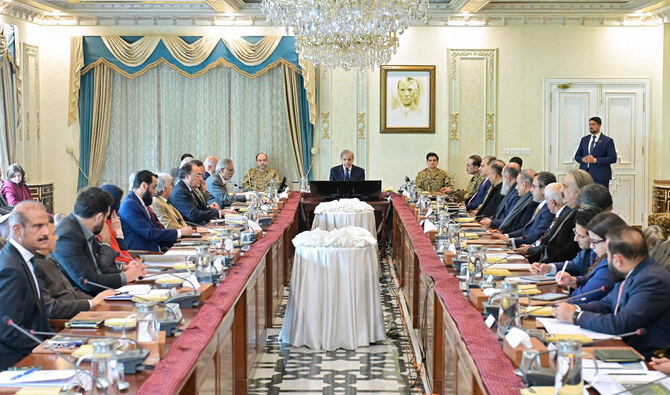
“In certain areas of Khyber Pakhtunkhwa and Balochistan, the conspiracies being woven against Pakistan involve an external hand,” Sharif said while addressing the apex committee meeting of the National Action Plan in the federal capital. “We are well aware of the countries providing assistance [to militant groups].”
The prime minister emphasized closer cooperation among the Pakistani authorities to defeat militancy.
“I would only request that if the provinces, along with the federation and the Pakistan Army, could make a plan,” he said. “I feel we have to discuss how to eliminate this [militant violence].”
Sharif stressed that Pakistan’s success in different domains depended on improved law and order and the complete elimination of militants.
“Unity of thought and action” among stakeholders, he noted, was essential to thwarting militant schemes aimed at destabilizing the country.
The meeting was attended by Army Chief Gen. Asim Munir, DG Inter-Services Intelligence Lt. Gen. Asim Malik, federal ministers and all provincial chief ministers.
Last month on December 27, military spokesman Lt. Gen. Ahmed Sharif Chaudhry reported that 925 militants were killed in 59,775 operations across the country in 2024, with the majority in Khyber Pakhtunkhwa and Balochistan.
Militant attacks have surged in Pakistan since November 2022, following the collapse of a fragile truce between Islamabad and the Tehreek-e-Taliban Pakistan (TTP).
Ethnic Baloch separatists are also engaged in a decades-long struggle for independence, accusing the central government of exploiting the province’s natural resources.


![]()

Pakistan PM blames ‘external hand’ for militant violence, urges coordinated action on security
Short Url
https://arab.news/mbv4t
Pakistan PM blames ‘external hand’ for militant violence, urges coordinated action on security
- Shehbaz Sharif asks federation, provinces and army to formulate a security strategy at the earliest
- Military says security forces have killed 925 militants last year in 59,775 operations across Pakistan
Latest updates


© 2026 SAUDI RESEARCH & PUBLISHING COMPANY, All Rights Reserved And subject to Terms of Use Agreement.