

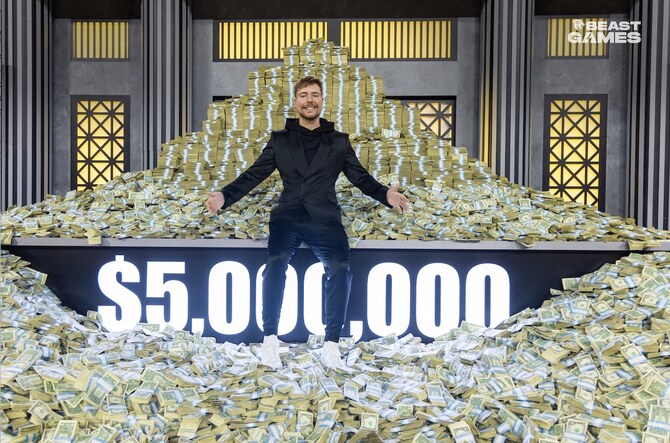

DUBAI: It’s a high bar, but “Beast Games” might be the most cynical TV show ever produced. Amazon — owned by Jeff Bezos; estimated net worth $251 billion — throws a reported $100 million at 26-year-old social-media behemoth Jimmy Donaldson (aka MrBeast; estimated net worth $500 million) so he can make a reality competition show that borrows heavily from a hugely successful fictional South Korean show and gives the “largest ever cast” (1,000 participants) the opportunity to win $5 million (the “largest ever single prize”) and a host of other ‘smaller’ (i.e. still huge) prizes along the way.
Why? Probably not because the studio execs — or Bezos himself — are huge MrBeast fans. But think of all the data to be mined when the latter’s 340 million YouTube subscribers sign up to Amazon Prime — that’s the kind of payoff that makes it worthwhile (and $100 million for Amazon is kind of like a regular person’s $5).
And what do the audience get in return for surrendering their personal info to the rapacious advertiser and retailer? Basically “Squid Game” without any deaths, but with much of that show’s energy and aesthetics. Donaldson and his crew of long-time friends/assistants have built careers out of giving away huge amounts of money to people for completing challenges (or snatching it from them if they fail), and now they’re doing it with higher production values.
The tasks (at least in the first three episodes) are straightforward, childish even (catch a ball; throw a ball into a receptacle…), but the mind games are intense — often, competitors must sacrifice themselves so others can continue. Those that choose to do so look absolutely bereft. If you’re wondering whether anyone involved in “Beast Games” picked up on the fact that “Squid Game” was intended to satirize the spiritual vacuum of late-stage capitalism via the portrayal of the gleeful exploitation of desperate, cash-strapped people for entertainment, we’re guessing the answer’s no.
Still, as a TV show, “Beast Games” is compelling in its way — think “Ultimate Fail” videos crossed with “The Traitors.” It’s slickly packaged and fast-moving (within the first half-hour, half of the contestants are culled), like MrBeast’s YouTube content. The psychology is fascinating — the weird notion so many of the contestants have that they’re “destined” to win a game of mostly chance and not much skill, or that, somehow, “needing” it enough will see them through; or the way that, within a matter of hours, herd mentality and peer pressure make people forget that they’re competing to try and secure life-changing money for their loved ones rather than impress a group of almost-strangers to whom they owe nothing.
“Beast Games” keeps you engaged, then, but it doesn’t keep you invested. That’s partly because Donaldson and co., who come across as affable and a bit goofy online, haven’t made the jump to “traditional” media comfortably. Particularly Donaldson, who, as a gameshow host, lacks warmth and charisma and spends much of his time shouting dystopian catchphrases (“Everyone has a price!” or, gazing down on the contestants from the wall of Beast City, “They look like ants!”).
It will be an enormous success.


