

Investigators seek clues to New Orleans attacker’s path to radicalization

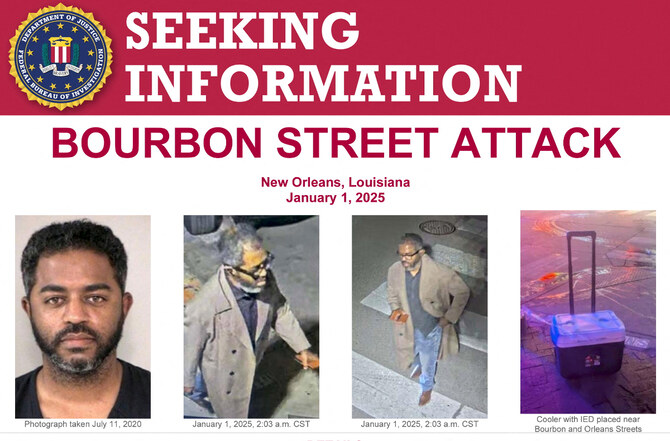
This FBI wanted poster shows Shamsud-Din Jabbar's July 11, 2020 photograph alongside video surveillance still images of him walking along a street, before he drove a truck into a crowd in New Orleans, Louisiana, on January 1, 2025. Also seen is a photo of one of the coolers containing an improvised explosive device placed by Jabbar near the intersection of Bourbon and Orleans Street. (REUTERS)
Short Url
Updated 03 January 2025
Follow

Investigators seek clues to New Orleans attacker’s path to radicalization

  • Jabbar’s profile atypical for Daesh recruits, says former FBI agent
  • Jabbar is a former US veteran who worked for a major corporation
  • Daesh uses online platforms for recruitment, experts say

WASHINGTON: As investigators learn more about the man who pledged allegiance to the Daesh group, or ISIS, and killed 14 people with a truck on New Year’s Day in New Orleans, a key question remains: How did a veteran and one-time employee of a major corporation become radicalized?
FBI Deputy Assistant Director Christopher Raia said on Thursday that videos made by Shamsud-Din Jabbar just before the attack showed the 42-year-old Texas native supported Daesh, claimed to have joined the militant group before last summer and believed in a “war between the believers and nonbelievers.”
While the FBI was looking into his “path to radicalization,” evidence collected since the attack showed that Jabbar was “100 percent inspired by ISIS,” said Raia.
Jabbar, who authorities said acted alone, was killed in a shootout with police.
His half-brother, Abdur Jabbar, said in an interview that Jabbar, who had worked for audit firm Deloitte, abandoned Islam in his 20s or 30s, but had recently renewed his faith.


Abdur Jabbar told Reuters in Beaumont, Texas, where Jabbar was born and raised, that he had no idea when his half-brother became radicalized.
Ali Soufan, a former FBI agent who investigated terrorism cases and is on an advisory council to Homeland Security Secretary Alejandro Mayorkas, said Jabbar did not fit the typical profile of those radicalized by Daesh.
Jabbar served for 10 years in the US Army and was in his 40s, Soufan noted, explaining that people who fall prey to Daesh recruitment are typically much younger.
“This is a guy who … went from being a patriot to being an Daesh terrorist,” said Soufan.
Attackers responsible for a range of deadly strikes have claimed a link to Daesh and other jihadist groups.
They included the lone survivor of the Islamist squad that killed 130 people across Paris in 2015, the man who killed 49 people at a gay nightclub in Florida in 2016, and the man who drove a truck into a crowded bike path in 2017 in New York City, killing eight people.
Some attacks, like those in 2015 in Paris, were carried out by trained Daesh operatives. But investigators found no evidence of a direct role for the terrorist group in others.


Online recruitment

It is still unclear what contact Jabbar might have had with overseas extremist groups.
US officials and other experts say Daesh conducts most of its recruiting in online chatrooms and over encrypted communications apps since losing the “caliphate” it overran in 2014 in Iraq and Syria to a US-led military coalition. Even as the coalition continues hitting the group’s remaining holdouts, Daesh has stepped up operations in Syria while its Afghanistan- and Africa-based affiliates have kept recruiting, expanding their networks and inspiring attacks.
US officials say Daesh has used the deaths of tens of thousands of Palestinians in Israel’s war in Gaza to boost its recruitment.
Nate Snyder, a former US Department of Homeland Security (DHS) counterterrorism official, said both international and US-based extremist groups follow a similar playbook to draw in new recruits.
The groups use social media to push their message and then move discussions to encrypted app such as Telegram, which could evolve into one-on-one conversations, Snyder said.
“Then people feel like they’re part of a community,” said Snyder, who left DHS in December and joined the race to chair the Democratic National Committee.
Recruits could either receive direct orders or self-radicalize to take action, Snyder said.
Individuals susceptible to recruitment “might have lost their jobs, might have had a mental health crisis, might have just concluded that however hard they’ve tried, they never belong,” said Edmund Fitton-Brown, a former British diplomat who led a UN team that monitors Daesh and Al-Qaeda.
The main appeal of Daesh is its determination to establish a Sunni Muslim “caliphate” ruled by Islamic law, unlike the Taliban, which “has sold out to Afghan nationalism,” or Al-Qaeda, members of which have cooperated with Iran’s Shiite Muslim-run government, he said.
“People that are carrying out those attacks may never in their lives have actually met somebody who is a member of Daesh,” said Fitton-Brown, a senior adviser to the Counter-Extremism Project, a policy and research organization. “But that doesn’t mean they can’t carry out an Daesh-inspired attack.” Crashing cars into crowds or staging stabbing rampages “are unsophisticated, very low-budget attacks (that) are almost impossible to defend against,” he continued. “If you are determined enough to kill unsuspecting public, you are going to be able to do it.”


Trump cuts India tariffs as Modi ‘agrees’ to stop buying Russian oil

Updated 13 sec ago
Follow

Trump cuts India tariffs as Modi ‘agrees’ to stop buying Russian oil

  • US will impose an 18 percent tariff on Indian goods, down from the earlier 50 percent punitive levy
  • Withdrawal from Russian oil may affect India’s relations with BRICS, expert says

NEW DELHI: The US and India have announced reaching a trade agreement after months of friction, with President Donald Trump saying that Prime Minister Narendra Modi had “agreed” to halt purchases of Russian oil.

In August, Trump accused India, which imports most of its crude oil, of funding Moscow’s war in Ukraine and subjected it to a combined tariff rate of about 50 percent on most of the exports.

Following a call with Modi on Monday, Trump took to social media to say that he would cut with immediate effect US levies on Indian goods to 18 percent after Modi “agreed to stop buying Russian Oil, and to buy much more from the United States and, potentially, Venezuela.”

At the same time, India, Trump wrote, would “reduce their Tariffs and Non Tariff Barriers against the United States, to ZERO,” committing to buy “over $500 BILLION DOLLARS of US Energy, Technology, Agricultural, Coal, and many other products.”

Modi confirmed the agreement on social media, saying: “Made in India products will now have a reduced tariff of 18 percent,” without commenting on Russian oil or duty-free imports of American goods.

When the US announced its punitive tariffs last year, India quickly moved forward with free trade negotiations with other countries — signing a deal with Oman and finalizing negotiations with New Zealand and the EU.

While the agreements were expected to partially offset the loss of exports to the US, economists did not expect they would immediately mitigate it, as shifting supply chains takes time.

The newly announced agreement with the US will therefore offer short-term relief for Indian exporters — especially of textiles, gems, jewelry and marine products — who were facing the threat of a market exit.

“In that case, the trade deal with the US is a welcome step. It provides short-term relief, allowing India to continue exporting to the US without being forced to exit the US market and diversify with a huge transition cost,” said Anisree Suresh, geoeconomics researcher at the Takshashila Institution.

“However, one shouldn’t look at it as a comprehensive long-term trade deal like the one India signed with the EU. The unpredictability of the Trump administration remains a major concern, regardless of whether there is a trade deal with the US ... India cannot treat this deal the same as other FTAs, as it is limited in scope and subject to reversal.”

When the US imposed its punitive tariffs on India, about 66 percent of total Indian exports were subject to that rate. Overall, India recorded a negative margin of 19.5 percent, meaning its exports were taxed more heavily than those of its competitors.

“From that point of view, Indian goods will have a larger market over there. However, there’s a problem when we talk about a 0 percent tariff on the US,” said Prof. Arun Kumar, a development economist.

“The US will be able to export a lot more to India, and therefore it will affect our production within the economy. And that will be a setback, so while exports may rise, the internal economy may actually suffer because of this decrease in tariffs on American goods. And especially if it affects agriculture.”

The sudden withdrawal from India’s partnership with Russia may not have a serious economic impact but politically could affect New Delhi’s relations, also with other countries, especially those from BRICS — a grouping that besides India and Russia includes also Brazil and China, and is the most powerful geopolitical forum outside of the Western world.

“You can always substitute Russian oil with some other oil, but I think it’s more of a strategic question, because India and Russia have had long-standing relationships, and if we bend to US pressure and reduce purchases from Russia, then it will affect in future also our relationship with Russia, because we will not be seen as a stable ally,” Kumar said.

“BRICS nations will not trust India very much in the future ... and that’s what Trump wants. He wants to disrupt BRICS. That’s what he has been doing right since the beginning to divide nations and deal with them individually.”