

Deputy PM labels Gaza war UN’s ‘crisis of credibility’ as Pakistan joins Security Council

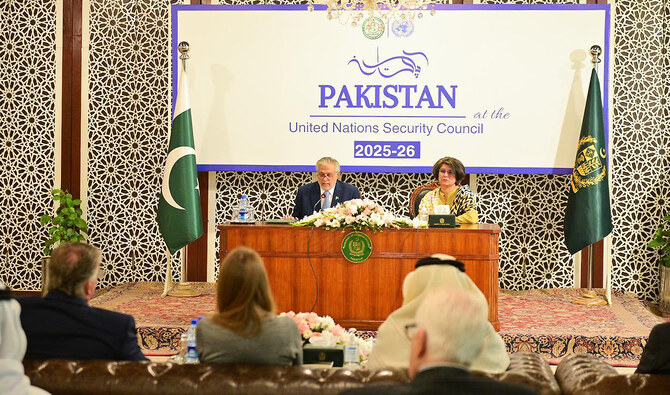
Pakistan’s Deputy Prime Minister Ishaq Dar (left) addresses an event attended by the heads of resident Missions of the UN Security Council Member States in Islamabad, Pakistan, on January 1, 2025. (Foreign Office of Pakistan)
Short Url
Updated 01 January 2025
Follow

Deputy PM labels Gaza war UN’s ‘crisis of credibility’ as Pakistan joins Security Council

  • Ishaq Dar highlights global challenges in an address to envoys after Pakistan gets two-year UNSC term
  • Deputy PM calls for multilateralism, vows to bridge international divides by working with other nations

ISLAMABAD: Pakistan’s Deputy Prime Minister Ishaq Dar on Wednesday described the ongoing war in Palestine as a “crisis of credibility” for the United Nations Security Council (UNSC), highlighting foreign occupations depriving people of the right to self-determination, as the country begins its two-year term as a non-permanent member of the council.

Elected in June 2024 with overwhelming support, Pakistan secured 182 votes in the 193-member General Assembly, marking its eighth term on the UNSC.

The council is the most powerful chamber of the global body, comprising five permanent members with veto power and 10 non-permanent members elected for two-year terms. While non-permanent members cannot veto resolution, they play a crucial role in decision-making and contribute significantly to the council’s functioning.

Addressing a group of envoys in Islamabad, Dar expressed gratitude for the international community’s confidence in Pakistan’s role on the council, pledging to collaborate with other states to uphold the UN Charter and bridge international divides amid pressing global challenges.

“Pakistan is beginning to pursue its role in the UN Security Council at a time when we are confronted with many unprecedented challenges,” he said. “Situations of conflict and continued foreign occupation defy the promise of the United Nations to save succeeding generations from the scourge of war and guarantee self-determination.”

“Longstanding unresolved disputes from Jammu and Kashmir to Palestine continue to simmer,” he added. “The ongoing situation in Gaza, including the blatant war crimes and acts of genocide being committed against the innocent Palestinians, represents a crisis of credibility for the United Nations Security Council.”

The deputy premier also highlighted the breakdown of arms control regimes, escalating arms races and the rise of intolerance and extremist ideologies as critical global concerns.

“Today, as we stand at a critical juncture, we remain ready to contribute meaningfully to the council’s work, drawing on our rich legacy and faith in multilateral diplomacy,” he said. “We look forward to playing a constructive role in bridging existing divides, fostering consensus and upholding the council’s mandate in accordance with the UN Charter.”

Outlining Pakistan’s priorities for its UNSC term, he reiterated a firm commitment to the world body’s charter.

“We will remain committed to pursuing just and peaceful resolution of outstanding and ongoing disputes, opposing the resort to unilateral and illegal use or threat of use of force, combating terrorism in all its forms and manifestations, supporting effective UN peacekeeping, peace enforcement and peacebuilding efforts, and contributing effectively toward the resolution of regional and global crises.”


Pakistan accuses India of manipulating Chenab flows, seeks clarification under Indus Waters Treaty

Updated 8 sec ago
Follow

Pakistan accuses India of manipulating Chenab flows, seeks clarification under Indus Waters Treaty

  • Foreign office spokesperson says sudden variations in river flows threaten agriculture, food security and livelihoods downstream
  • He also condemns a hijab-removal incident in India, calling it part of a broader pattern of religious intolerance and Islamophobia

ISLAMABAD: Pakistan said on Thursday it had observed abrupt variations in the flow of the River Chenab during the ongoing month, accusing India of manipulating river flows at a critical point in the agricultural cycle and saying it had written to New Delhi seeking clarification.

Local media reported quoted Pakistani officials as saying India released about 58,000 cusecs of water at Head Marala on Dec. 7–8 before sharply reducing flows to roughly 870–1,000 cusecs through Dec. 17, far below the 10-year historical average of 4,000–10,000 cusecs for this period.

Pakistan’s Foreign Office spokesman Tahir Andrabi told a weekly media briefing in Islamabad India had failed to share prior information or operational data on the Chenab flows, a practice he said New Delhi had previously followed under the 1960 Indus Waters Treaty. New Delhi said earlier this year it had put the treaty “in abeyance” following a gun attack in Indian-administered Kashmir that it blamed on Pakistan, a charge Islamabad denied, calling instead for an impartial and transparent international investigation.

Pakistan also described India’s unilateral suspension of the treaty as a violation of international law and an “act of war.”

“Pakistan would like to reiterate that the Indus Waters Treaty is a binding international agreement, which has been an instrument of peace and security and stability in the region,” Andrabi said. “Its breach or violation, on one hand, threatens the inviolability of international treaties in compliance with international law, and on the other hand, it poses serious threats to regional peace, principles of good neighborliness, and norms governing interstate relations.”

Andrabi said Pakistan viewed the sudden variations in the Chenab’s flow with “extreme concern and seriousness,” saying the country’s Indus Waters Commissioner had written to his Indian counterpart seeking clarification in line with procedures outlined in the treaty.

“Any manipulation of river flow by India, especially at a critical time of our agricultural cycle, directly threatens the lives and livelihoods, as well as food and economic security of our citizens,” he continued. “We call upon India to respond to the queries raised by Pakistan.”

He said Pakistan had fulfilled its obligations under the Indus Waters Treaty and urged the international community to take note of India’s “continued disregard” of a bilateral treaty and to counsel New Delhi to act responsibly under international law.

Andrabi maintained Pakistan remained committed to peaceful resolution of disputes with India but would not compromise on its water rights.

In the same briefing, he also condemned an incident in which the chief minister of the Indian state of Bihar was seen in a video forcibly removing the hijab of a Muslim woman during a public interaction, followed by remarks by a minister in Uttar Pradesh who mocked the episode, saying it reflected a broader pattern of religious intolerance and Islamophobia and warranted strong condemnation.