‘Like a dream’: Photographer’s return to Syria

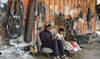
AFP photographer Sameer Al-Doumy never dreamed he would be able to return to the hometown in Syria that he escaped through a tunnel seven years ago after it was besieged by Bashar Assad’s forces. (AP)
Short Url
Updated 01 January 2025
Follow

‘Like a dream’: Photographer’s return to Syria

  • AFP photographer Sameer Al-Doumy never dreamed he would be able to return to the hometown in Syria that he escaped through a tunnel seven years ago after it was besieged by Bashar Assad’s forces

DOUMA: AFP photographer Sameer Al-Doumy never dreamed he would be able to return to the hometown in Syria that he escaped through a tunnel seven years ago after it was besieged by Bashar Assad’s forces.
Douma, once a rebel stronghold near Damascus, suffered terribly for its defiance of the former regime, and was the victim of a particularly horrific chemical weapons attack in 2018.
“It is like a dream for me today to find myself back here,” he said.
“The revolution was a dream, getting out of a besieged town and of Syria was a dream, as it is now being able to go back.
“We didn’t dare to imagine that Assad could fall because his presence was so anchored in us,” said the 26-year-old.
“My biggest dream was to return to Syria at a moment like this after 13 years of war, just as it was my biggest dream in 2017 to leave for a new life,” said the award-winning photographer who has spent the last few years covering the migrant crisis for AFP’s Lille bureau in northern France.
“I left when I was 19,” said Sameer, all of whose immediate family are in exile, apart from his sister.

“This is my home, all my memories are here, my childhood, my adolescence. I spent my life in Douma in this house my family had to flee and where my cousin now lives.
“The house hasn’t changed, although the top floor was destroyed in the bombardments.
“The sitting room is still the same, my father’s beloved library hasn’t changed. He would settle down there every morning to read the books that he had collected over the years — it was more important to him than his children.
“I went looking for my childhood stuff that my mother kept for me but I could not find it. I don’t know if it exists anymore.
“I haven’t found any comfort here, perhaps because I haven’t found anyone from my family or people I was close to. Some have left the country and others were killed or have disappeared.
“People have been through so much over the last 13 years, from the peaceful protests of the revolution, to the war and the siege and then being forced into exile.
“My memories are here but they are associated with the war which started when I was 13. What I lived through was hard, and what got me through was my family and friends, and they are no longer here.
“The town has changed. I remember the bombed buildings, the rubble. Today life has gone back to a kind of normal as the town waits for people to return.”

Douma was besieged by Assad’s forces from the end of 2012, with Washington blaming his forces for a chemical attack in the region that left more than 1,400 people dead the following year.
Sameer’s career as a photojournalist began when he and his brothers began taking photos of what was happening around them.
“After the schools closed I started to go out filming the protests with my brothers here in front of the main mosque, where the first demonstration in Douma was held after Friday prayers, and where the first funerals of the victims were also held.
“I set up my camera on the first floor of a building which overlooks the mosque and then changed my clothes afterwards so I would not be recognized and arrested. Filming the protests was banned.
“When the security forces attacked, I would take the SIM card out of my phone and the memory card out of my camera and put them in my mouth.”
That way he could swallow them if he was caught.
In May 2017, Sameer fled through a tunnel dug by the rebels and eventually found himself in the northern rebel enclave of Idlib with former fighters and their families.

“I took the name Sameer Al-Doumy (Sameer from Douma) to affirm that I belonged somewhere,” even though he was exiled, he said. “I stopped using my first name, Motassem, to protect my family living in Damascus.
“In France I have a happy and stable life. I have a family, friends and a job. But I am not rooted to any particular place. When I went back to Syria, I felt I had a country.
“When you are abroad, you get used to the word ‘refugee’ and you get on with your life and make a big effort to integrate in a new society. But your country remains the place that accepts you as you are. You don’t have to prove anything.
“When I left Syria, I never thought one day I would be able to return. When the news broke, I couldn’t believe it. It was impossible Assad could fall. Lots of people are still in shock and are afraid. It is hard to get your head around how a regime that filled people with so much fear could collapse.
“When I returned to the Al-Midan district of Damascus (which had long resisted the regime), I could not stop myself crying.
“I am sad not to be with my loved ones. But I know they will return, even if it takes a while.
“My dream now is that one day we will all come together again in Syria.”


From gunshots to the Africa Cup, Sudanese players endure brutal war to bring hope

Updated 2 sec ago
Follow

From gunshots to the Africa Cup, Sudanese players endure brutal war to bring hope

CASABLANCA: When Sudan player Ammar Taifour first heard gunfire outside his hotel room, he shrugged it off and went back to sleep. He had a soccer match to play.
But hours later, gunfire erupted again and gunmen surrounded the hotel in Omdurman, central Sudan, trying to seize control of the area. Taifour, a 28-year-old American-Sudanese midfielder, didn’t realize the shots marked the beginning a brutal war that would claim tens of thousands of lives and displace millions.
“We saw them from the windows all around the hotel holding guns,” Taifour told The Associated Press at the Africa Cup of Nations this week. “They were shooting at army aircraft. It was completely unexpected.”
Taifour and his teammates, coaches and medical staff were trapped inside the hotel for more than two days, as food and water supplies ran low. They left only after the gunmen withdrew, and Taifour flew back to the United States, leaving his career in Sudan behind as he searched for a new team.
His experience mirrors that of other Sudanese players forced to flee the country, leaving family members behind in the war-torn African nation while attempting to pursue soccer careers at the highest level.
A brutal war
The war in Sudan was labeled by the UN as the world’s worst humanitarian crisis. It erupted in April 2023 when a power struggle between the military and the powerful paramilitary Rapid Support Forces exploded into open fighting, with widespread mass killings and rapes, and ethnically motivated violence.
The conflict has killed more than 40,000 people according to UN figures, but aid groups say the true number could be many times higher. More than 14 million people have been displaced, as disease outbreaks and famine spread in parts of the country.
But the Sudanese national team, known as the Falcons of Jediane, is persevering, and it qualified for the Africa Cup despite training and playing every qualifying game abroad. Sudan even defeated Ghana, denying the African powerhouse qualification for the four-week tournament.
Symbol of hope
For many Sudanese, the team has become a symbol of hope and unity and a rare source of joy to escape wartime hardship. Ahead of their team’s opening match against Algeria in the Moroccan capital Rabat, Sudanese supporters erupted in celebration, waving national flags and honking car horns. Hundreds chanted “Sudan!” and danced as they made their way to stadiums and fan zones.
“The war has destroyed many parts of the country and killed far too many innocent people,” national team player Mohamed Abuaagla told the AP. “Playing and winning games brings happiness to our people back home. We are trying to plant a small seed of a smile in them, despite the hardships they are enduring.”
The players themselves have faced many challenges. With the league suspended due to the war, players were forced to play abroad, often in neighboring Libya.
Sudan’s two largest clubs, Al Merrikh and Al Hilal, compete in Rwanda’s league. Previously, they played in Mauritania’s championship, with Al Hilal going on to win it. Last year, the Sudan Football Association organized what it called an “elite league,” an eight-team competition that lasted less than a month.
Abuaagla lost his uncle during the war.
“He was sick, but we couldn’t take him to a hospital because they were all deteriorated from the fighting,” Abuaagla said, fighting tears.
Both players said the war is a driving force for Sudanese players on the field. They carry the weight of their compatriots’ struggle, whether at home or abroad, and feel a greater responsibility to represent Sudan now than ever before.
Something to celebrate
Sudanese rally behind their team because it serves as an apolitical symbol of the country, political and security risk analyst Thomas O’Donoghue told the AP. It can unify people and remind them or something worth celebrating, he said.
“But I don’t think the soccer team alone can push the warring parties toward a ceasefire or mediation,” O’Donoghue said. “The conflict has been ongoing for nearly three years and involves numerous domestic and international stakeholders, many with economic interests in Sudan.”
Sudan lost its opening Africa Cup match against Algeria and will hope to progress from its group with good results against Burkina Faso and Equatorial Guinea. But the team has also been plagued by injuries, with three forward, the team captain and a full back all ruled out.
“It’s a difficult situation. Sometimes I don’t feel comfortable talking about it, but I just have to deal with those who are available and how best you can use them,” Sudan coach James Kwesi Appiah said after the loss to Algeria.
The players competing in Morocco are determined to go as far as possible, and the dream of lifting the trophy.
“Before each game, I pray for the people back in Sudan,” Taifour said. “They deserve happiness, and I try to do my best to bring that to them.”