Blasts in northwest Pakistan leave 2 dead, 13 wounded including policemen

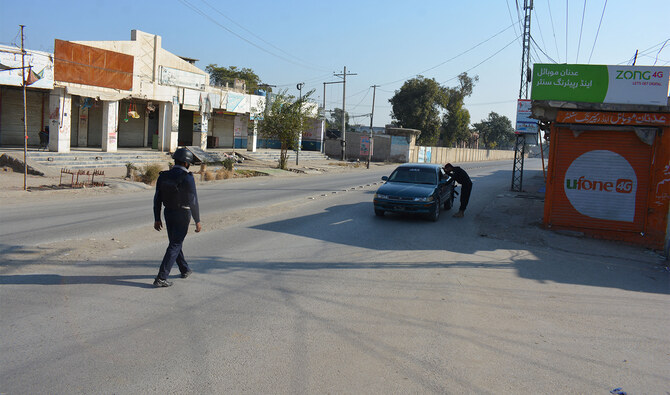
A Pakistani policeman checks a car in front of a shuttered market after Taliban militants seized a police station in Bannu on December 20, 2022. (AFP/File)
Short Url
Updated 01 January 2025
Follow

Blasts in northwest Pakistan leave 2 dead, 13 wounded including policemen

  • First attack targeted a funeral in Azam Warsak, the other was directed against a police van in Bannu
  • Such incidents have surged in recent years, contributing to an atmosphere of heightened insecurity

PESHAWAR: Two people were killed and at least 13 others, including several police personnel, were injured in two separate bomb blasts in northwestern Khyber Pakhtunkhwa (KP) province on Tuesday, police said.
KP, which shares a long and porous border with Afghanistan, has experienced a surge in militant violence in recent years. The region has been targeted by deadly suicide bombings and attacks on both civilians and security forces, contributing to an atmosphere of heightened insecurity.
Police spokesperson in the province, Habib Islam, told Arab News the first explosion occurred in Azam Warsak, a town on the outskirts of Wana, the headquarters of South Waziristan district, as people dispersed from a funeral ceremony.
“The blast left two persons dead and eight others wounded. The explosion was triggered by a remote-controlled device, but it can’t be immediately confirmed who was the target of the attack,” he added.
Soon after the incident, a heavy police contingent rushed to the crime scene to evacuate the dead and wounded to the nearest medical facility.
Dr. Hammad Mehmood, a senior medical practitioner at the DHQ Hospital Wana, said the staff received a total of nine wounded, with two critically injured individuals referred to Dera Ismail Khan for treatment.
The second blast occurred in Bannu district, where a police mobile van was targeted with an improvised explosive device (IED), leaving five policemen injured, a senior police officer, Zahir Nawaz, told Arab News.
“Five policemen were injured in a blast triggered by a device planted in the Mamaskhel area of Bannu district,” he added.
Over 82 policemen have been killed in attacks, ambushes, and targeted killings in KP this year, according to official data.
Such attacks have been on the rise in northwestern Pakistan in recent months, with most being claimed by the banned Tehreek-e-Taliban Pakistan (TTP) militants.
TTP fighters have targeted security forces’ convoys and check posts and carried out targeted killings, as well as kidnappings of law enforcers and government officials.
Earlier this month, two policemen were killed and three injured in an attack on a check post in the province’s Shangla district.
Pakistan has frequently accused neighboring Afghanistan of sheltering and supporting the TTP and other militant groups, urging the administration to prevent its territory from being used by armed factions to launch cross-border attacks.
The Afghan Taliban deny the charge, insisting Pakistan’s security issues are an internal matter.



Pakistan, Iraq agree on tighter coordination over pilgrims under new regulated travel system

Updated 4 sec ago
Follow

Pakistan, Iraq agree on tighter coordination over pilgrims under new regulated travel system

  • New system requires all Iraq-Iran pilgrimages to be organized by licensed groups under state oversight
  • Long-running “Salar” model relied on informal caravan leaders, leading to overstays and missing pilgrims

ISLAMABAD: Pakistan and Iraq this week agreed to closely coordinate on the management and security of Pakistani pilgrims, as Islamabad rolls out a new, tightly regulated travel system aimed at preventing overstays, undocumented migration and security breaches during religious visits to Iraq and Iran.

The understanding was reached during a meeting between Pakistan’s Interior and Narcotics Control Minister Mohsin Naqvi and Iraq’s Interior Minister General Abdul Amir Al-Shammari on Thursday evening, where both sides discussed measures to facilitate pilgrims while strengthening oversight, Pakistan’s interior ministry said.

The agreement comes as Pakistan dismantles its decades-old pilgrim travel model and replaces it with a centralized, licensed system after authorities confirmed that tens of thousands of Pakistani pilgrims had overstayed or gone missing abroad over the past decade, triggering concerns from host governments.

“You have, for the first time during your tenure, taken effective measures to organize pilgrim groups, which are commendable,” Al-Shammari told Naqvi, according to Pakistan’s interior ministry.

“All pilgrims included in the list provided by Pakistan’s Ministry of Interior will be allowed to enter Iraq,” he added, making clear that only travelers cleared under the new system would be permitted.

Naqvi said Pakistan would strictly enforce return timelines under the revised framework.

“Pilgrims traveling to Iraq will not be allowed to stay beyond the designated period,” he said, adding that relevant authorities in both countries would remain in close coordination.

Both interior ministers also agreed to strengthen information-sharing and joint mechanisms on security cooperation, counterterrorism and the prevention of human smuggling, officials said.

“The safety, dignity, and facilitation of Pakistani pilgrims is the top priority of the Government of Pakistan,” Naqvi said.

Al-Shammari said he would visit Pakistan soon to finalize a joint roadmap to further improve pilgrim facilitation, security coordination and broader bilateral cooperation, according to the interior ministry.

Pakistan’s government has overhauled its pilgrim travel regime this year, abolishing the long-running “Salar” system under which informal caravan leaders managed pilgrimages. The move followed official confirmation that around 40,000 Pakistani pilgrims had overstayed or disappeared in Iran, Iraq and Syria over the past ten years.

Under the new Ziyarat Management Policy, only licensed Ziyarat Group Organizers (ZGOs) are allowed to arrange pilgrimages, with companies held directly responsible for ensuring pilgrims return on time. Authorities have completed security clearance for 585 companies seeking registration, while scrutiny of applications remains ongoing.

Islamabad has also barred overland travel for major pilgrimages, including Arbaeen, citing security risks in Pakistan’s southwestern Balochistan province, meaning all travel to Iraq and Iran is now restricted to regulated air routes.

Tens of thousands of Pakistani pilgrims travel each year to Iraq and Iran to visit some of the most revered shrines in Shia Islam, including the mausoleums of Imam Ali in Najaf and Imam Hussain in Karbala in Iraq, and major religious sites in Mashhad and Qom in Iran. Pilgrimages peak during religious occasions such as Arbaeen, when millions of worshippers converge on Karbala from across the region. The scale of travel, often involving long stays and cross-border movements, has long posed logistical, security and migration-management challenges for Pakistani authorities and host governments alike.