Pakistani security forces suffer deadliest year in decade while fighting insurgency— think tank

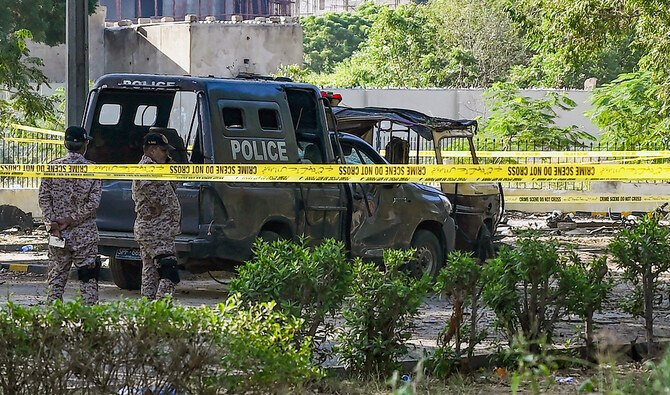
Security personnel inspect the site, a day after an explosion allegedly by separatist militants targeted a high-level convoy of Chinese engineers and investors near the Karachi international airport in Karachi on October 7, 2024. (AFP/File)
Short Url
Updated 31 December 2024
Follow

Pakistani security forces suffer deadliest year in decade while fighting insurgency— think tank

  • On average, nearly seven lives were lost daily, says Islamabad-based think tank’s report
  • Pakistan military says 925 insurgents, 383 soldiers were killed in operations during 2024

PESHAWAR: Pakistani security forces in 2024 suffered the highest causalities in nearly a decade while battling insurgency, an Islamabad-based think tank said.

This comes as militants attacked a security post in the country’s restive northwest, which borders Afghanistan, killing a police officer and a civilian early Tuesday.

An officer was also wounded in the attack at the Draban Post in Dera Ismail Khan, a district in Khyber Pakhtunkhwa province, local police official Abdullah Khan said, adding that the civilian was an employee of the Customs department.

No one claimed responsibility for the attack but suspicion was likely to fall on the Pakistani Taliban, also known as Tehrik-e-Taliban Pakistan, who often target security forces across the country, especially in the former tribal regions in the troubled northwest bordering Afghanistan.

The Center for Research and Security Studies said in its report Tuesday that this year was the deadliest for Pakistani security forces in 9 years.

“On average, nearly seven lives were lost daily,” according to the report which tallied “at least 685 fatalities and 444 terror attacks.” It also said: “Equally alarming were the cumulative losses of civilians and security personnel, i.e. 1612 fatalities, accounting for over 63 percent of the total recorded this year and marking 73 percent more losses compared to 934 outlaws eliminated.”

The think tank said its latest report was based on data collected from open sources, mainly media outlets. In Pakistan, the military doesn’t regularly confirm causalities among troops.

There was no immediate comment from the military on the report.

Last week, military spokesman Lt. Gen. Ahmad Sharif said in a news conference that 925 insurgents were killed in 2024, a record high compared to the past five years, while 383 soldiers were killed in such operations. He also said Pakistani security forces this year conducted 59,775 operations against insurgents in the country.

Pakistan in recent months has stepped up intelligence-based operations against the Pakistani Taliban, emboldened since the Afghan Taliban seized power in Afghanistan in 2021. 


Pakistan invites Bangladesh’s new prime minister for official visit in post-election outreach

Updated 7 sec ago
Follow

Pakistan invites Bangladesh’s new prime minister for official visit in post-election outreach

  • Planning minister Ahsan Iqbal attends swearing-in in Dhaka, proposes reviving regional cooperation
  • Islamabad offers scholarships, connectivity and academic exchanges to expand bilateral ties with Dhaka 

ISLAMABAD: Pakistan has formally invited Bangladesh’s newly elected prime minister, Tarique Rahman, to visit Islamabad, its information ministry said on Wednesday after senior minister Ahsan Iqbal met the new premier in Dhaka following the oath-taking ceremony.

The outreach signals a cautious attempt by the two South Asian nations to improve relations decades after the 1971 war that led to Bangladesh’s independence from Pakistan, with diplomatic engagement historically limited and economic links underdeveloped compared with regional potential.

After former Bangladeshi prime minister Sheikh Hasina was ousted during the 2024 political upheaval and fled to India, relations between Dhaka and Islamabad began to normalize after years of near-frozen contact. For over a decade under Hasina’s Awami League government, Bangladesh had aligned closely with India and kept Pakistan at diplomatic arm’s length. 

The political shift in Dhaka — culminating in the 2026 election victory of the Bangladesh Nationalist Party (BNP) led by Tarique Rahman — created space for engagement, including the relaunch of direct flights, high-level political and military exchanges, technical cooperation and business ties. The reset reflects broader regional dynamics: Bangladesh diversifying its diplomacy beyond India, and Pakistan seeking economic partnerships in South Asia amid a geo-economic foreign policy push.

“Planning Minister Ahsan Iqbal conveyed a formal invitation from the Prime Minister of Pakistan to Prime Minister Tarique Rahman to undertake an official visit to Pakistan at a mutually convenient date,” a Pakistani information ministry statement said, quoting Iqbal who represented Islamabad at the oath taking. 

“The two leaders discussed avenues to reinvigorate bilateral relations and enhance regional cooperation.”

The two sides discussed expanding cooperation in education, research and digital governance, including a proposed “Pakistan–Bangladesh Knowledge Corridor” to promote academic partnerships and student exchanges.

Islamabad said it had allocated 500 scholarships for Bangladeshi students, with 75 already traveling to Pakistan for higher education, and proposed closer coordination between national data and statistics institutions in both countries.

Officials also discussed improving direct flight connectivity to boost trade, tourism and business links, as well as cooperation in small and medium-sized industries and technology-enabled services.

The statement added that both sides supported stronger cultural engagement, including joint celebrations next year marking the 150th birth anniversary of philosopher-poet Muhammad Iqbal.

Both countries reaffirmed their commitment to strengthening ties and promoting regional stability and economic cooperation, the statement added.