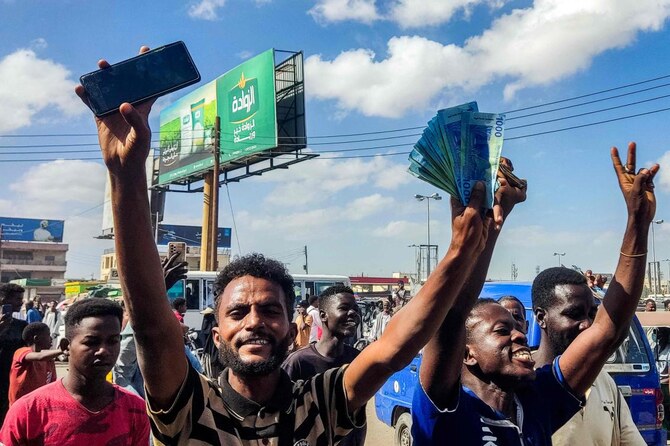
Dozens protest in Sudan as army-backed govt switches out banknotes

Protesters call upon the army-backed Sudanese government to extend the deadline to exchange Sudanese pound banknotes after authorities changed two of the notes in circulation. (AFP)
Short Url
Updated 31 December 2024
Follow

Dozens protest in Sudan as army-backed govt switches out banknotes

  • Army-backed government set deadline for residents of the six states under its control to swap old 500 and 1,000 Sudanese pound banknotes for new ones

PORT SUDAN: Dozens of Sudanese demonstrated outside the seat of the army-backed government in Port Sudan on Tuesday to protest against its move to enact a partial currency swap.
The army-backed government had set a Monday deadline for residents of the six states under its control to swap old 500 and 1,000 Sudanese pound banknotes for new ones.
But as dozens protested outside government offices in the Red Sea port city on Tuesday, information minister Khalid Al-Aiser announced that residents would have until Jan. 6 to replace their old notes.
The value of the Sudanese pound has plummeted during 20 months of fighting between the regular army and the paramilitary Rapid Support Forces, from 500 to the dollar in April 2023 to 2,500 to the dollar now.
The war has killed tens of thousands of people, uprooted more than 12 million and left no sector of the economy unscathed.
The army-backed government says the partial currency swap aims to “protect the national economy and combat criminal operations” by counterfeiters.
But the arrival of Monday’s deadline paralyzed transport and trade in Port Sudan, the country’s main export outlet.
Bus drivers, petrol stations and store owners refused to accept the old banknotes, while banks had only limited supplies of the new notes, AFP correspondents reported.
Many Sudanese accused the administration of placing an extra burden on the war-weary and increasingly impoverished population.
Critics have also warned that the move risks adding an economic dimension to the divide between areas under army control and those held by the RSF.
The RSF now controls nearly all the western region of Darfur and swathes of the center and south, while the army holds the north and east.
Greater Khartoum is split between the warring sides.
The RSF has already banned the use of the new notes in areas under its control and accused the army of “a conspiracy to divide the country.”


Israel spied on US forces at Gaza aid base: Sources

Updated 08 December 2025
Follow

Israel spied on US forces at Gaza aid base: Sources

  • US commander summoned Israeli counterpart to say: ‘Recording has to stop here’
  • Staff, visitors from other partner countries have also raised concerns about Israeli surveillance

LONDON: Israel conducted widespread surveillance of US forces involved in an aid mechanism for Gaza, The Guardian reported.

The Civil-Military Coordination Center in southern Israel was launched in October as a joint body to monitor the ceasefire and oversee the entry of aid into the war-torn Palestinian enclave.

But sources with knowledge of internal disputes told The Guardian that open and covert recordings of meetings at the CMCC had prompted disputes between the two partners.

Lt. Gen. Patrick Frank, the US commander of the center, summoned his Israeli counterpart to explain that “recording has to stop here.”

Other countries, including the UK and UAE, are also involved in the CMCC. Staff and visitors from partner countries have likewise raised concerns about Israeli surveillance activities at the center.

When the CMCC began operations, media in the US and Israel reported that the latter was handing over authority to American forces.

Yet Israel still retains effective control over what enters the territory despite Washington’s considerable leverage, according to one US official.

US forces who arrived at the CMCC, including logistics experts, were keen to increase the flow of aid into Gaza.

But they soon discovered that Israel had implemented a wide range of controls on purported “dual-use” goods, creating a larger impediment than any engineering challenge relating to aid delivery. These included basic goods such as tent poles and chemicals used for water purification.

Dutch Foreign Minister David van Weel has said he was briefed at the center on “one of the dual-use barriers that was being lifted as a result of the conversations (there).”

It came in response to growing awareness that Israeli restrictions on deliveries stood as the biggest barrier to the entry of aid into Gaza.

Israeli authorities had also restricted basic items such as pencils and paper — required by Palestinian students for school — without explanation.

There is widespread hesitancy among aid organizations and diplomats over joining the CMCC’s efforts, despite being invited to do so.

The center lacks any Palestinian representation, and even US efforts to schedule video calls with Palestinian officials were vetoed by Israeli staff there.