

Pakistan unveils economic plan for sustainable growth amid challenges

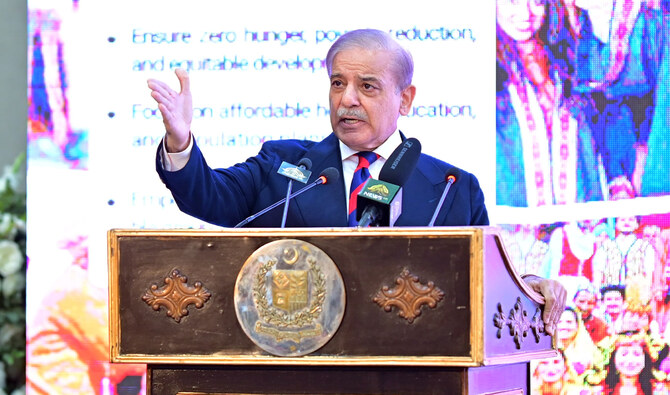
Pakistan Prime Minister Shehbaz Sharif addresses the launch ceremony of National Economic Transformation Plan in Islamabad, Pakistan, on December 31, 2024. (PMO)
Short Url
Updated 31 December 2024
Follow

Pakistan unveils economic plan for sustainable growth amid challenges

  • Economic transformation plan to focus on export-led growth so Pakistan escapes boom-bust economic cycle, says finmin
  • Development takes place as Pakistan grapples with economic crisis that has triggered inflation, drained its foreign reserves

ISLAMABAD: Pakistan’s government is set to launch its five-year homegrown National Economic Plan today, Tuesday, targeting sustainable growth and development in the long-term, Finance Minister Muhammad Aurangzeb said amid Islamabad’s struggle to ward off its macroeconomic crisis. 

Pakistan’s government has attempted to steer itself out of a prolonged macroeconomic crisis that has weakened the South Asian country’s currency and drained its foreign exchange reserves over the past two years. 

Pakistan’s Planning Minister Ahsan Iqbal said in July that the National Economic Plan will be based on the 5Es framework (exports, energy, economic growth, education and equality), adding that it would aim to foster stability and lay the foundation for future growth in Pakistan.

In a video message, Aurangzeb said the plan has been aptly titled “Uraan Pakistan” which means “Flying Pakistan,” and aims to take the country’s prevalent macroeconomic stability to sustainable growth. 

“There are three to four key pillars of this [economic plan],” Aurangzeb said. “First of all, our growth will be export-led so that we do not go into the boom-bust cycle that we have been going through for the past few eras. Secondly, the private sector has to lead this country,” he added. 

Pakistan agreed to a 37-month, $7 billion bailout program from the International Monetary Fund (IMF) this year, promising the lender financial reforms in exchange for it. These reforms include increasing the tax base, regulating the energy sector and handing over loss-making state owned enterprises to the private sector. 

“The structural reforms that we have started, we have to take them through the finishing line,” the minister said. “Whether that is on the taxation side, whether its on the energy side, whether it’s our SOE reforms, whether it’s our privatization agenda.”

Aurangzeb vowed that the plan would put Pakistan on an upward economic trajectory in the next two to three years, saying it would ensure that this will be the last IMF program Islamabad resorts to. 

The development takes place amid Prime Minister Shehbaz Sharif’s increased efforts for greater collaboration in trade, defense, agriculture and other key sectors of the economy with regional allies to attract foreign investment and brighten Pakistan’s economic prospects.

In its move to attract foreign investment in key sectors, Pakistan has enhanced its bilateral trade and investment ties with Saudi Arabia, the United Arab Emirates, Russia, Central Asian states and other Gulf countries. 

Pakistan suffered a sovereign default before Islamabad clinched a last-gasp $3 billion bailout program from the International Monetary Fund (IMF) in 2023 that helped its economy stay afloat. Pakistan’s Finance Minister Muhammad Aurangzeb has repeatedly said Islamabad needs to adopt an export-led economy to achieve long-term and sustainable economic growth.


Bahraini commander witnesses Pakistan Navy passing-out parade in Karachi

Updated 18 sec ago
Follow

Bahraini commander witnesses Pakistan Navy passing-out parade in Karachi

  • Rear Admiral Ahmed Mohamed bin Ali says it is a matter of immense pleasure for him to review commissioning of personnel at his alma mater
  • The training you have received has prepared you to step into a challenging yet deeply satisfying career, he tells young officers, midshipmen

ISLAMABAD: Rear Admiral Ahmed Mohamed Ebrahim Al bin Ali, commander of Royal Bahrain Naval Force, witnessed passing-out parade of Pakistan Navy’s 124th Midshipmen and 32nd Short Service Commission Course in Karachi, where he spoke with the newly inducted officers.

The passing-out parade was held at the Pakistan Naval Academy, at which Commandant Commodore Zia-ur-Rehman congratulated 90 midshipmen and 38 cadets who had completed short service commission after going through academic and training phases.

In his address, Rear Admiral Ali said it was a matter of immense pleasure for him to review the commissioning of personnel at his alma mater, the Pakistan Naval Academy, which he had joined as a cadet in February 1983.

“You must be confident and self-assured that you have been trained at one of the best naval academies of the region. The training you have received at Pakistan Naval Academy has prepared you to step into a challenging yet deeply satisfying career,” he told the young officers and midshipmen.

“It has equipped you with essential military and academic skills and you should spare no effort to build up on these to achieve excellence in your professions.”

Pakistan armed forces have long been training cadets and officers from friendly countries. Currently, the Pakistan Naval Academy is training future officers from Bahrain, Djibouti, Iraq, Sri Lanka and Turkiye.

The Bahraini commander said that being here as the chief guest had taken him back to yesteryears and he would have flashbacks of the familiar sounds and aura of this naval academy.

“I cannot help but marvel at the wonderful transformation that has taken place since my days,” he said.

Pakistan and Bahrain have maintained close diplomatic, security, trade and defense relations and have undertaken joint training and security initiatives, besides regular high-level exchanges.

Bahrain’s Read Admiral Ali met Pakistan Naval Chief Admiral Naveed Ashraf earlier this week, according to Pakistan Navy. They discussed matters of mutual interest, regional maritime security and avenues for bilateral naval cooperation.

Earlier in Sept., Pakistan and Bahrain agreed to enhance cooperation in naval training and regional maritime security operations. During the same month, the Bahraini Chief of Defense Staff Lt. Gen. Thiab Saqer Abdulla Al-Nuaimi met with Pakistan’s Air Chief Marshal Zaheer Ahmed Baber Sidhu and expressed Bahrain’s interest in learning from the PAF’s experience in multi-domain operations.