

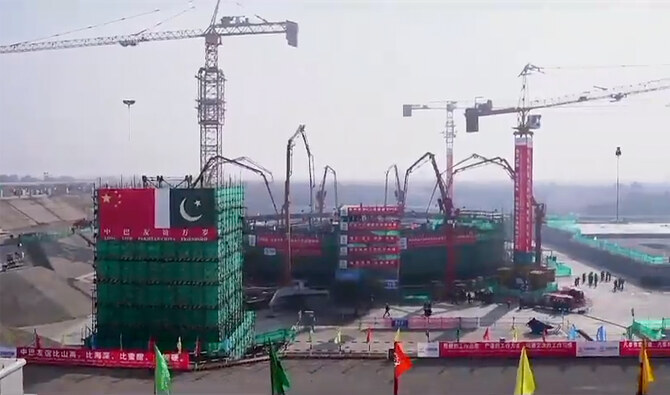
Pakistan begins construction of $3.5 billion Chinese-designed nuclear energy project

The screengrab taken from a video shared by Pakistan's state broadcaster PTV News shows construction site of Chinese-designed nuclear energy project, Chashma-5, being constructed along the left embankment of the Indus River in Mianwali, Pakistan, on December 31, 2024. (PTV News)
Short Url
Updated 31 December 2024
Follow

Pakistan begins construction of $3.5 billion Chinese-designed nuclear energy project

  • The Chashma-5 nuclear power plant is being constructed along the left embankment of the fast-flowing Indus River in Mianwali
  • Beijing is building roads, bridges, power plants, and railways in Pakistan to link its far west with Gwadar port on Indian Ocean

ISLAMABAD: Pakistan has begun construction of a $3.5 billion Chinese-designed nuclear energy project, which would produce 1,200 megawatts of electricity, Prime Minister Shehbaz Sharif said on Monday.

Pakistan and China are longtime allies. Beijing is building roads, bridges, power plants, and railways under the China-Pakistan Economic Corridor (CPEC), part of President Xi Jinping’s Belt and Road Initiative, to link its far west with the

Chinese-built Gwadar port on the Indian Ocean in Pakistan’s Balochistan.

The nuclear power plant, known as Chashma-5, is being constructed at a site along the left embankment of the fast-flowing Indus River in Mianwali, a district in the eastern Punjab province. The site is already home to four Chinese-supplied nuclear power plants that were built in recent decades.

In a post on X, Sharif said the Chashma-5 nuclear power plant was another “milestone” in strategic cooperation between the two friendly countries.

“Commencement of construction of the most modern and the biggest, C-5 Nuclear Power Plant is another milestone in strategic cooperation between Pakistan and China. The plant will contribute 1200 MW electricity,” Sharif said.

“I congratulate PAEC (Pakistan Atomic Energy Commission) and CNNC on this remarkable achievement.”

The development comes as Pakistan, which has one of the highest electricity tariffs in the region, is making preparations to stop capacity payments to independent power producers (IPPs), and PM Sharif’s cabinet this month approved settlement agreements with eight bagasse-based IPPs, with the aim to reduce electricity prices and save the national exchequer billions of rupees.

High cost of power is one of the key factors that leads to inflation in the South Asian country.

Pakistan has also been holding talks on reprofiling power sector debt owed to China and structural reforms, but progress has been slow. It has also vowed to stop power sector subsidies.


Pakistan saw 73% increase in combat-related deaths in 2025— think tank

Updated 28 December 2025
Follow

Pakistan saw 73% increase in combat-related deaths in 2025— think tank

  • Pakistan reported 3,387 deaths thus year, among them 2,115 militants and 664 security forces personnel, says think tank
  • Civilian deaths increased by 24% to 580 in 2025, compared to 468 in 2024, as Pakistan saw 1,063 militant attacks in 2025

ISLAMABAD: Combat-related deaths in Pakistan this year increased by 73%, with both security forces and militants suffering casualties in large numbers, a report published by an Islamabad-based think tank said on Sunday.

As per statistics released by the Pakistan Institute for Conflict and Security Studies (PICSS), combat-related deaths in 2025 rose 73% to 3,387, compared with 1,950 in 2024. These deaths included 2,115 militants, 664 security forces personnel, 580 civilians and 28 members of pro-government peace committees (combatants), the think tank said in a press release. 

“Militants accounted for about 62% of total combat-related deaths, and their 2,115 fatalities represented the highest annual militant death toll since 2015, when 2,322 militants were killed,” PICSS said. 

Compared to last year, militant deaths recorded a steep increase by 122% as the PICSS reported that 951 militants had been killed in 2024.

The think tank, however, said this year was also particularly bloody for Pakistani security forces. PICSS recorded 664 security personnel deaths in 2025, a 26% rise from 528 in 2024, and the highest annual figure since 2011, when 677 security forces personnel lost their lives. 

Civilian deaths also increased by 24% to 580 in 2025, compared with 468 in 2024, marking the highest annual civilian toll since 2015, when 642 civilians were killed. 

As per the PICSS report, at least 1,063 militant attacks took place in 2025, a 17% increase compared with 908 in 2024 and the highest annual total since 2014, when 1,609 militant attacks were recorded. 

The report also noted a 53 percent increase in suicide attacks this year, with 26 such incidents reported in 2025 compared with 17 in 2024. 

“PICSS noted an expanding trend in the use of small drones, including quadcopters, with 33 such incidents recorded during 2025, alongside increased use of unmanned aerial vehicles by security forces,” the report said. 

The report noted an 83% rise in arrests of suspected militants, with 497 arrested in 2025 compared to 272 in 2024. 

This 2025 figure is the highest annual total of suspected militants arrested since 2017, when 1,781 militants were either arrested or laid down their weapons.

“PICSS noted that most violence remained concentrated in Pashtun-majority districts of Khyber Pakhtunkhwa, including the tribal districts (erstwhile FATA), and in Balochistan,” it said. 

Pakistan has been grappling with a surge in militant attacks in its western provinces of Khyber Pakhtunkhwa and Balochistan, both bordering Afghanistan, this year. 

Islamabad blames Afghanistan for providing sanctuaries to militants it alleges use Afghan soil to carry out attacks against Pakistan. Kabul denies the charges.