

Israel army says intercepted missile launched from Yemen
Israel army says intercepted missile launched from Yemen/node/2584790/middle-east
Israel army says intercepted missile launched from Yemen
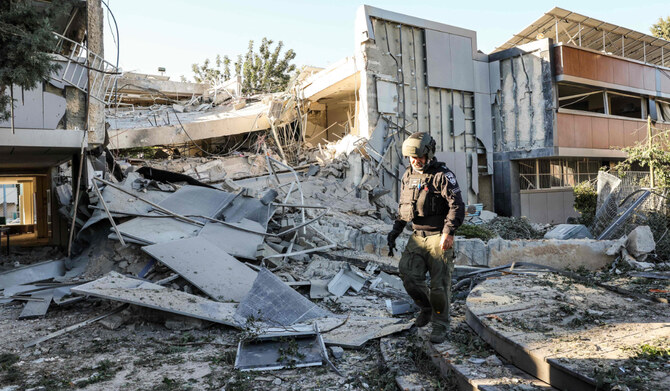
A member of a Bomb Disposal Unit inspects the rubble of a destroyed school building in Ramat Gan, near Tel Aviv, on December 19, 2024, after the campus was struck by debris from the reported interception of a projectile from Yemen. (AFP)
Israel army says intercepted missile launched from Yemen
The latest warnings from top Israeli officials came after a missile fired by the Houthis wounded 16 people in Israel’s main commercial city of Tel Aviv
Updated 31 December 2024
AFP
JERUSALEM: The Israeli military on Monday said that it had intercepted a missile launched from Yemen before it crossed into Israeli territory.
Yemen’s Iran-backed Houthi rebels have been firing missiles and drones at Israel and ships in the Red Sea and Gulf of Aden in what they describe as solidarity with Palestinians since the war in the Gaza Strip broke out in October of last year.
In recent weeks, they have claimed to have fired several missiles at Israel, triggering retaliatory strikes from Israel targeting the rebels’ strategic assets and infrastructure.
“Following the sirens that sounded a short while ago in central Israel, a missile launched from Yemen was intercepted by the IAF (air force) prior to crossing into Israeli territory,” the Israeli military said in a statement.
Israel’s emergency service provider, Magen David Adom, reported that it had received no reports of any casualties so far.
On Saturday, Israel intercepted a similar missile launched from Yemen.
The Iran-backed Houthis have controlled large parts of Yemen since seizing Sanaa and ousting the government in 2014.
They have stepped up their attacks since November’s ceasefire between Israel and another Iran-backed group, Hezbollah in Lebanon.
Israel has also struck Yemen, including targeting Sanaa’s international airport on Thursday.
An Israeli statement said its targets included “military infrastructure” at the airport and power stations in Sanaa and Hodeida — a major entry point for humanitarian aid — as well as other facilities at several ports.
Houthis use these sites “to smuggle Iranian weapons into the region and for the entry of senior Iranian officials,” the statement said.
Israeli Prime Minister Benjamin Netanyahu has warned the Houthis, saying that Israeli strikes against them would “continue until the job is done.”
“We are determined to cut this branch of terrorism from the Iranian axis of evil,” he said in a video statement last week.
Defense Minister Israel Katz also recently declared: “We will hunt down all of the Houthis’ leaders — nobody will be able to evade the long arm of Israel.”
The latest warnings from top Israeli officials came after a missile fired by the Houthis wounded 16 people in Israel’s main commercial city of Tel Aviv.
That attack prompted strikes by the United States against the rebels in Sanaa.
American and British forces have repeatedly struck rebel targets in Yemen this year in response to Houthi attacks on shipping in Red Sea-area waters vital to global trade.
In July, a Houthi drone attack on Tel Aviv killed an Israeli civilian, prompting the first Israeli retaliation on Hodeida.
Epstein tried to build web of powerful ties across Middle East, documents show
Updated 8 sec ago
DUBAI: The departure of the chief executive of Dubai port giant DP World is the biggest fallout in the Middle East from US Department of Justice documents which show that disgraced financier Jeffrey Epstein tried to build a powerful network of political figures and business leaders across the region. DP World announced on Friday that Sultan Ahmed Bin Sulayem had resigned as chief executive and chair. The decision to act was taken after Bin Sulayem’s name appeared in the Epstein files, two sources with direct knowledge of the matter told Reuters, and as his relationship with the late convicted sex offender faced increasing scrutiny. In their correspondence, Bin Sulayem discussed sexual relationships with women with whom Epstein helped him connect. In an email dated November 9, 2007, Bin Sulayem told Epstein he had met one such woman in New York, whom he does not name and with whom he said he did not have sex. “Yes after several attempts for several months we managed to meet in NY,” he wrote, adding that there was a misunderstanding because “she wanted some BUSINESS! while i only wanted some PUSSYNESS!“ Dubai’s ruler on Friday also issued a decree appointing a new chairman for Dubai’s Ports, Customs and Free Zone Corporation, one of several roles Bin Sulayem held. Reuters was able to independently review only some of the Epstein files relating to Bin Sulayem and was unable to ascertain what specifically led to his departure from DP World although the sources said, without providing further details, that it was related to the files. Bin Sulayem did not respond to Reuters requests for comment on his departure. DP World declined to comment. COOKING TOGETHER In one email exchange, Epstein described Bin Sulayem as funny, trustworthy and a foodie. Epstein went on to say that Bin Sulayem, a Muslim, does not drink and prays five times a day. An undated photograph that appears in an email and is publicly available shows Epstein cooking with Bin Sulayem and the two of them looking relaxed together. The full name of the person it was sent to by Epstein is not provided. Bin Sulayem has not publicly commented on Epstein’s description or the emails about his relationship with him. Being named in the file is not evidence of criminal activity. But after members of the US Congress said Bin Sulayem’s name appeared in files released by the US Department of Justice (DOJ), he faced renewed questions from some of DP World’s financial backers over his past interactions. Bin Sulayem did not respond publicly to those concerns. The UK development finance agency, British International Investment, and Canada’s second-largest pension fund said last week they would suspend all new investment with DP World over Bin Sulayem’s alleged ties to Epstein. “We are shocked by the allegations emerging in the Epstein Files regarding Sultan Ahmed Bin Sulayem,” said a spokesperson for BII, without saying which allegations he was referring to. “In light of the allegations, we will not be making any new investments with DP World until the required actions have been taken by the company.” Canadian pension fund La Caisse said it was “pausing additional capital deployment alongside the company” until DP World clarified the situation and took “the necessary actions.” In a statement after Friday’s leadership changes at DP World, BII welcomed DP World’s decision and said it looked forward to continuing “our partnership to advance the development of key African trading ports.” La Caisse said “the company took the appropriate measures” and that it would “move quickly to work with DP World’s new leadership to continue our partnership on port projects around the world.” Bin Sulayem did not immediately respond when asked by Reuters to comment on the actions taken by BII and La Caisse. DP World declined comment. NETWORK OF CONTACTS The large cache of documents released by the DOJ, including text messages and emails, also shows the Middle East was no exception to Epstein’s efforts to use his wealth to build relationships with prominent people in politics, finance, academia and business around the world. Reuters was unable to ascertain how successful Epstein was in seeking to influence his contacts in the Middle East, and whether his advice was heeded. The DOJ documents reviewed by Reuters show Epstein tried to advise Qatari business leaders and political figures during the 2017-21 blockade of Qatar by Saudi Arabia, the United Arab Emirates, Bahrain and Egypt over accusations that Doha failed to curb ties with Iran and supported terrorism, which Qatar denied. In exchanges with a Qatari businessman and ruling family member Sheikh Jabor Yousuf Jassim Al Thani, Epstein urged Qatar to “stop kicking and arguing...let the heat come down a bit.” He said “the current Qatar team is very weak” and “FM is not experienced and it shows.” Qatar’s foreign minister at the time was Sheikh Mohammed bin Abdulrahman Al Thani, who now serves as both foreign minister and prime minister. Sheikh Mohammed has not commented publicly on Epstein’s portrayal of him. Asked about the exchange, Qatar’s International Media Office, which handles media requests for the prime minister, declined to comment. There was no response to a Reuters request for comment emailed to three companies in Qatar that Sheikh Jabor is listed as chairman of, or to a text message sent to an individual who, according to the files released by the DOJ, works in Sheikh Jabor’s office. Epstein urged Doha to forge links with Israel to stay in the good graces of Donald Trump, who was then in his first term as US president. He suggested the Gulf state either move toward recognizing Israel or pledge $1 billion to a fund for terrorism victims. Ultimately, Qatar stuck to its independent course. In 2021, the blockading countries restored ties with Doha, and ties between the Trump administration and Qatar are now strong. DISCUSSION OF SAUDI ARAMCO IPO Epstein discussed Saudi Aramco’s initial public offering in dozens of email exchanges. In one exchange dated September 10, 2016, with a person named as Aziza Alahmadi, and with former Norwegian diplomat Terje Roed-Larson copied in, Epstein warned that Aramco going public could expose Saudi Arabia to lawsuits and asset seizures. Saudi Aramco declined to comment on these emails. Alahmadi could not be reached for comment and Reuters was unable to establish her role, if any, in Epstein’s activities. In an email dated October 16, 2017, and also sent to Alahmadi, Epstein suggested selling China an option to buy a $100-billion stake in Aramco rather than pursuing a traditional IPO, saying it would provide liquidity while limiting exposure to public markets. Saudi Aramco declined to comment to Reuters on the emails. Roed-Larsen did not immediately respond to a request for comment sent by email via his lawyer. Epstein’s reach also extended to Egypt, the documents released by the DOJ show. Some emails show a request from a family member of Hosni Mubarak — the wife of his son Gamal Mubarak — that was passed on to Epstein asking for help in 2011, following the former president’s ouster and subsequent legal troubles. They did not say what kind of assistance was sought and Reuters was unable to establish whether Epstein had tried to intercede on the family’s behalf. Reuters emailed a request for comment to one lawyer and sent a text message to another, both of whom represented Gamal Mubarak. There was no immediate response.