LONDON: When voters around the globe had their say in 2024, their message was often: “You’re fired.”
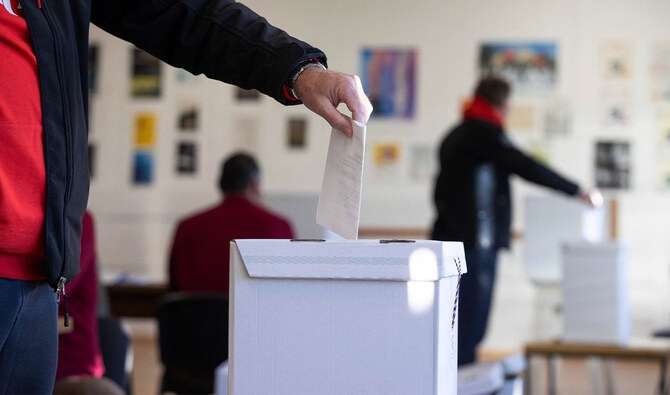
Some 70 countries that are home to half the world’s population held elections this year, and in many incumbents were punished. From India and the United States to Japan, France and Britain, voters tired of economic disruption and global instability rejected sitting governments — and sometimes turned to disruptive outsiders.
The rocky democratic landscape just seemed to get bumpier as a dramatic year careened toward its end, with mass protests in Mozambique and Georgia, an election annulled in Romania and an attempt to impose martial law in South Korea.
Cas Mudde, a professor of international affairs at the University of Georgia who studies extremism and democracy, summed up 2024 in Prospect magazine as “a great year for the far right, a terrible year for incumbents and a troublesome year for democracy around the world.”
INCUMBENTS BATTERED
One message sent by voters in 2024: They’re fed up.
University of Manchester political scientist Rob Ford has attributed the anti-incumbent mood to “electoral long COVID” -– lingering pandemic-related health, education, social and economic disruptions that have made millions of people unhappier and worse off. High inflation, fueled by Russia’s invasion of Ukraine, and mass displacement from that war and conflicts in the Middle East and Africa have added to the global unease.
In South Africa, high unemployment and inequality helped drive a dramatic loss of support for the African National Congress, which had governed for three decades since the end of the apartheid system of white minority rule. The party once led by Nelson Mandela lost its political dominance in May’s election and was forced to go into coalition with opposition parties.
Incumbents also were defeated in Senegal, Ghana and Botswana, where voters ousted the party that had been in power for 58 years since independence from Britain. Namibia’s ruling SWAPO party extended its 34 years in power in December -– but only by a whisker.
Uruguay’s leftist opposition candidate, Yamandú Orsi, became the country’s new president in a November runoff that delivered another rebuke to incumbents.
In India, the world’s largest democracy, Prime Minister Narendra Modi’s Hindu nationalist Bharatiya Janata Party lost its parliamentary majority in a shock election result in June after a decade of dominance. It was forced to govern in coalition as the opposition doubled its strength in Parliament.
Japanese politics entered a new era of uncertainty after Prime Minister Shigeru Ishiba’s governing Liberal Democratic Party, which has ruled almost without interruption since 1955, suffered a major loss in October amid voter anger at party financial scandals. It now leads a minority government.
The UK’s July election saw the right-of-center Conservatives ousted after 14 years in office as the center-left Labour Party swept to power in a landslide. But the results also revealed growing fragmentation: Support for the two big parties that have dominated British politics for a century shrank as voters turned to smaller parties, including the hard-right party Reform UK led by Nigel Farage.
AUTHORITARIANS ADVANCE
Britain is not alone in seeing a rise for the right. Elections in June for the parliament of the 27-nation European Union saw conservative populists and the far right rock ruling parties in France and Germany, the EU’s biggest and most powerful members.
The anti-immigration National Rally party won the first round of France’s parliamentary election in June, but alliances and tactical voting by the center and left knocked it down to third place in the second round, producing a divided legislature and a fragile government that collapsed in a Dec. 4 no-confidence vote.
In Austria, the conservative governing People’s Party was beaten by the far-right, pro-Russia Freedom Party in September, though other parties allied to keep it out of a coalition government.
Nepotism and political dynasties continued to exert influence -– and to be challenged. After messy elections in February, Pakistan elected Prime Minister Shehbaz Sharif, younger brother of three-time leader Nawaz Sharif. Indonesia, Southeast Asia’s largest democracy, elected President Prabowo Subianto, son-in-law of the late dictator Suharto.
Bangladeshi Prime Minister Sheikh Hasina, the world’s longest-serving female leader, won a fourth successive term in a January election that opposition parties boycotted. Months later, her 15-year rule came to a tumultuous end: After mass student-led protests in which hundreds were killed, Hasina was ousted in August and fled to India.
In Sri Lanka, voters also rejected a discredited old guard. Voters elected the Marxist Anura Kumara Dissanayake as president in September, two years after an island-wide public movement by an engaged middle class removed the long-ruling Rajapaksa clan.
INTERFERENCE ALLEGATIONS
Covert meddling and online disinformation were growing concerns in 2024. Meta, the parent company of Facebook, Instagram and WhatsApp, said that this year it took down 20 election-related “covert influence operations around the world, including in the Middle East, Asia, Europe and the US” It said Russia was the top source of such meddling, followed by Iran and China.
In Romania, far-right candidate Călin Georgescu came from nowhere to win the first round of the presidential election in November, aided in part by a flood of TikTok videos promoting his campaign. Amid allegations of Russian meddling, Romania’s Constitutional Court canceled the presidential election runoff two days before it was due to take place after a trove of declassified intelligence alleged Russia organized a sprawling campaign across social media to promote Georgescu. No date has yet been set for a rerun.
Moldova’s pro-Western President Maia Sandu won a November runoff against her Moscow-friendly rival in an election seen as pivotal to the future of one of Europe’s poorest nations.
Georgia has seen huge protests since an election in October was won by the pro-Moscow Georgian Dream party, which suspended negotiations on joining the European Union. The opposition and the pro-Western president, Salome Zourabichvili, have accused the governing party of rigging the vote with Russia’s help.
UNCERTAINTY REIGNS
Possibly the year’s most seismic result, Donald Trump’s victory in November’s US presidential election, has America’s allies and opponents bracing for what the unpredictable “America-first” leader will do with his second term.
And instability already reigns on several continents as the year ends. Venezuela has been in political crisis since a July election marred by serious fraud allegations which both President Nicolás Maduro and the opposition claim to have won. Amid opposition protests and a harsh crackdown, opposition candidate Edmundo González went into exile in Spain.
In Mozambique, the Frelimo party that has ruled for half a century was declared the winner of an October election that the opposition called rigged. Weeks of ongoing street protests across the country have left more than 100 dead.
South Korea’s conservative President Yoon Suk Yeol — weakened after the liberal opposition retained control in an April election -– astonished the country by declaring martial law in a late-night announcement on Dec. 3. Parliament voted to overturn the decision six hours later, and within days voted to impeach Yoon. The crisis in the deeply divided country is far from over.
Democracy’s bumpy ride looks likely to continue in 2025, with embattled incumbents facing challenge in countries including Germany, where Chancellor Olaf Scholz lost a confidence vote on Dec. 16, triggering an early election likely in February. Canada will also vote in 2025, with the governing Liberals widely unpopular and increasingly divided after almost a decade in power.
Seema Shah, head of democracy assessment at the Stockholm-based International Institute for Democracy and Electoral Assistance, said global surveys suggest support for the concept of democracy remains strong, but the numbers plummet “when you ask people how satisfied they are with their own democracy.”
“People want democracy. They like the theory of it,” she said. “But when they see it actually play out, it’s not living up to their expectations.”


![]()

Lessons from elections held in 70 countries in 2024
Short Url
https://arab.news/caczg
Lessons from elections held in 70 countries in 2024
- After controversial elections in February, Pakistan elected Shehbaz Sharif as the prime minister
- Rocky democratic landscape just seemed to get bumpier as a dramatic year careened toward end
Latest updates






© 2026 SAUDI RESEARCH & PUBLISHING COMPANY, All Rights Reserved And subject to Terms of Use Agreement.