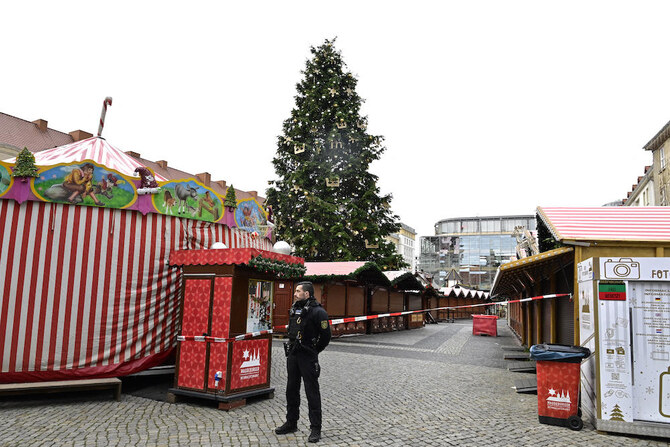
BERLIN: German security and intelligence chiefs are due on Monday to face questioning about the car-ramming attack that killed five people and wounded more than 200 at a Christmas market 10 days ago.
They will be quizzed about possible missed clues and security failures before the December 20 attack in the eastern city of Magdeburg, where police arrested the 50-year-old Saudi psychiatrist Taleb Al-Abdulmohsen at the scene.
Interior Minister Nancy Faeser, Saxony-Anhalt state officials, and the heads of Germany’s domestic and foreign intelligence services are expected to face a closed-door committee hearing in parliament from 1200 GMT.
Abdulmohsen is the only suspect in the attack in which a rented BMW sport utility vehicle plowed through the crowd of revelers at high speed, leaving a trail of bloody carnage.
Investigators have yet to declare a suspected motive in the assault that used a motor vehicle as a weapon, which recalled past jihadist attacks, including in Berlin and in the French city of Nice in 2016.
Abdulmohsen, by contrast, has voiced strongly anti-Islam views, sympathies with the far right, and anger at Germany for allowing in too many Muslim war refugees and other asylum-seekers.
According to unconfirmed media reports citing unnamed German security sources, he has in the past been treated for mental illness and tested positive for drug use on the night of his arrest.
The Saudi suspect has been remanded in custody in a top-security facility on five counts of murder and 205 counts of attempted murder, prosecutors said, but not so far on terrorism-related charges.
Chancellor Olaf Scholz, who faces elections in February, has declared that Germany needs to “investigate whether this terrible act could have been prevented.”
“No stone must be left unturned,” he told news portal t-online on Friday, echoing similar comments by Faeser.
Scholz said that “over the years, there have been repeated clues” about the suspect, adding that “we must examine very carefully whether there were any failings on the part of the authorities in Saxony-Anhalt or at the national level.”
German media digging through Abdulmohsen’s past and his countless social media postings have found expressions of anger and frustration, and threats of violence against German citizens and politicians.
Saudi Arabia said it had repeatedly warned Germany about Abdulmohsen, who came to Germany in 2006 and was granted refugee status 10 years later.
A source close to the Saudi government told AFP that the kingdom had in the past sought his extradition.
Germany has not officially commented on this claim, but would usually deny requests to send people granted asylum back to the country they fled.
Abdulmohsen had a history of brushes with the law and court appearances in Germany, media have reported, including for threats of violence.
German police have said they had contacted Abdulmohsen in September 2023 and October 2024, and then repeatedly tried but failed to meet him again in December.
Police hold such meetings with people deemed a potential threat to make clear they are under close watch and to deter misconduct.
Ahead of the German elections, the Christmas market bloodshed has reignited fierce debate about immigration and security, after several deadly knife attacks this year blamed on Islamist extremists.
The head of the conservative opposition, Friedrich Merz, wrote that, whether the attacker was a jihadist or an anti-Islam activist, “conflicts are being fought out on German soil... We have to stop this!”


![]()

German security chiefs to face questions over Christmas market attack
Short Url
https://arab.news/ma6ek
German security chiefs to face questions over Christmas market attack
- They will be quizzed about possible missed clues and security failures before the December 20
- Suspect remanded in custody on five counts of murder and 205 counts of attempted murder


Latest updates


© 2026 SAUDI RESEARCH & PUBLISHING COMPANY, All Rights Reserved And subject to Terms of Use Agreement.