Pakistan president signs madrasa registration bill into law after months of delay

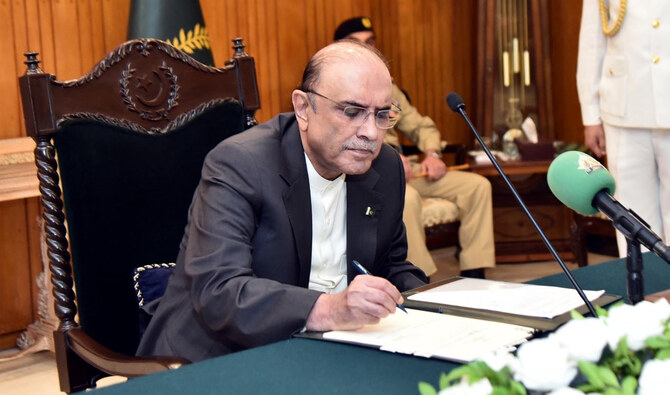
This file photograph, taken and released by Pakistan’s Press Information Department on July 23, 2024, shows Pakistan President Asif Ali Zardari signing a bill at the President House in Islamabad. (PID/File)
Short Url
Updated 29 December 2024
Follow

Pakistan president signs madrasa registration bill into law after months of delay

  • The development comes two days Pakistan’s federal cabinet approved tweaks to the Societies Registration Act, 1860
  • Every seminary existing before commencement of new law will be required to get itself registered in 6 months it says

ISLAMABAD: Pakistan President Asif Ali Zardari on Sunday signed into law a bill relating to the registration of madrasas (religious seminaries) in the country, following months of delay despite its passage from parliament.
The Societies Registration (Amendment) Bill, 2024 was passed by both houses of Pakistan parliament in October this year, but it was caught in limbo after President Zardari cautioned parliamentarians to consider international obligations before altering existing procedures to register religious seminaries.
The main sticking point was that the new bill amended the existing procedure for registering madrasas with the education ministry and says the institutions should be affiliated with the industries ministry instead.
“The Societies Registration (Amendment) Bill, 2024 is assented to, as advised by the prime minister,” read a notification signed by President Zardari.
Although the notification was dated Dec. 27, but it was issued to media on Sunday, Dec. 29.
Every religious seminary existing before the commencement of the Societies Registration (Amendment) Act, 2024, if not already registered, shall get itself registered under the Act within six months from the commencement of the Societies Registration (Amendment) Act, 2024, according to the new law.
A seminary established after the promulgation of the new law will get itself registered under the Act within one year of its establishment.
The passage of the bill was widely reported to have been one of the conditions on which the Jamiat Ulema-e-Islam (JUI) religious party supported the coalition government of Prime Minister Shehbaz Sharif and helped it secure two-third majority required in parliament to pass the 26th Constitutional Amendment in October.
The JUI religious party, which rigorously campaigned for the bill in recent months, welcomed Sunday’s development and said it would continue to play its role in “protecting religious seminaries.”
“Religious schools are the fortress of Islam and the guardians of Pakistan’s ideological geography,” it said in a statement.
“Unity of [religious] scholars is important for the protection of religious institutions.”


Pakistan PM takes notice of passenger offloading issue, forms committee to streamline immigration

Updated 16 December 2025
Follow

Pakistan PM takes notice of passenger offloading issue, forms committee to streamline immigration

  • Several passengers complained last month of being offloaded at airports despite having genuine travel documents
  • Committee comprising IT minister to be led by minister for overseas Pakistanis, submit report to PM within three weeks 

ISLAMABAD: Prime Minister Shehbaz Sharif has taken notice of reports of arbitrary offloading of Pakistani passengers at various airports and has constituted a 14-member committee to streamline immigration procedures, the Ministry of Overseas Pakistanis said this week. 

The development took place after several passengers last month complained they were being offloaded at various Pakistani airports despite carrying valid travel documents, drawing public ire on social media platforms.

These reports coincided with Islamabad’s crackdown on illegal immigration, which gained significant attention in Pakistan after the arrest of several Pakistani and foreign nationals at airports with forged documents in recent years.

As per a notification by the Ministry of Overseas Pakistanis seen by Arab News dated Dec. 15, Sharif has formed a 14-member committee comprising the federal IT minister, state minister for overseas Pakistanis, and secretaries of both ministries. The committee will be led by the federal minister for overseas Pakistanis. 

“A committee comprising the following members has been constituted to deliberate upon and implement measures for eliminating and minimizing human discretionary elements in the issuance and renewal of the Protectorate of Emigrants (POE) stamp for bona fide emigrants proceeding abroad,” the notification reads. 

A POE stamp is a mandatory government endorsement on a Pakistani passport that is required by a citizen traveling abroad for employment. 

The committee’s terms of reference (ToRs) include suggesting a “workable and end-to-end digitized process” for online issuance of POE stamps. It has also been tasked to undertake measures to develop a system to facilitate the online renewal of POE stamps.

The committee will suggest a mechanism to monitor workers’ satisfaction with the issuance, renewal of POE stamps and related immigration clearance arrangements.

“[Provide] recommendations for any other related measures which can improve the existing POE arrangements and bring them in line with international best practices,” it added. 

The notification said the committee will finalize its findings within three weeks and submit a report to the prime minister. 

Pakistan’s Interior Minister Mohsin Naqvi last month urged authorities not to offload passengers with valid travel documents. 

Pakistan has also intensified its crackdown against individuals accused of exploiting visas to solicit money in Saudi Arabia. 
Officials have warned the practice is damaging the country’s image and could affect genuine visa seekers, including religious pilgrims.