Saudi Arabia’s flynas launches Dammam-Red Sea flights to boost tourism connectivity

1 / 5
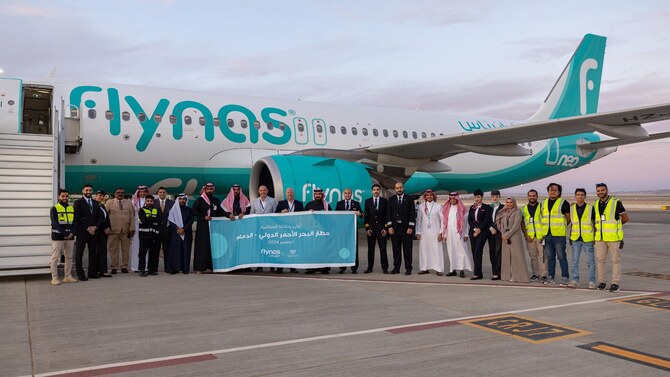
Saudi airline flynas launched its first direct flights between the Red Sea destination and Dammam to support the Kingdom’s travel and tourism industry. X/@RedSeaGlobal
2 / 5
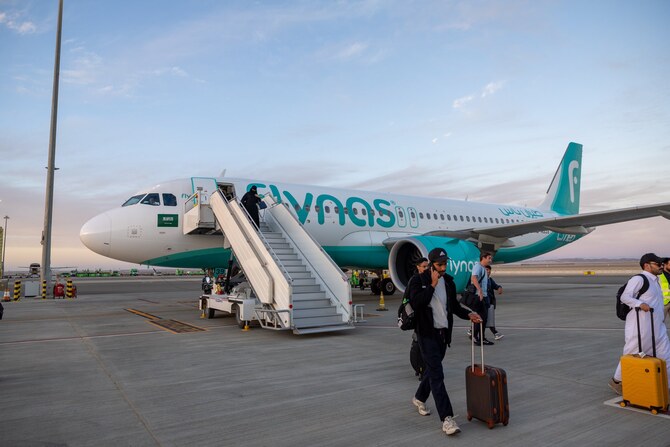
Saudi airline flynas launched its first direct flights between the Red Sea destination and Dammam to support the Kingdom’s travel and tourism industry. X/@RedSeaGlobal
3 / 5
Saudi airline flynas launched its first direct flights between the Red Sea destination and Dammam to support the Kingdom’s travel and tourism industry. X/@RedSeaGlobal
4 / 5
Saudi airline flynas launched its first direct flights between the Red Sea destination and Dammam to support the Kingdom’s travel and tourism industry. X/@RedSeaGlobal
5 / 5
Saudi airline flynas launched its first direct flights between the Red Sea destination and Dammam to support the Kingdom’s travel and tourism industry. X/@RedSeaGlobal
Short Url
Updated 29 December 2024
Follow

Saudi Arabia’s flynas launches Dammam-Red Sea flights to boost tourism connectivity

  • New service operates twice weekly, on Thursdays and Saturdays
  • RSI is key in helping the Kingdom attract a significant amount of tourists by 2030

RIYADH: Saudi low-cost airline flynas has launched a new direct route connecting Dammam’s King Fahd International Airport to the Red Sea, enhancing access to the Kingdom’s premier tourism destination.

The inaugural flight, which landed on Dec. 26, marked the first direct connection between the Eastern Province and the Red Sea International Airport.

The new routes support Saudi Arabia’s Vision 2030, which aims to make the Kingdom a global tourism hub by enhancing connectivity and infrastructure, while RSI is key in helping the nation attract a significant amount of tourists by the end of the decade.

The new service operates twice weekly, on Thursdays and Saturdays, and complements existing flights from Riyadh and Jeddah, strengthening RSI’s role as a domestic and international tourism hub.


Since September 2023, The Red Sea destination has hosted visitors at its five luxury resorts, supported by national carrier Saudia’s regular domestic services.

In 2024, RSI achieved another milestone by welcoming its first international flight from Dubai International Airport, operated by flydubai.

These developments highlight RSI’s growing role as a key gateway to Saudi Arabia’s tourism offerings.

Once fully operational, RSI will run entirely on renewable energy generated by 760,500 photovoltaic panels and one of the world’s largest off-grid battery energy storage systems.

Current airside operations, including lighting, navigation, and meteorological equipment, are already exclusively powered by renewable energy.


Upon its completion in 2030, the expansive development will feature 50 resorts offering up to 8,000 hotel rooms and more than 1,000 residential units across 22 islands and six inland sites.

The development will also feature luxury marinas, golf courses, diverse dining options, and entertainment facilities, positioning it as a global leader in sustainable and luxury tourism.

In November, flynas added two new African destinations to its network beginning on Jan. 8.

The airline will operate three weekly flights from Riyadh to Uganda and three from Jeddah to Djibouti, according to the company’s statement.


The expansion is part of the airline’s “We Connect the World to the Kingdom” initiative and supports Saudi Arabia’s National Civil Aviation Strategy, which aims to expand connectivity to 250 international destinations and reach 330 million passengers.

The routes to Uganda and Djibouti also align with Saudi Arabia’s goal of welcoming 150 million tourists annually by 2030 and advancing the Pilgrims Experience Program, which seeks to streamline travel access to the holy cities of Makkah and Madinah.

Red Sea International is strategically located to serve 250 million people within a three-hour flight radius, covering the Middle East, parts of Europe, and Africa. 


US allows countries to buy Russian oil stranded at sea for 30 days

Updated 13 March 2026
Follow

US allows countries to buy Russian oil stranded at sea for 30 days

  • US issues 30-day license for stranded Russian oil purchases
  • Measure the latest by Trump administration to calm energy markets jolted by Iran war

The United States issued ​a 30-day license for countries to buy Russian oil and petroleum products currently stranded at sea in what Treasury Secretary Scott Bessent said was a step to stabilize global energy markets roiled by the Iran war.
The announcement comes a day after the US Energy Department said that the US would be releasing 172 million barrels of oil from the strategic petroleum reserve in an effort to curb sky-rocketing oil prices in the wake of the war in Iran. That release was part of a broader commitment by the 32-nation International Energy Agency to release 400 million barrels of oil. The agency said earlier on Thursday that he war in the Middle East ‌was creating the ‌biggest oil supply disruption in history. Bessent, in a statement on X ​released ‌hours ⁠after benchmark ​oil prices ⁠shot above $100 a barrel, said the measure was “narrowly tailored” and “short-term” and would not provide significant financial benefit to the Russian government.
“The temporary increase in oil prices is a short-term and temporary disruption that will result in a massive benefit to our nation and economy in the long-term,” Bessent said in the statement, echoing President Donald Trump.
Thursday’s license, which authorizes the delivery and sale of Russian crude oil and petroleum products loaded on vessels as of March 12, will remain valid through midnight Washington time on April 11, according to the text of the license posted on ⁠the Treasury Department’s website. The US Treasury previously issued a 30-day waiver on March ‌5 specifically for India, allowing New Delhi to buy Russian oil stuck ‌at sea. Among other measures to tame energy prices, Trump has already ordered ​the US International Development Finance Corporation to provide political ‌risk insurance and financial guarantees for maritime trade in the Gulf and said the US Navy ‌could escort ships in the region. In another attempt to control prices, the Trump administration is considering temporarily waiving a shipping rule known as the Jones Act to ensure energy and agricultural products can move freely between US ports, the White House said. Waiving the rule would allow foreign ships to carry fuel between US ports, potentially lowering costs and speeding deliveries.
“The president ‌is taking every action he can to lower prices ... unsanctioned oil that’s at sea to get that into the market, continuing to push our own ⁠producers to drill and ⁠expand production as fast and as far as they can, providing regulatory relief, and you’re going to see more and more in the days to come,” White House Deputy Chief of Staff Stephen Miller told Fox News’ “Primetime” program on Thursday.
There were about 124 million barrels of Russian-origin oil on water across 30 different locations globally as of Thursday, Fox News reported, adding that the US license would provide around five to six days of supply when taking into account the daily loss of oil from the Strait. Trump said earlier on Thursday the United States stood to make significant money from oil prices driven higher by the war, prompting criticism from some lawmakers who accused him of caring only about rich people.
US and Israeli strikes on Iran and the subsequent response by Tehran have widened regional tensions and paralyzed shipping through the Strait of Hormuz, disrupting vital ​Middle East oil and gas flows and sending energy ​prices higher.
Raising the stakes for the global economy, Iran’s Islamic Revolutionary Guard Corps says it will block oil shipments from the Gulf unless the US and Israeli attacks cease.